April Reading

I feel repetitive in noting I didn’t read as much as I’d hoped to this past month, but April was truly one for lite reading. In part, due to an overall lack of motivation and, more importantly, the precedence of a wonderful family visit. Nonetheless, a few things did get read, and for those interested, here they are.

  • Bartleby, the Scrivener: A Story of Wall Street, by Herman Melville
  • Dawn, by Octavia E. Butler
  • Not a Nation of Immigrants: Settler Colonialism, White Supremacy, and a History of Erasure and Exclusion, by Roxanne Dunbar-Ortiz
  • The City Inside, by Samit Basu
Continue reading

March Reading

I blame this month’s lack of reading on the U.S. government. In particular, preparing documentation for our appointment at the U.S. embassy to obtain a Consular Report of Birth Abroad (CRBA), which perhaps I’ll write about at another time, but probably won’t. The good news is at least all that work/not-reading paid off and our little one is now a U.S. citizen.

But in between cursing profligate bureaucratic obtuseness and the absurdity of citizenship, a few books got read, along with a series of fascinating academic essays, which I’ll be sharing more about below. This month’s round-up includes:

  • Becoming an Ally to the Gender-Expansive Child: A Guide for Parents and Carers by Anna Bianchi
  • The Terraformers by Annalee Newitz
  • Gender Born, Gender Made: Raising Healthy Gender-Nonconforming Children by Diane Ehrensaft
  • The Adventures of Amina al-Sirafi by S.A. Chakraborty
  • Polarización y transfobia: Miradas críticas sobre el avance de los movimientos antitrans y antigénero en México por Julianna Neuhouser, et al.
  • Unapologetic: A Black, Queer, and Feminist Mandate for Radical Movements by Charlene Carruthers
  • The Midnight Library by Matt Haig
Continue reading

February Reading

Another month gone and some more books read. Why not share? Building off the epically popular “January Reading” post, clicked on by an entire 11 people who weren’t me, I’ve decided to expand the Internet a bit and add a post for February’s books.

As a result of life circumstances, I didn’t get as much reading done as I was hoping to this month, though some books definitely gave me a lot to talk about. How about you? What have you been reading? As for myself, here are the texts this post will be talking about:

  • Foundation and Earth by Isaac Asimov
  • The Keeper’s Six by Kate Elliott
  • The Visit by Chimamanda Ngozi Adichie
  • King Leopold’s Ghost: A Story of Greed, Terror, and Heroism in Colonial Africa by Adam Hochschild
  • Radon Journal Issue 2
  • Sustainable Superabundance: A Universal Transhumanist Invitation by David W. Wood
  • The Actual Star: A Novel by Monica Byrne
  • The Idea of the World: A Multi-Disciplinary Argument for the Mental Nature of Reality by Bernardo Kastrup
Continue reading

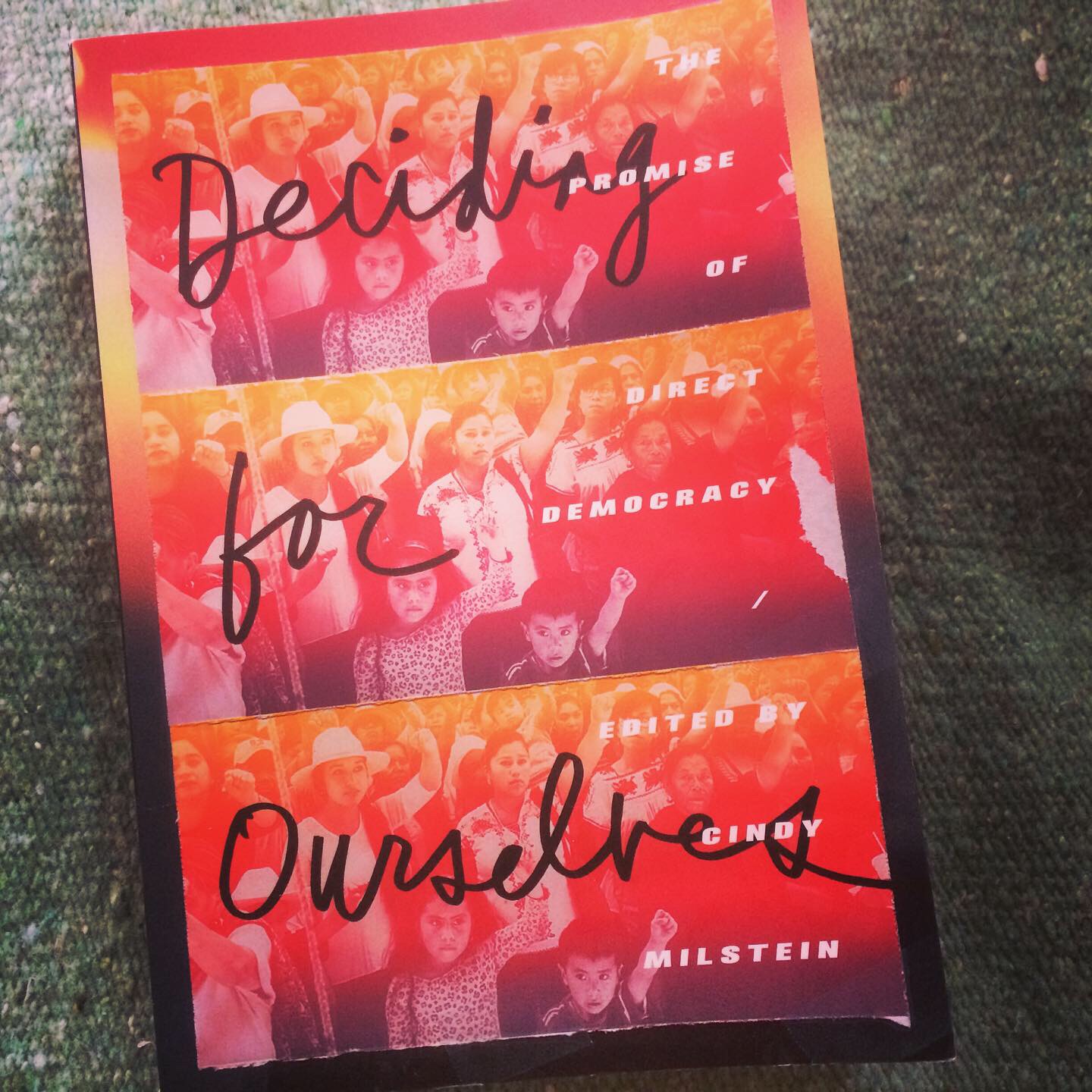
Out Now: “Deciding for Ourselves: The Promise of Direct Democracy”

While it emerges in the midst of tragic and difficult circumstances, I am excited for the release of the anthology Deciding for Ourselves: The Promise of Direct Democracy, edited by Cindy Milstein and to which I contributed the chapter “The Bonfires of Autonomy in Cherán.” As we make our way through this time of loss and uncertainty and begin to think about what comes next, I hope it may offer some insight and inspiration.

It’s now available for a short time on a “Pay What You Can” basis from AK Press.

As the book description reads, “A better world through self-determination and self-governance is not only achievable. It is already happening in urban and rural communities around the world.” This is what Deciding for Ourselves dives into, a theme that couldn’t feel more pressing and necessary.

My contribution looks at the indigenous P’urhépecha municipality of Cherán, located in Michoacán, Mexico. For the past nine years, Cherán has operated under a form of autonomous communal government after a popular uprising removed cartels, local police, politicians and political parties from the area. While the story of the rebellion and its immediate aftermath have been well documented, the chapter takes an in-depth look at how the communal government functions and meets the daily needs of Cherán’s residents, why the government took the form that it did, and how life has changed and is experienced in a place where community and government are woven into a shared communal fabric.

If mutual aid, solidarity, autonomy, self-determination and collective liberation are ideas that interest or resonate with you, this book is worth picking up. And at up to 75% off, it’s a great deal that also helps support an independent radical publisher.