In a world of sharp edges, do we need more knives?

I suppose this merits a content warning. But what doesn’t, anymore?

I don’t have an answer to that question. I just thought it sounded pretty. Maybe I’m being too blithe. Or too emo. Maybe yes. Maybe no. Binaries are boring. Manicheanism is so third century. It is impossible to be right all the time. Or left. Or pre or post or anti or pro. Hypocrisy is an innate human condition. We fit in no boxes, neither the ones they try to cram us into nor the ones into which we willingly seal ourselves. The contorting hurts, we adopt unnatural postures, but in that discomfort instead of cutting to break free, we often cut one another to fit them into our box. Or to ensure they’ll never fit. Or we cut ourselves thinking it’s worth the pain to have a little more breathing room in our cage. It’s a shame the remnants that get left behind: gossamer slices of authenticity we were too embarrassed or afraid to share in this world full of sharp edges.

Continue reading →

Meanwhile, in Mexico: Axolotls and attacks on autonomy

With the on-again, off-again war against Iran, Israel’s “ceasefire” slaughters in Gaza and Lebanon, the fact that everything is unaffordable and people can’t find jobs, and the nonconsensual foisting of an immensely inept Skynet on all of us, it’s hard to track – let alone process and still function – with all that is happening under the current worldwide regime of fascist terribleness. But in case the barrage of promotions hasn’t wormed its way into your brain yet, let us not forget that the World Cup is right around the corner, another Carnival of Capitalism to distract us.

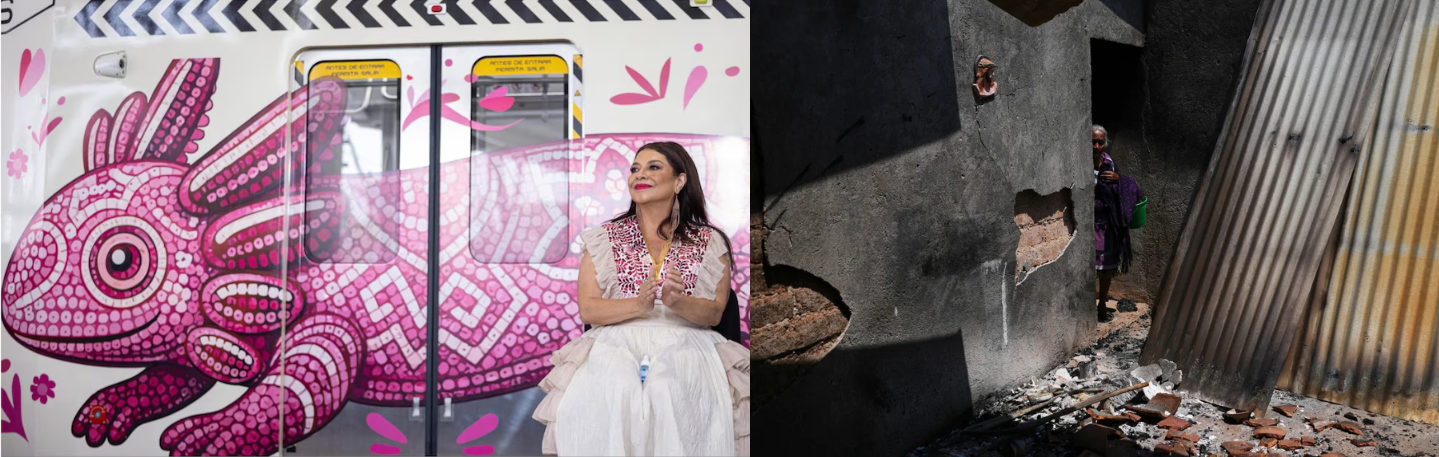
In Mexico City, the head of the government, Clara Brugada, is preparing for the event by overseeing the spending of between 500 million and 3.2 billion pesos (29 to 185 million USD) to basically paint purple axolotls all over the city. Why fix crumbling infrastructure when one can just “axolotlify” it? Why attend to the fact that rent has increased 155% in the city and every 48 hours three houses are taken off the market and turned into vacation rentals as gentrification spirals out of control? Where social cleansing is not limited to painted axolotls but increased raids against migrants in the city? As expected, some of the populace has responded with memes. Others have taken to the streets, pointing to the deeper crises in Mexico, with the cry that “Behind the Cup are hidden graves and troops.”

For her part, President Claudia Sheinbaum thinks the “axolotlization” of Mexico City “looks pretty.” But she’s also got her hands full with CIA officers driving off cliffs in Chihuahua and blowing up narcos in the State of Mexico, not to mention her ally, Rubén Rocha Moya, the currently-on-sabbatical governor of Sinaloa being indicted by the United States for protecting the Chapitos faction of the Sinaloa Cartel in return for its help getting elected. This not only implicates a prominent member of the ruling MORENA party in organized crime, but also shows he is an active partisan in the Sinaloa Cartel’s internal war that has left more than 4,000 dead and 3,500 disappeared since September 2024.

Continue reading →

Subversion and self-critique in the self-managed university

I am pleased to share that my first peer-reviewed article, “Re-visioning the university: José Revueltas and academic self-management,” has been published by the journal Radical Americas. Below is a short post contextualizing and summarizing the article that I wrote for the journal’s blog, reposted here with permission.

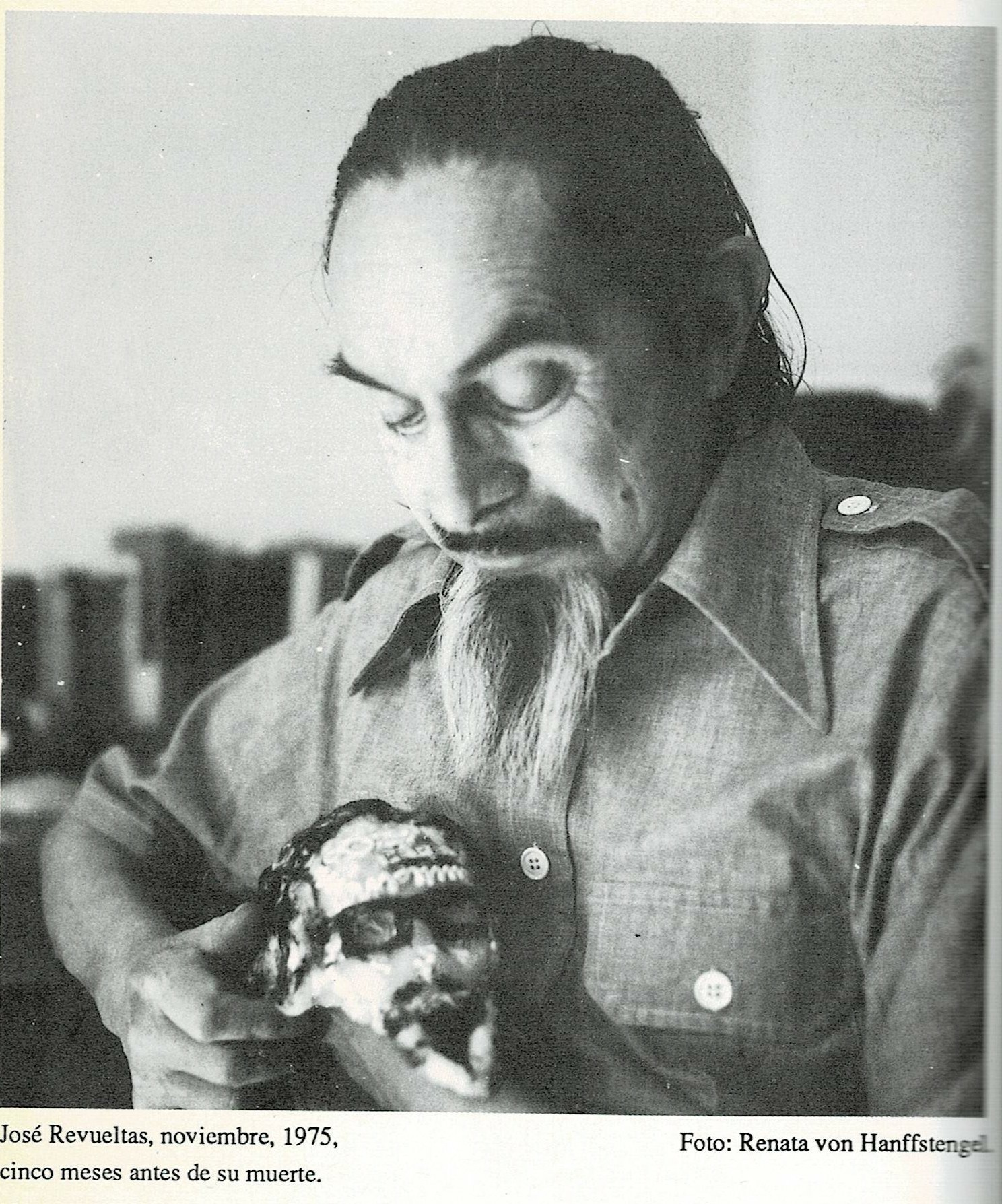
This past 14 April marked fifty years since the death of José Revueltas, a singular figure of the mid-twentieth-century Mexican left. A four-time political prisoner, a winner of the National Prize for Literature, a communist twice expelled from the Mexican Communist Party, and a self-taught university professor, Revueltas was a heterodox, flawed, contradictory but immensely committed individual in the struggle for a better world. As a student of social movements and state repression in Mexico, I was intrigued by both his fascinating biography and – with important and notable exceptions – the limited scholarly engagement his later work and theoretical contributions have received.

Initial drafts of this article came together as students around the United States and beyond claimed space on their campuses to demand an end to U.S. and academic complicity with Israel’s genocide in Gaza. That wave of mobilization has passed, but another will surely come. In the meantime, the university remains in crisis, caught between forces of neoliberalism and far-right reaction and the ever-present question of its role in society. Revisiting Revueltas’s theory of academic self-management as put forward during the student movement in Mexico City in 1968 thus seems apropos at this moment. I am excited to have it published as an open-access article by Radical Americas, a journal welcoming early career professionals (which I most definitely am) and dedicated to the practice of systemic critique.

As such, my article seeks to accomplish two main tasks. One is to trace Revueltas’s political trajectory over the decades, demonstrating how it evolved to criticize the means he once embraced as the framework for revolutionary change, and how this evolution coincided with the dynamics of the 1968 movement. The second is to examine the contents of his theory of academic self-management as a transformative vehicle for the restructuring of society as a whole. In his attempt to theorize and give shape and direction to a movement as it was unfolding, Revueltas argued for the subversive role of the university as space for the self-critique of the society in which it was embedded. He proposed a non-hierarchical institution collaboratively managed by faculty and students dedicated to reflexively engaging with the most pressing concerns of the country and world. His vision for academic self-management began in the university but did not end there. Instead, practices of self-management would extend to the masses, ultimately leading to a socialist Mexico predicated upon absolute freedom, democracy, and justice. While aspirational, arguably utopian, and not explicitly adopted by the student movement, Revueltas’s theory offers insights not only into his own political progression and the mobilizations of which he was a part but can serve as a point of inflection for those immersed in similar concerns today.


Re-visioning the university: José Revueltas and academic self-management by Scott Campbell (Claremont Graduate University, CA, USA) is published in Radical Americas, volume 11.

Incomplete thoughts on ICE and harm

The actions of ICE around the so-called United States are deeply troubling on several levels. One is the violence and terror of their actions themselves. Another is the fascist, white supremacist ideology dictating and justifying those actions. A third, perhaps underexamined, is the impact those actions have on us as targets, resistors, or merely observers.

The deployment of unaccountable, masked mercenaries whose sole purpose is to kidnap, terrorize, and murder people of color and those in solidarity with them has appropriately sparked outrage. Their mission is to rend the social fabric of families and entire communities. The newest ICE recruit, the Secretary of the Department of Homeland Security, and everyone in between deserve nothing but our opprobrium, condemnation, and rejection. Their mythical palingenetic vision of a pure nation to be achieved through ethnic cleansing and mass violence is unequivocally fascist. They must be countered. There is no grey area: they have made their agenda and ambitions clear. To support ICE is to support fascism. To support fascism is to be a fascist. These are the terms of the debate. And there is no debate with fascism. It is only to be defeated. That millions of U.S. citizens continue to back the activities of ICE gives it no more legitimacy than did the 43% of Germans who voted for the Nazi Party in March 1933 give legitimacy to its platform. When the mandate for one’s existence – be it an individual, a party, an ideology, or a government – is to cause harm, then one has forfeited any claim to legitimacy.

Continue reading →

Elections: The house always wins

“No to the political parties’ electoral process.”

Those to the left of the varied strains of normative fascism that pass for mainstream political discourse in the United States nowadays have likely been inundated with celebratory messages and reports of Zohran Mamdani’s victory in the New York City mayoral elections yesterday. By all accounts, today the air is a little fresher as we are all lifted up by the winds of change because around one million people in a corner of what is called the U.S. voted for a “democratic socialist,” whatever that means anymore. Faith in democracy and electoral politics abound as the “right” or “good” candidate won this time. Mamdani is the exception that proves the rule that the system works. Nagging doubts about the validity of representative democracy as a means to order our social and political lives have been put to rest. Hope has been restored. But there is a thin line between hope and naivety. I propose the following be considered alongside any rejoicing.

Nobody won. There are almost 4.7 million “active registered voters” in NYC out of a population of 8.48 million. Only two million or so people voted. Meaning the vast majority of New Yorkers, including registered voters, did not vote. As in every election, most people couldn’t be bothered to engage in the charade of casting a vote. Mamdani didn’t win. Nobody won. Nobody represents us. Nobody should be in office.

Mamdani’s victory isn’t news. He was the Democratic candidate in a Democratic city running an iteration of “The Rent is Too Damn High” campaign in a place where rent costs an average of $4,000 per month. It would be nonsensical for him not to win when almost two-thirds of registered NYC voters are Democrats. (Yes, yes, I get it, the party  and media machines were against him.) The heavens haven’t opened; politics have just played out as politics play out. Despite the overwhelming odds in his favor, Mamdani only won 50% of the vote. Andrew Cuomo, whose own shadow wouldn’t even vote for him, still managed to get more than 850,000 votes. This wasn’t a runaway victory or a landslide endorsement of democratic socialism or, even less, a statement on U.S. foreign policy. It was a Democrat winning where the Democrat always wins.

Continue reading →

Conversation with Non Serviam Media

Last month, I had the opportunity to chat with Lucy with the Non Serviam Media team about a variety of topics, from organizing, anarchism, academia, and the importance of an anti-colonial framework in doing political work. If you’re interested in hearing me prattle on for 90 minutes or so, here’s your opportunity! It can be listened to below or wherever you listen to your podcasts.

In Memory of Carolina Saldaña

En español a continuación.

On August 1, I was looking for resources to share about Black August and naturally thought of Carolina. She’d written a book on it in Spanish, after all. For many years, she had organized events in Mexico commemorating Black August, seeking to lift up the legacy and ongoing struggle of the Black liberation movement and its political prisoners and prisoners of war. While I didn’t end up using any of her work that day in what I shared, remembering her called forth a wave of fond recollections. I made a mental note to reach out to her, as we hadn’t been in touch in a couple of years. Sadly, a few hours later, I heard from compas in Mexico that she passed away that morning.

Common adjectives that have been used to remember Carolina Saldaña include relentless, tireless, and unceasing. They are all accurate and true. Carolina was truly a force, guided by a commitment and passion for solidarity and freedom that compelled her work over the years that I had the honor to know her. We first connected in 2008, when I began working with the now-defunct website El Enemigo Común. Carolina was already involved – unsurprisingly – as she seemed to be active with most independent media projects in Mexico. Our communication originated over email until we had the opportunity to meet in person a couple of years later during one of my trips to Mexico.

Continue reading →

Accountable to history

Photo by Al Benoit on Unsplash

When I was very young, I used to believe that my parents were omniscient and infallible. They knew everything and were never wrong. As I aged, I of course realized the faults of my assumptions. Being a parent now myself, I especially realize how absurd that notion was. We make it up as we go along, doing the best we can with the information we have at hand. Mistakes are part of the practice.

Part of my younger beliefs was that my parents were responsible for or had control over worldly developments. They were adults, they had agency that I did not. I am sure there is some psychological term for this, but, likely for the sake of simplicity, I subordinated systems of authority and power into the hands of those I was most familiar with who also had such seemingly tremendous power and authority – my parents.

Again, this belief waned as I grew, but it became replaced by a perhaps more right-sized view of accountability and action in the world. Rather than holding the expectation that my parents could control everything, I was interested in what they contributed to change and making the world a better place, broadly speaking. As my worldview became explicitly infused with politics during my adolescence and its accompanying arrogance, I more specifically wanted to know what they did that was in accord with my view of what they should have done.

Continue reading →

Fighting against forgetting

At the invitation of Mirtha Pérez, the mother of Nadia Vera, I prepared this short piece on grief and collective memory ten years after the Narvarte murders. It was originally published in Spanish on Memorial Narvarte.

I did not know Alejandra, Mile, Nadia, Rubén or Yesenia. I only learned of their existence after their deaths. It is a double loss to realize the lives one might have encountered had they not been stolen so abruptly and so cruelly. Despite not knowing them in life, I have had the honor to participate in a very small way in trying to maintain their memories and presences over the past ten years.

It began when I read Mirtha’s letter-poem to her daughter, Nadia, marking one year after her murder. Working with independent media outlets in what is called the United States, I translated her letter, published it online, and shared it among friends, comrades, and on social media. As a result, a dear compa who was editing an anthology on collective grief and mourning asked to include the translation in the volume, along with a brief introduction written by me.

Continue reading →

Zines for these times

Photos courtesy of Cindy Barukh Milstein

9/13/25 Update: Another zine from Cindy has been published that also includes a contribution by me. Check out The Heart is a Muscle: 19 Embodiments of Antifascist Grief here.

How to make sense of this moment, survive and resist in this moment, and hold ourselves and one another up during this moment are all important and pressing concerns to many of us. Over the past several months, dear comrade Cindy Barukh Milstein (Mastodon; Instagram) has been editing and crafting zine-based interventions that speak directly to those matters.

At their kind invitation, I have had the honor of submitting short pieces to two of them. Rather than excising my own words from their context and placing them alone here, I wanted to encourage those who are interested to explore the two zines – and others! – in their entirety.

The first is Anarchist Compass: 29 Offerings for Navigating Christofascism. As Cindy writes, this zine is “an act of love and solidarity. It is intended for everyone who sees themselves on the side of antifascism, including those who’ve newly had their eyes opened. It’s especially dedicated to those who, in myriad ways, rebelliously, collectively, and bravely care for each other.”

The second is Everyday Antifascism: 14 Ways that Solidarity Keeps Us Safer. Again, Cindy states, “This zine does not offer sugarcoated ‘hope’ to somehow smooth over these utterly distasteful times. Yet I believe strongly in cracks in the edifice of hierarchical power and the promise they hold, and that there are always cracks even under the worst conditions. This zine, then, is a small sampler of acts of solidarity that just might keep us safer under fascism in order to get more of us to the other side, toward a world without fascism.”

While you’re clicking on links, here are two more with zines that Cindy has curated recently: Don’t Just Do Nothing: 20 Things You Can Do to Counter Fascism and Ritual as Resistance: 18 Stories of Defending the Sacred.

Enjoy! And remember to share!