
Originally posted on It’s Going Down.
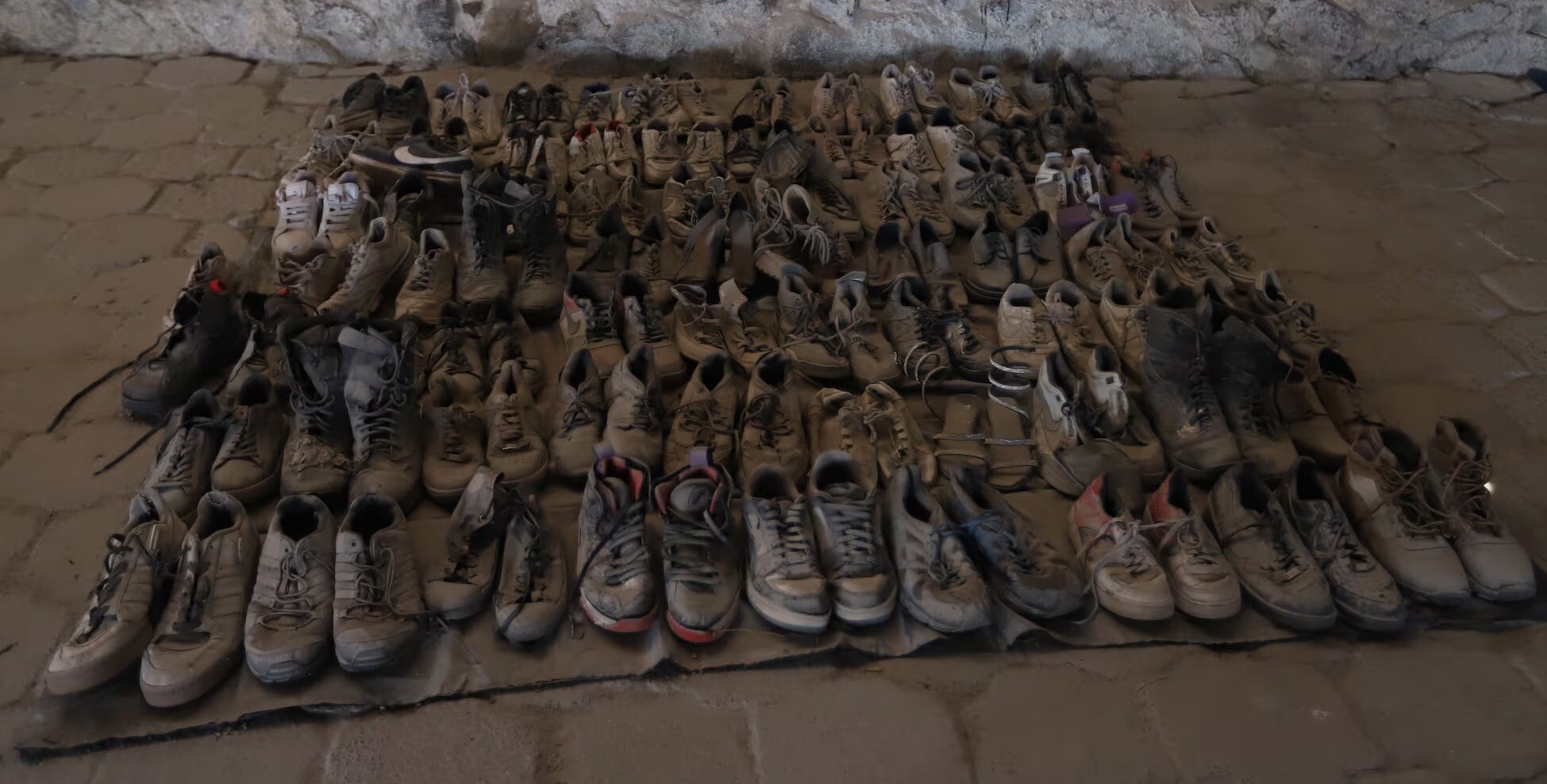
On March 5, the Warrior Searchers of Jalisco, a collective of family members of the disappeared, found a gruesome scene on a ranch in Teuchitlán, near Guadalajara, Jalisco. There, at a location supposedly searched by the state government in September 2024, they found three cremation ovens, clandestine graves, hundreds of human remains, and countless personal items and clothing, along with lists of names. The discovery of the forced recruitment and extermination camp run by the Jalisco New Generation Cartel (CJNG) has sent shockwaves throughout Mexico. It is a moment that makes plain the profound severity of the crisis gripping the country and the collective trauma endured after nearly twenty years of the so-called “drug war.” Civil society organizations have called for Saturday, March 15, to be a day of national mourning, with no place for politicians. The below text by Silvia L. Gil, published in Revista Común and translated by Scott Campbell, wrestles with the significance of what was found in Teuchitlán and what might be needed to counter the horror.
Several years ago, I heard a colleague say that in order to stop evil from reproducing itself, we had to stop denying it. She argued that our societies had put on a blindfold. Although this may be true in some parts of the world, it seemed to me that in Mexico what we needed was more of a truce, to stop staring horror in the face. That the problem was not exactly that we should look more or better, but that to survive in the face of what we already saw we should stop looking. At least for a while. This apparent paradox – pain surrounds us, but we cannot become so sensitized as we run the risk of being paralyzed – is very important in this time when violence and extreme precarity have intensified. There comes a point at which we are unable to assimilate all that we see in a world of injustice. If in other latitudes with this situation – which we can call a global war against life – an answer is sought to the initial question of how to not deny the pain that is spreading throughout the world, in Mexico, the question did a double somersault: once we have seen it all, once we have moved beyond any fictional scenario, what kind of deep transformation of the human do we need so that the horror never repeats itself again?
A few days ago, the group of family members “Guerreros Buscadores de Jalisco [Warrior Searchers of Jalisco]” uncovered remains at a ranch known as La Estanzuela in the locale of Teuchitlán. There, they found crematorium ovens, innumerable graves (it is said that the same graves were used on several occasions), human remains, clothing, shoes of the victims… For years it was known that young people were captured through offers of employment. In the midst of extreme precarity, many opted to go to the place where the job was supposed to be offered. They never returned home. Others were taken by force. The ranch served as a forced recruitment center: only some survived – the strongest – who could ascend the criminal structure. Collectives of the family members of the disappeared affirm that this reality was know about for more than ten years. Authorities were alerted on countless occasions. A survivor has related that in the three years they were there, some 1,500 people were killed. It is impossible to have exact numbers, to know the scale of the horror. We can probably only know a bit of what happened by weaving the testimonies of the surviving victims. I wonder how long it will be before we can truly hear their words. To understand the objective of an atrocity of this type is very difficult. The absence of intelligibility is part of the same device of power: the less we understand, the more we are paralyzed in horror, the less sense we can make of what initially seems to respond to the irrational, to the monstrous and unnameable, the more space this kind of power will have to deploy itself.

Mexico currently has 123,808 disappeared and unaccounted-for persons, according to this month’s report from the National Search Commission. It must be kept in mind that these numbers are always provisional. For the first time in the country a greater effort at identification is being made, but there are also innumerable families that make no reports because they are either afraid of the consequences or because they know doing so will yield no result. Jalisco is one of the most violent states in the country. And it is the state with the highest number of disappearances. The governor of Jalisco, from the Citizen’s Movement party, Enrique Alfaro, ran out of Mexico almost the day after his term ended in October 2024. At the moment, he resides in Madrid, following the footsteps of Felipe Calderón and Enrique Peña Nieto. In recent times, Madrid seems to be a refuge not only for the international right, but also for the suspected collaborators with organized crime.
When we try to understand how a horror of this size is possible, there is a reading that is essential to make, but which, unfortunately, is not enough: we are facing a system of absolutely unbridled and cruel capital accumulation. What this “unbridled” means is that all limits that delimited the framework of this accumulation have been blown apart, so that any means to achieve it becomes possible. Atrocities are normalized because they are a means to open new market niches, but because above all, just like legal markets, the drive for more – greater extraction, greater yield, greater consumption – is a mandate that permanently mobilizes (Sayak Valencia has worked on this link between subjectivity, violence, and capital). The same competition within the market also appears between criminal groups: it is not enough to kill; one must kill in the most atrocious and sophisticated way. As Adriana Cavarero says, contemporary power is not content with killing because that would be too little. And this is where the idea that horror has only economic causes and that, therefore, it could be explained through class struggle, unfortunately falls short. I say “unfortunately” because if we could stop this horror with a policy of providing economic resources so that people did not have the need to respond to a call for dangerous employment, that would obviously be for the best. And that path, of course, must not be abandoned. But perhaps it is necessary to sharpen our analysis.
In principle, accumulating capital by means of extreme exploitation does not require the extra suffering and unspeakable violence that we find these days in the stories of Izaguirre’s survivors. Subduing the will of the victims could be enough to exploit them as forced labor. However, we encounter an excess, limits that are annulled in the cruelest way, leaving a trail of ruined bodies, where whatever sense of humanity disappears. What kind of enjoyment is that which is activated when the humanity of another is annulled before me? What kind of human being is this that doesn’t use the suffering of the other as a means to achieve something – which is in itself terrible – but whose work consists in making them suffer until nothing remains in that subject that could make them a carrier of life, that life that at some point was irreducible in its singularity? It is inevitable to think of Auschwitz. If for the Nazi extermination camp to be possible, it was necessary to build a long-standing policy of antisemitism, what is the ideology at work in Teuchitlán? Or is there not even a malevolent idea, a plan on earth, that explains this atrocity?
One line of research that circulates these days has to do with the cartels’ training techniques. According to Michael W. Chamberlain, a human rights defender for decades in Mexico, they come from the army. In a recent interview, he explained that one of the main objectives of these techniques is “desensitization.” It is striking that he did not in this case speak of “dehumanization”: the emphasis is not on the loss of the qualities with which the “human” is defined, such as reason, logos, or coexistence in society, but what is absent is something particular: sensitivity. As when sight or smell is lost, a part of the individual is erased, but the whole remains. This means that a certain type of subject emerges, one that does not cease to be human, but that has eliminated the sensitive capacity from themself. They eliminate it in order to sustain a degree of cruelty that we can hardly conceive. It seems to me that here appears one of the most important questions at play in our time: the mutation of a kind of individual who cuts all connections that link them to the world and to themself. They are not even a disaffected subject: their capacity for affectation is still presupposed, which would have been displaced or even denied, but which is still present, even if only as a trace. It is as if this individual, in turn, having forgotten who they are, is obliged to eliminate their place in the world by means of every practice of cruelty. They remain somehow outside of the scene in which they are the protagonist.
It would seem that there is an idea that circulates in the midst of the horror: a way of understanding the human who manages, through the extreme practice of cruelty, “to work” every day in an extermination camp. According to testimonies, this could also imply the use of sexual violence: the other, the difference, is subjected for one’s own benefit or enjoyment, to demonstrate superiority. What is revealed here seems to me to be fundamental to what we must consider as a society: it is not only the accumulation of capital at play, but a certain way of understanding the human as a hierarchy of the One over all those considered different. A kind of power based on the brutalization of the dispossessed, feminized body. It is important to remember that this kind of cruelty is repudiated by the immense majority of the population in Mexico and in the entire world, and that is important not to lose sight of in a moment of fascistization: life is sustained and defended in many ways at the same time. But it is fundamental to consider how this logic, this mutation of the subject, is uniting itself with the planetary processes of capital accumulation, intensifying them.
It is not only accumulating wealth in an economic sense, expanding markets without restraint, but also maintaining the authority of a power that, in order to dominate everything before it, needs to break the ties that bind it to the world that it inhabits. Appropriating difference, subjugating otherness, are conditions that don’t have to do only with a monetary objective. It is a type of domination, a type of construction of authority, of demonstration of an untouchable power. It is the type of power upon which patriarchy is based, that power that uses sexual violence as an intimate appropriation of difference to confirm its authority. This means that disarming the horror also requires a profound transformation of who we are: a recovery and reorientation of a blocked sensibility.

The other big question during these days is a classic question of moral philosophy: what kind of ethical responsibility is demandable in an extreme situation? In other words: what about the municipal police, with the authorities who saw that the kids at the truck stop in Guadalajara didn’t return? I believe that what has happened in Jalisco reveals not only that there is one power, but that, when we speak of “colluding powers,” we must integrate how the chains of command are also chains of threat, extortion, and blackmail. They are not just about free individuals choosing between good or evil. It is very dangerous for us, as society, to morally judge the actions of a person who surely finds themself under threat or in life conditions that we don’t know about. From a Kantian position, we should probably die before going against the universal principles that govern our actions. We should not do to someone that which we would not accept for ourselves. But perhaps this posture is too heroic and individualist, and forgets that very possibly it is not only our own life at stake, because others could depend on it, those that we have in mind when we are facing death – a daughter, a dependent father, a brother. When we say that they are enlarged chains, we must understand that an extermination center is sustained through the silent penetration of violence that has been occupying a territory. Many studies have emphasized that if organized crime produces something it is the deep cracking of communities through suspicion, fear, silence. Once again appears the pretense of power to make life a project where the minimum bonds of social cohesion are broken. Only a completely broken society can be the basis of that project of domination.
And here appears the ethical question we need to ask ourselves: How do those of us respond who are not – at least for the moment – under the threat of the horror? What massive actions do we set in motion to say no, that we resist the psychic mutation activated by this ideology of domination, that we are going to defend the youth, the friends and sisters, that we are going to forge again our connections to become stronger and stronger, that the power of the markets does not seduce us nor do we want the enjoyment that violently annuls the other [al otro], the others [las otras]? How to affirm, so that it is clear, that we are counterposing, with all our strength and difficulties, another idea of the world, without guarantees, but with determination, one that, in addition to stopping the unlimited accumulation of capital profits, reconsiders our place in the world from a position that rejects violence against otherness? How to insist that this is why this past March 8th a struggle was held that has the capacity to at the same time be against economic exploitation, heteropatriarchy, and racism? A struggle to promote a subject that is not only not subjected to extreme precarity, but also contrary to the symbolic organization aimed at annihilation? How to sustain our ethical contention against a war that spreads out over life?
This March 15, National Mourning in the streets, counterposing our collective force against the horror and violence.
 Falling Into Incandescence
Pingback: Because all of Mexico is Teuchitlán – Falling Into Incandescence