
Separatio ♏︎
[Qualities of separatio: order out of confusion, awareness of opposites, separation of earth and sky, of mother and father, of subject from object, of I from not-I]

“Separate the earth from the fire, the subtle from the dense, gently, and with great ingenuity.”
– The Emerald Tablet, circa 200-800 CE
Who am I? Who am I not?
Who says who I am? Who do I say I am?
When I see what I see, who sees?
When I think what I think, who thinks?
When I hear what I hear, who hears?
When I feel what I feel, who feels?
Thoughts arise, linger, and pass. I am not my thoughts.
Pain arises, lingers, and passes. I am not my pain.
Emotions arise, linger, and pass. I am not my emotions.
My body arises, lingers, and will pass. I am not my body.
All I see, hear, taste, touch, smell, feel, think; I see it arise, linger, and pass.
Who is the I that sees?
Who is the not-I that arises, lingers, and passes?
The I is a permanence that sees the impermanent not-I.
But if all is not-I, then what is I?
Is the seeing I not an I at all?
Pronouns perish in the pleroma.
We are not who we seem.
We are not as we’re seen.
We are far more than that.
The I’s of something greater.
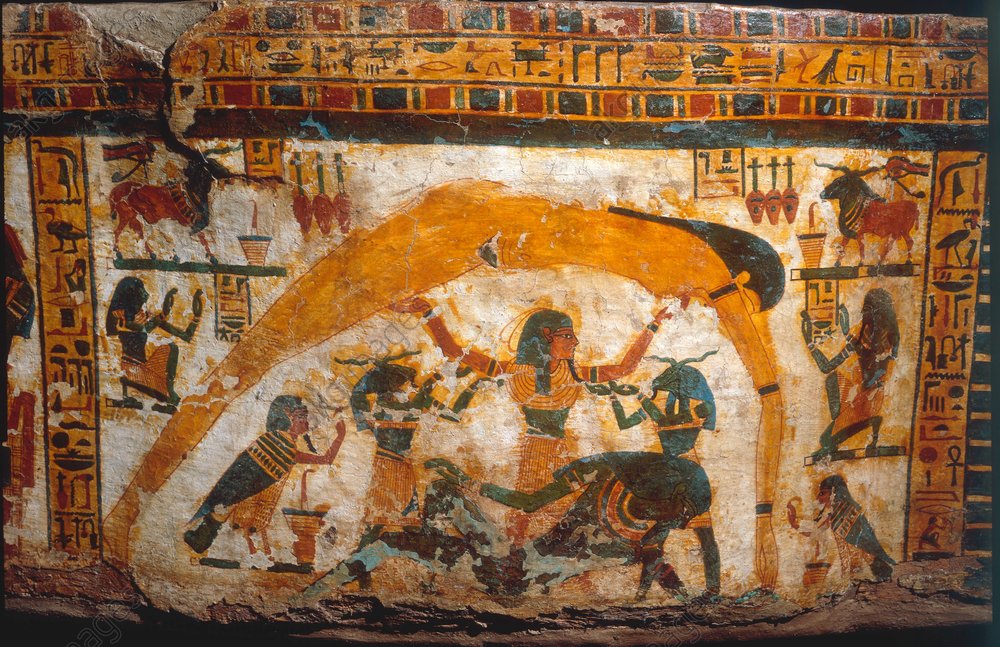
The god of totality, Re-Atum, gave birth to the twins Shu and Tefnut, who became the first divine couple. Shu and Tefnut then also gave birth to twins: Geb, the masculine god of the earth; and Nut, the feminine goddess of the sky. Geb and Nut married and were forever locked in an embrace. Re-Atum ordered their father Shu, god of the air, to separate them. Standing on Geb, Shu pushed Nut up, forming the arc of the sky. Thus the earth and heavens were separated, allowing life to populate the earth.
Hence the natural striving of the creature goeth towards distinctiveness, fighteth against primeval, perilous sameness. This is called the principium individuationis. This principle is the essence of the creature. From this you can see why indistinctiveness and non-distinction are a great danger for the creature.
Carl Jung
When we strive after the good or the beautiful, we thereby forget our own nature, which is distinctiveness, and we are delivered over to the qualities of the pleroma, which are pairs of opposites. We labor to attain to the good and the beautiful, yet at the same time we also lay hold of the evil and the ugly, since in the pleroma these are one with the good and the beautiful. When, however, we remain true to our own nature, which is distinctiveness, we distinguish ourselves from the good and the beautiful, and, therefore, at the same time, from the evil and the ugly.
 Falling Into Incandescence