Afro-Pessimism and Palestinian Liberation

5/18/25 Update: Rather than these rambling thoughts, I encourage interested readers to check out my lengthier essay examining this topic.

As part of a reading group, for our last meeting I selected the following texts: “Mama’s Baby, Papa’s Maybe: An American Grammar Book,” by Hortense Spillers; “Afro-Pessimism: The Unclear Word,” by Jared Sexton; and, “The Social Life of Social Death: On Afro-Pessimism and Black Optimism,” also by Jared Sexton. As part of our meetings, those who choose the readings for the week have to do a written response as to how the readings incorporate into their research interests in general. In discussion with the reading group crew, I’ve decided to publish my response publicly in an effort to move our endeavor forward. If you’re interested in joining our group, reach out to me. The only requirements being that you’re bilingual (Spanish/English) and that you’re down to burn this all to the ground.

As I grapple with the three texts we read for this week, I cannot but help view them – as I am currently viewing everything – through the lens of Palestine. Therefore, I’m interested in doing what Frank Wilderson firmly disavows: a comparative reading of Palestine through the lens of Afro-Pessimism. I believe that doing so can offer insights on the current situation in Palestine and also on the arguments put forward by Spillers and Sexton. I want to acknowledge that to do so does great injustice to both narratives and subjects. Despite appreciable claims of Black-Palestinian solidarity, they cannot be conflated along the lines of historical experience nor ontological construction. At least not linearly nor literally. I believe metaphorically, however, there are openings or sites for exploration that I wish to delve into here.

Continue reading

Netanyahu, the Global far-Right, and Building Solidarity with Palestine: In Conversation with Scott Campbell

Originally posted on It’s Going Down.

On this episode of the It’s Going Down podcast, we host a discussion with IGD contributor Scott Campbell, as we cover the current situation on the ground in Palestine, the Netanyahu government in Israel and its links to the global far-Right, the role of the US in the conflict, and what possible avenues social movements could take in the fight against apartheid and occupation.

During our discussion, Scott gives us a short history of the occupation of Palestine by the state of Israel, the political players on the ground, the role of the United States, and how Israel has worked to export its brand of ethno-nationalism and counter-insurgency around the world.

Over the course of our talk, we touch on the connections between settler-colonial regimes around the world, how we can use history as a tool to inform our struggles, and how we might go about building our capacity to act in solidarity.

More Info: Scott Campbell on Mastodon, Decolonization is Not a Metaphor, Movement Memos podcast, and Behind the 21st Century Intifada

photo: Ahmed Abu Hameeda via Unsplash

music: “Real Gaza Me Seh!” by Hanouneh ft. Promoe

A Letter to the President (of my university)

The president of the university I attend just sent out a lamentable statement to the entire school regarding the recent events in Palestine. For what it’s worth, here is my response:

Dear President Jessup,

I am sure you are receiving numerous responses to this email from a number of perspectives. Nonetheless, I feel I must contribute mine.

I understand your condemnation of the Hamas attacks. I am, however, disheartened by your failure to condemn Israel’s response to the attacks. What is happening in Gaza is more than a “humanitarian crisis,” as if it were struck by a natural disaster. Israel is carrying out war crimes, such as the forcible transfer of populations, a total siege and blockade of food, water and fuel, the use of white phosphorous, the bombings of civilian, media, and medical targets, and the killing thus far of at least 1,900 people, including 614 children.

Continue reading

The raids on Al-Aqsa in context

Some quick, brief thoughts on the ongoing repression and resistance in occupied Palestine:

The consecutive brutal raids on al-Aqsa during Ramadan by the fascist government of Israel shouldn’t been seen as isolated incidents. Nearly 100 Palestinians have been killed so far this year by Israeli forces, including massacres in Jenin and Nablus. Harsher conditions have been imposed on thousands of Palestinian political prisoners. Laws from banning the flying of the Palestinian flag to allowing Israel to strip Palestinian citizens of Israel of citizenship have been passed.

Relatedly, other measures, such as the revocation of the 2005 law removing settlements from the northern West Bank, to the loosening of gun ownership regulations, to the creation of a National Guard specifically designed to target Palestinians and under the control of Kahanist Itamar Ben-Gvir, all point to a government desiring and planning for conflict and escalation as a means to continue the Zionist settler-colonial project.

Continue reading

Glimmers Against the Horizon

For a little more than a year I lived in Palestine. This text is not about that time but rather a phenomenon I first encountered there. That would be, in an overarching sense, the experience of the normalization of the expectation of the abnormal event. In this context, an abnormal event refers to an incident or circumstance that is outside the range of normative human experience and often beyond the capacity of the human psyche to make sense of or healthily integrate. During my time in Palestine, abnormal events were occurrences such as the nighttime raids of villages or homes, killings, woundings, beatings, kidnappings, tortures, and home demolitions carried out by Israeli military forces or settlers. (This is limited to the West Bank and would be much more devastating if expanded to include Gaza. Also left out are scenarios such as protests, which one enters into knowing that Israel will utilize varying levels of violence.)

Israeli forces carried out these actions with a consistency accompanied by an intentional unpredictability. In practice, this meant holding in one’s awareness the knowledge that something bad was going to happen, and soon. There was no if. When, where, and how bad? were the ever-lingering questions. And, given the limited territory on which these events occurred, would it involve those one knows or perhaps even oneself? To daily hold the apprehension, dread, or anxiety of the knowledge of an impending but unknown calamitous event is psychologically and physically exhausting. Its presence festers in the background, tingeing even the most positive or enjoyable of activities with an ambiguous darkness, an ill-at-ease that can not be put aside. For at any moment, the phone may ring or text may arrive with the news that something has happened.[1]

Continue reading

In Memory of Basil al-Araj

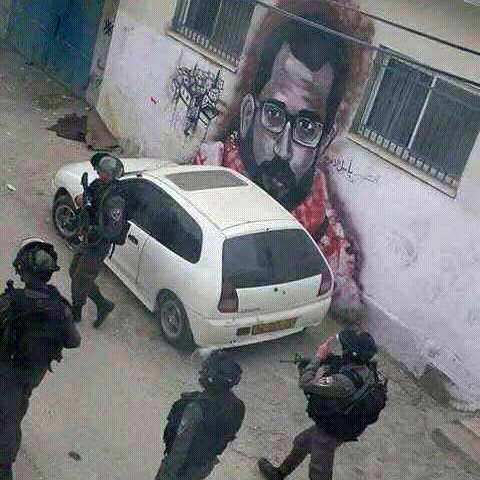
Israeli occupation forces walk past a mural of Basil al-Araj in al-Aroub refugee camp near Hebron.

Shortly after arriving in Palestine in 2012, a comrade invited me to a demonstration in front of al-Muqata’a in Ramallah, the seat of the Palestinian Authority in the occupied West Bank. It was a significant symbolic event, being the first protest against the PA directly in front of its headquarters with about 100 people holding signs on the sidewalk condemning PA President Mahmoud Abbas’ decision to hold negotiations with Israel. Nothing much happened, but that nothing much clearly irritated the PA.

Following the protest, several people met at a nearby café. That was the first time I met Basil al-Araj. Similarly, nothing much happened, but the more time I spent in Palestine, the more and more frequently I found myself in Basil’s company. He spoke passable English, and aside from translations by others, that was how we communicated given that I embarrassingly managed to live there for more than a year and not learn Arabic.

Continue reading

Podcast interview with sole

In February, I saw down with renowned indie hip-hop artist sole for a few hours and the result is the latest episode of his podcast, the Solecast, released yesterday. We covered a lot of ground, from Occupy Oakland to Palestine, Chiapas, Cuba, Rojava, the elections, anarchism and more. And he said a bunch of unnecessarily nice stuff about me in the intro, for which I thank him.

Give it a listen and let us know what you think!

https://soundcloud.com/soleonedotorg/solecast-25-w-scott-campbell-on-anarchism-palestine-chiapas-cuba-the-electoral-spectacle

Disclaimer: That photo is a screenshot from a 2011 interview I did with Keith Olbermann. I don’t like it but sole does and it’s his show, so who am I to argue?