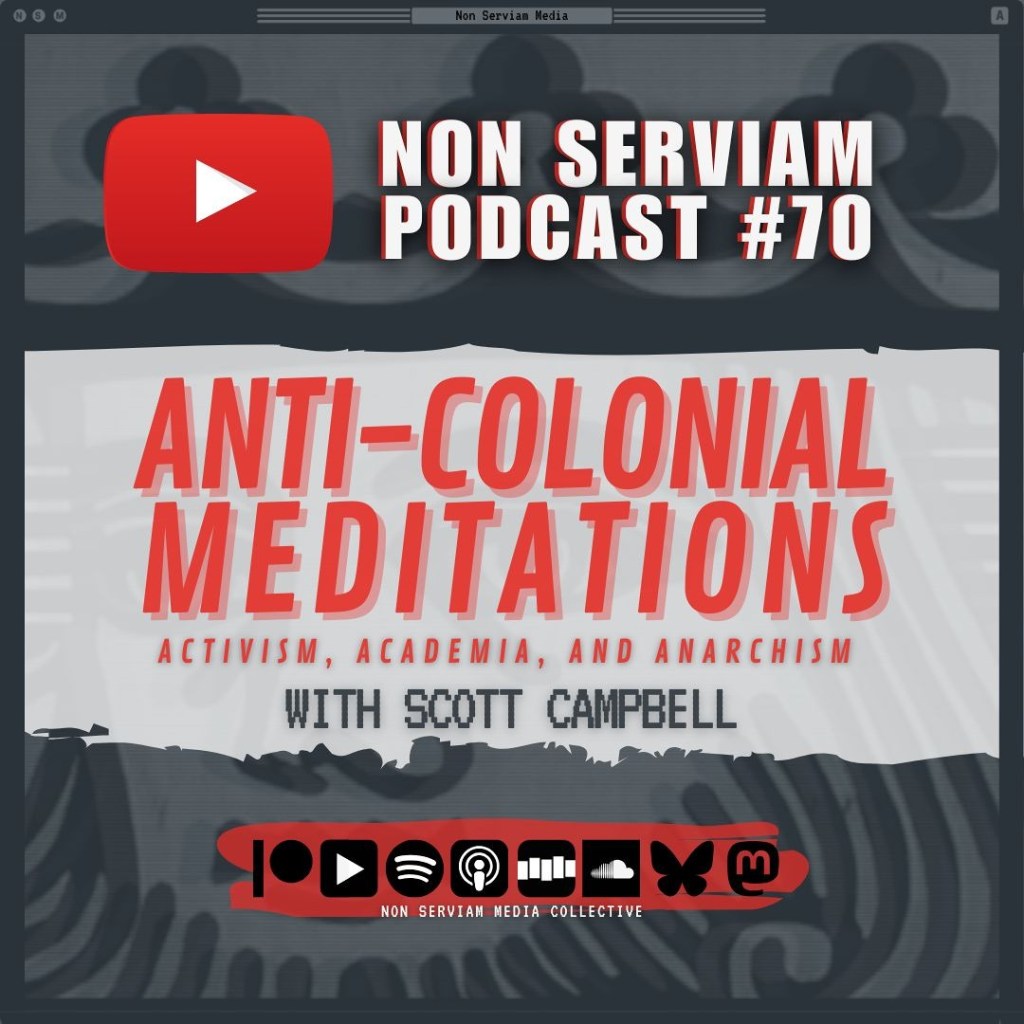
Conversation with Non Serviam Media

Last month, I had the opportunity to chat with Lucy with the Non Serviam Media team about a variety of topics, from organizing, anarchism, academia, and the importance of an anti-colonial framework in doing political work. If you’re interested in hearing me prattle on for 90 minutes or so, here’s your opportunity! It can be listened to below or wherever you listen to your podcasts.

Ayotzinapa and Palestine bleed on the same map

Originally published on It’s Going Down.

September 26, 2025, marks 11 years since the State attack on students from the Ayotzinapa Rural Normal School in Iguala, Guerrero, during which six people were killed, 25 wounded, and 43 students disappeared. The following is the transcript of a Spanish-language audio segment produced by Radio Cósmica Libre in collaboration with the efforts of Communicators for Palestine. It is based on information provided by Eduardo Ibañez from the Mexico City Encampment for the 43. It has been translated into English by Scott Campbell.

Mexico, September 26, 2014. Palestine, July 2014. Two dates that seem unrelated but that resonate with a shared echo.

That night in Iguala, 43 campesino students were uprooted from their dormitories, from their classrooms, from their dreams. That summer in Gaza, more than 2,000 Palestinian lives were taken in a matter of weeks by the military machinery of Israel. What connects a young normalista from Guerrero with a Palestinian girl who will never become a teenager? The answer is in the language of State violence, in the economy of death that connects the Mexican narco-state with Israeli necropolitics.

It is a long story. In Mexico, the rural normal schools emerged in the 1930s to educate the children of poor campesinos and to train teachers committed to their communities. In Palestine, the Nakba of 1948 inaugurated a life under occupation, dispossession, and forced displacement.

Two processes that appear distinct but that share the experience of peoples who were denied the right to exist in conditions of dignity. In 2014, the stories intersected. While Gaza suffered bombardments during July and August, students from the Ayotzinapa rural normal school went out into the streets of Mexico to protest in solidarity.

Just one month later, they themselves were victims of forced disappearance and murder in Iguala. The disappearance did not just erase bodies, it also condemned mothers, sisters, and wives to a life of interminable searching. State violence produces widows, orphans, mutilated families, communities condemned to permanent mourning.

State crime has no passport. Governments that kill in the name of security learn from one another. Necropolitics speaks many languages, but death always says the same thing: “You don’t matter.”

Continue reading

Accountable to history

Photo by Al Benoit on Unsplash

When I was very young, I used to believe that my parents were omniscient and infallible. They knew everything and were never wrong. As I aged, I of course realized the faults of my assumptions. Being a parent now myself, I especially realize how absurd that notion was. We make it up as we go along, doing the best we can with the information we have at hand. Mistakes are part of the practice.

Part of my younger beliefs was that my parents were responsible for or had control over worldly developments. They were adults, they had agency that I did not. I am sure there is some psychological term for this, but, likely for the sake of simplicity, I subordinated systems of authority and power into the hands of those I was most familiar with who also had such seemingly tremendous power and authority – my parents.

Again, this belief waned as I grew, but it became replaced by a perhaps more right-sized view of accountability and action in the world. Rather than holding the expectation that my parents could control everything, I was interested in what they contributed to change and making the world a better place, broadly speaking. As my worldview became explicitly infused with politics during my adolescence and its accompanying arrogance, I more specifically wanted to know what they did that was in accord with my view of what they should have done.

Continue reading

Afropessimism and Palestinian Liberation: An Essay

In October 2023, at the beginning of an ever-escalating genocide against the Palestinian population of Gaza, I wrote some rambling, rather perfunctory, thoughts on Afropessimism and Palestinian Liberation. I have since attempted to elaborate my thinking into a more structured argument, the result of which is the below essay. Declined for publication by several academic journals, I have decided to post it here, unsure of its merits but hoping amidst the words there may be a useful contribution to the conceptualizations of our collective struggles for liberation and the centrality of the Palestinian cause. I welcome feedback, critical or otherwise. As it is a lengthy essay, I have also made it available as a PDF.

Abstract: This paper draws upon Black feminist theory and Afropessimism to interrogate Palestinian demands for liberation. In doing so, it figures Zionism as a project of modernity and evaluates its epistemology through Sylvia Wynter’s formulation of the “genre of Man.” Subsequently, it picks up Afropessimism’s extension of Wynter’s thought to critique the ontology of the Human. As Zionism, a modern endeavor, knows itself through the othering of Palestinians, an Afropessimistic reading of Palestinian demands is examined. It is argued that Palestinian liberation is an impossibility in the current ordering of knowledge and being, demanding the end of the Human and this world.

In the face of genocide, the question of Palestinian liberation has never been more salient. Yet what liberation looks like and how to obtain it is a matter of debate. Formations such as the Palestine Liberation Organization and the Palestinian National Authority have accepted a two-state solution framework that would see a State of Palestine established alongside the State of Israel. Others have called for one binational state, where Israelis and Palestinians would live side by side under a secular, democratic government.[1] For its part, Palestinian civil society has focused less on a specific solution and more on the implementation of rights guaranteed under international law. This approach can be seen in the 2005 call for Boycott, Divestment, and Sanctions against Israel, which demands an end to the Israeli occupation of Palestinian territory, equal rights for Palestinian citizens of Israel, and the right to return for Palestinian refugees.[2] In a similar manner, scholars such as Rashid Khalidi have called for a focus on the inequality present in the Zionist project, proposing that a just solution in Palestine should be premised on equal rights for all inhabitants of the region: “Absolute equality of human, personal, civil, political, and national rights must be enshrined in whatever future scheme is ultimately accepted by the two societies. This is a high-sounding recommendation, but nothing else will address the core of the problem, nor will it be sustainable and lasting.”[3]

On the surface, appeals to equality and international law hold a certain resonance. They are aspirational yet practical, fitting within the current discourse regarding the fair and just organization of societies. At the same time, such approaches are hindered by unquestioned assumptions regarding the origins and intentions of constructs such as equality and international law, as well as the possibility of obtaining true or absolute justice within the current world paradigm. This paper argues that the present ontological and epistemological foundations of human being in this world – on which claims to equality or international law are based – impede the realization of Palestinian liberation. It posits that Palestinian freedom necessitates the creation of new worlds and, rather than the legislating of equality, the jettisoning of constructs such as modernity and the Human.

To make its case, this paper will place questions of Palestinian liberation into conversation with Black feminist thought and Afropessimism. It will first demonstrate the Zionist project to be one firmly rooted in modernity and loyalty to whiteness. Subsequently, it will draw upon the critiques of modernity formulated by Black feminist theorists, primarily Sylvia Wynter, arriving at a problematization of Man, or the current supremacy of the white, Western bourgeois male. Afropessimism will extend Wynter’s judgment of Man to encompass that of the Human, showing that Humanity itself is contingent upon anti-Blackness. Having troubled the construct of the Human, this paper will apply an Afropessimistic reading to Palestinian liberation, asking if total freedom means destruction of the Human, and Palestinians have been rendered as not-Human by Zionism, how can Afropessimism inform Palestinian liberation? I argue that Afropessimism not only assists in descriptively generating a theoretical reading of the Palestinian plight as the anti-modern Other, but also can prescriptively aid in conceptualizing resistance. My culminating argument, as mentioned above and built off the frameworks offered by Afropessimism and the Black feminist theory from which it emerged, is that true Palestinian liberation necessitates the end of modernity, the Human, and therefore, this world.

Continue reading

Questions

“I thought about how the world can be anything and how sad it is that it’s this.”
– Nana Kwame Adjei-Brenyah, Chain-Gang All-Stars

When they are intentionally starving children in Gaza, what more does one need to know about Zionism? What conversations can be had? What legitimate disagreements can there be? Can there be a good-faith defense of genocide?

When genocide is livestreamed to every electronic device daily for 563 days (and counting), and it is still permitted to continue – not only permitted, but abetted and supported – what value is this world, its systems, its laws, its governments, its justice?

What does it mean when Democrats and Republicans can agree on nothing except for their shared desire for more dead Palestinians? What could be done with 17.9 billion dollars other than wholesale slaughter? What is the significance of bipartisan support for genocide facilitating the ascension of fascism in the last election? Does this nation-state, genocidal in its foundation and still committed to genocide 249 years later, merit anything other than opprobrium?

As a father, what do more than 17,400 dead children mean to me? When I look into my two-year-old’s eyes, what sense am I to make of the incomprehensible? Is there anything I would not do to keep him safe? Is there nothing I might not do to those who intentionally caused him harm? Does any parent feel differently? Is existence capacious enough for the pain of so many losses? Do we want it to be?

What does it mean when to be Palestinian means one’s life is disposable? What does it mean when to say “Palestine” means to be kidnapped, jailed, deported? What sense can be made of this world’s ontological hatred of the Palestinian? If its teleological zenith is genocide and fascism, is there anything worth salvaging? Why should we be loyal to that which would destroy us? Should we not seek to destroy it, instead?

What does it mean that genocide is but a symptom and the world is the sickness?

What if the answers did not scare us but guided us?

Gaza Solidarity Encampments on Occupied Land

The above map and following essay are from a project produced for a course I took last semester. As it may be of some relevance or utility, I have chosen to post it here. As always, thoughts, critiques, and feedback is welcomed.

The map accompanying this essay attempts to situate via multiple data points the location of Gaza Solidarity Encampments installed on the campuses of colleges and universities during April and May 2024 in what is demarcated as Los Angeles County. In particular, it seeks to raise the question of the implications of the taking of space in solidarity with an Indigenous struggle for liberation in Palestine on land that itself was ethnically cleansed and genocided of most of its Indigenous inhabitants. To do so, it first notes the identities and territories of the original populations of what is now Los Angeles County: the Tongva, Kizh, and Chumash peoples. Upon that is layered the colonial infrastructure and place designations to orient the gaze from a settler lens with the intention of inspiring reflection on the imposition of settler colonialism and belonging in space. If the colonial place names were absent, would the viewer’s familiarity with the area change? Finally, using tent icons, the map indicates the approximate location of the five Gaza Solidarity Encampments in the area that were erected in April and May 2024, along with the identification of the college or university, the name given to the encampment by those involved, and the Indigenous lands upon which the encampment was placed. The intention of the map is not to condemn nor to celebrate, but to problematize the conception of space in the context of resistance and to encourage the incorporation of a decolonial perspective in the work of protest.

Continue reading

The Watermelon Scare: Attacks on Palestine Solidarity Are Aimed At Silencing the Anti-War Movement

Originally published on It’s Going Down.

By Scott Campbell

On October 15th, the Samidoun Palestinian Prisoner Solidarity Network was labeled a “terrorist entity” by Canada and subjected to sanctions by the United States. These designations follow a previous ban in Germany and the labeling of Samidoun as a “terrorist organization” by Israel. The U.S. claims Samidoun is a “sham fundraiser whose efforts have supported terrorism” by the Popular Front for the Liberation of Palestine (PFLP), a Marxist-Leninist Palestinian political party also labeled as a “Foreign Terrorist Organization” by the U.S. For its part, Samidoun states it “does not have any material or organizational ties to entities listed on the terrorist lists of the United States, Canada or the European Union.”

Two days later, Republican Senator Marco Rubio sent a letter to the U.S. Attorney General requesting he “immediately open a domestic terrorism investigation” into the popular pro-Palestine website and social media account, Unity of Fields, known for posting anonymous reports of direct actions. In a statement, the group said it is “an anti-imperialist propaganda front…we don’t do actions, we only report on them and receive anonymous submissions.”

As the Civil Liberties Defense Center (CLDC) recently noted, Rubio also pushed the Attorney General to charge four activists in Florida who were arrested for writing pro-choice graffiti following the fall of Roe v Wade for “terrorism.” One activist was sentenced to a year in prison by the Middle District of Florida, the same court that recently awarded only 8 months to a man convicted of literally firebombing a Planned Parenthood clinic.

Likewise, while Rubio is trying to claim that an Instagram account is terrorism, he has of course stayed quiet while his own party works overtime to spread rampant misinformation in the wake of two devastating hurricanes hitting his state and about the upcoming election – to say nothing of members of his own party regularly attending neo-Nazi gatherings and increasing aligning with white nationalists.

One may disagree with Samidoun and Unity of Fields on their specific political positions, but the entire movement against the ongoing war and genocide in Gaza should be concerned with the state’s move to target them. In no way can Samidoun be understood as a “sham charity” or “terrorist entity,” nor a media project like Unity of Fields as responsible for “domestic terrorism.” Even if one were to accept the legitimacy of power to deploy a subjective term such as “terrorism,” in reality, the extent of Samidoun’s work is posting statements, organizing public educational and political events, and pushing online action campaigns, while Unity of Fields maintains a counter-info website and social media accounts.

Continue reading

One year on…

From “I’m Still Alive,” by Maisara Baroud, 2023-24.

At the time of this writing, since October 7, 2023, Israel has killed 42,612 people in Gaza, including 16,765 children. 97,166 people have been wounded. Academic estimates place the actual death toll to be as high as 335,000, out of a population of 2.3 million. In the West Bank, 742 people have been killed. As Israel escalates its rampage against Lebanon, more than 2,000 have been killed there. Numbers such as these do not even come close to capturing the depth of the genocidal horror that has been unleashed against the Palestinian people by Israel, aided and abetted and armed by the United States. We can compile numbers, share anecdotes, link to videos, repost poetry, and more, but no frame is large enough to hold the scope of the devastation. It is incomprehensible.

To mark, remember, resist one year of genocide, I had originally planned to write a lengthy post contextualizing Palestinians as agents of their own history as well as survivors of histories imposed upon them. I wanted to problematize narratives, challenge conceptions, propose nuance, and foment action. Alas, exigencies beyond my control have led me to abandon such a plan. I can leave only a title: Every prison riots. Every colony rebels.

Continue reading

Empathy amid extermination

In Israel’s ongoing genocide against the Palestinian people, the numbers are appalling: almost 31,000 dead, including 12,300 children; more than 72,000 wounded; more than 8,000 missing under the rubble. Eight-five percent of the population of 2.3 million internally displaced. Nearly half of Gaza’s homes destroyed or damaged. Dozens of hospitals and hundreds of schools and religious sites attacked. Children starved to death. Thousands made orphans. The list of atrocities, cruelties, and indignities goes on and on.

It feels like too much because it is too much. Even one death, one injury is too much. It has been too much for more than 75 years. Israel’s eliminationist campaign against the Palestinian people, aided and abetted by the United States and others, is intolerable and reprehensible. It is a preannounced genocide and an intentionally imposed famine, broadcast in real time. We are all spectators to the apocalypse; it is no longer possible to say that we didn’t know. What does it mean to consume the wholesale destruction of a people and their land?

Continue reading

A Front-line Report from the West Bank of Occupied Palestine

Originally posted on It’s Going Down.

On this episode of the It’s Going Down podcast, IGD contributor Scott Campbell speaks with a Palestinian comrade based in Ramallah, which is located in the occupied West Bank of Palestine. The West Bank, along with East Jerusalem and the Gaza Strip, has been under Israeli military occupation since 1967. For a deeper dive on the history of the occupation of Palestine by the state of Israel and how it is propped up by the US government, go here.

The interview covers the current unfolding situation on the ground in the various parts of Palestine, the role of the Palestinian Authority during Israel’s current war on Gaza, the place (or lack thereof) of anarchism in the struggle for Palestinian liberation, how international solidarity can best manifest itself, and much more.

photo: Miami Antifascist Newsletter