I blame this month’s lack of reading on the U.S. government. In particular, preparing documentation for our appointment at the U.S. embassy to obtain a Consular Report of Birth Abroad (CRBA), which perhaps I’ll write about at another time, but probably won’t. The good news is at least all that work/not-reading paid off and our little one is now a U.S. citizen.
But in between cursing profligate bureaucratic obtuseness and the absurdity of citizenship, a few books got read, along with a series of fascinating academic essays, which I’ll be sharing more about below. This month’s round-up includes:
Becoming an Ally to the Gender-Expansive Child: A Guide for Parents and Carers by Anna Bianchi
The Terraformers by Annalee Newitz
Gender Born, Gender Made: Raising Healthy Gender-Nonconforming Children by Diane Ehrensaft
The Adventures of Amina al-Sirafi by S.A. Chakraborty
Polarización y transfobia: Miradas críticas sobre el avance de los movimientos antitrans y antigénero en México por Julianna Neuhouser, et al.
Unapologetic: A Black, Queer, and Feminist Mandate for Radical Movements by Charlene Carruthers
In March of last year, we learned that my partner was pregnant. Along with the rollercoaster of emotions that entailed, we were also met with innumerable recommendations. Some of which, to my gringo ears, sounded completely bizarre, to be frank. “Don’t go out during an eclipse, or else your baby will be born with a cleft lip.” “Always wear something red to protect the baby.” “Put on a safety pin to ensure it reaches full term.”
But more than anything, as seemingly everywhere else in the world, advice and divination nearly always revolved around gender. “If your back hurts, it’s a boy.” “If you eat chiles, it’ll be a girl.” “If you don’t have much morning sickness, it’s a boy.” “If you have heartburn, it’s a girl.” The guessing game of gender seemed never ending and always pointing toward different conclusions, along with the constant questioning of what we, the parents, wanted: a girl or a boy.
Finally, about three months into the pregnancy, the obstetrician could make an “educated guess” that we were going to have a boy. Amount of chiles being eaten or not, this guess was later confirmed by subsequent ultrasounds. I wish I could say that my response was one of disinterest. Rather it was one of both joy at the thought of having a son, accompanied by the worry of knowing too many men (along with myself) and hoping my son wouldn’t be like them. But a third thought pervaded my thinking and continues to prod at me to this day: what does it even mean that this child is a boy?
Another month gone and some more books read. Why not share? Building off the epically popular “January Reading” post, clicked on by an entire 11 people who weren’t me, I’ve decided to expand the Internet a bit and add a post for February’s books.
As a result of life circumstances, I didn’t get as much reading done as I was hoping to this month, though some books definitely gave me a lot to talk about. How about you? What have you been reading? As for myself, here are the texts this post will be talking about:
Foundation and Earth by Isaac Asimov
The Keeper’s Six by Kate Elliott
The Visit by Chimamanda Ngozi Adichie
King Leopold’s Ghost: A Story of Greed, Terror, and Heroism in Colonial Africa by Adam Hochschild
Radon Journal Issue 2
Sustainable Superabundance: A Universal Transhumanist Invitation by David W. Wood
The Actual Star: A Novel by Monica Byrne
The Idea of the World: A Multi-Disciplinary Argument for the Mental Nature of Reality by Bernardo Kastrup
A brief update from Radio Zapote, translated by Scott Campbell, on the release from prison of Magda Soberanes and Karla Tello, who had been held since April 15, 2022, following a police raid on the Okupa Cuba.
The young social activists and feminists, Magda Soberanes and Karla Tello, were released from prison on February 23, and will be allowed to continue their legal proceedings in freedom. This joyous day comes after they had been held for almost a year in connection with the Okupa Cuba.
A movement for the immediate release of both women led to this victory against the injustice that is the Mexican justice system.
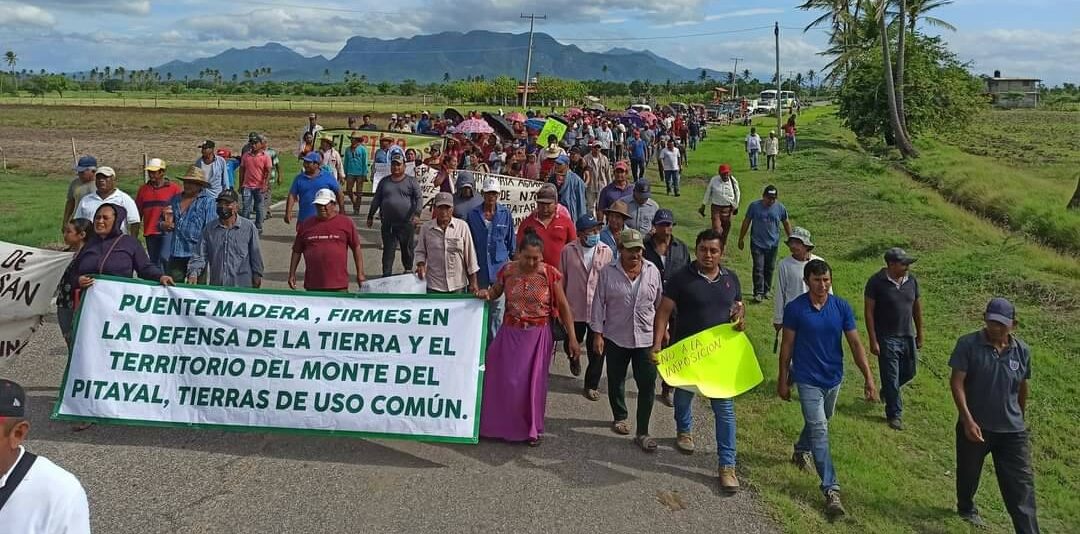
Indigenous Binniza residents of Puente Madera, in the municipality of San Blas Atempa, protest against the imposition of an industrial park on their communal lands.
The Mexican government, through the Ministry of Economy, announced that the first tenders towards the creation of planned industrial zones in the Interoceanic Corridor of the Isthmus of Tehuantepec (CIIT), in Oaxaca, will be open for bids in February.
“We hope that each development zone will generate investments of around one billion dollars,” said Raquel Buenrostro Sánchez, Minister of Economy, who anticipated that, in addition to government investment, resources from the United States government will be forthcoming.
At the end of 2022, the former head of the CIIT, Rafael Marín Mollinedo, announced that ten plots of land were ready for the construction of industrial parks. “At the beginning of the year, they will be opened for bidding so that developers can take charge and fill them with businesses,” he said in an interview with an infrastructure industry media outlet.
For those who don’t know, one thing I love to do is read. And while the Occidental calendar of months and years are rather arbitrary, one thing I have started doing in 2023 is writing brief reviews of what I’ve been reading and sharing them on a couple social media sites. I figured I might as well share them here as well. Instead of publishing each review as its own post, I’ve decided to just do a one-off round-up of every book I’ve read this month. I have no idea if this will be a regular feature of the blog, we’ll see what next month brings.
A major reason for doing this is that along with reading books, I love talking about books. So if you’ve got thoughts on any of the books or reviews below, or have your own recommendations, please do share! I’m always looking for new reads to add to my list.
Here’s a list of the books reviewed in this post:
Foundation’s Edge by Isaac Asimov
Critique of Black Reason by Achille Mbembe
The Intuitionist by Colson Whitehead
A Map to the Door of No Return: Notes to Belonging by Dionne Brand
Home: Habitat, Range, Niche, Territory by Martha Wells
The Memory Librarian: And Other Stories of Dirty Computer by Janelle Monáe
Ontological Terror: Blackness, Nihilism, and Emancipation by Calvin L. Warren
Machinehood by S.B. Divya
Cannibal Metaphysics by Eduardo Viveiros de Castro
It’s Going Down is in the midst of a brief (mutually agreed upon) takeover of the popular podcast It Could Happen Here. Alongside journalist Kim Kelly and labor organizer Tova, I joined their second episode on general strikes to discuss the history and my experiences at Occupy Oakland and in particular the general strike that occurred on November 2, 2011, when 100,000 people shut down the port of Oakland.
Spaniard and Indian Produce a Mestizo by Juan Rodríguez Juárez, 1715
Near the end of last year, I became a father. As expected, it’s been full of ups and downs, joys and frustrations, precious moments and sleepless nights. But one thing I didn’t expect to encounter was racism. More specifically, racism in the guise of compliments.
My partner is Mexican and currently we are living here as we wait an eternity for the US immigration system to process her visa request. During this time, we’ve been inundated by visits from her family members and friends. And I’ve been consistently taken aback by how many have pointed out the color of our child’s skin and complimented us on it – as if we somehow genetically modified our baby to meet their racialized expectations. “How light-skinned he is!” or “Oh, what a good color! Congratulations!” are some of the more frequent comments.
To be certain, our child is light-skinned and at this moment can easily pass as white. But the phenomenon of an individual telling my partner that she had “chosen well” by reproducing with me and as a result was “improving the race” was not a response we had been anticipating. Nor the other range of comments, such as our child being smart because “first-world babies are more advanced.” One wonders what words would have been (un)spoken if our child had different skin pigmentation.
On November 21, 2022, one hundred years after his death, anarchists gathered at the tomb of Ricardo Flores Magón in Mexico City, where clashes ensued with members of the Regional Confederation of Mexican Workers (CROM), leaving several compañerxs injured. In December, IGD contributor Scott Campbell interviewed Jaime, one of the anarchists present that day. The interview covers not only the events of November 21, but the life and legacy of Ricardo Flores Magón, the state’s attempts to recuperate his memory, and more.
How would you like to introduce yourself?
My name is Jaime. I’ll be speaking on behalf of those who took part in the action [on November 21], but which is not a collective.
Can you speak to the importance of Ricardo Flores Magón? Who was he, what is the significance of his work and legacy?
Ricardo Flores Magón was an anarchist, born in Eloxochitlán de Flores Magón, Oaxaca, in 1873, and who, at a very early age, became aware of the political and economic situation in Mexico at that time. He had contact with anarchist and libertarian ideas; he read Bakunin, Kropotkin, and Malatesta. As well, his Indigenous Mazatec origin and the practices of Indigenous communities, such as solidarity and mutual aid, had a large influence on the formation of his thought and ideology. From a very young age, he began to fight, to combat, to organize against the dictatorship of Porfirio Díaz, which brought him persecution and repression. He, along with his brothers Jesús and Enrique, and people such as Juan Sarabia and others, founded a newspaper in 1900, called Regeneración, through the distribution of which a network of liberal groups was created that over the years evolved into an insurrectional network.
In 1905, the Regeneración group left Mexico for exile in the United States. By then, Ricardo Flores Magón and others had been imprisoned, had been persecuted, the Regeneración printing press had been confiscated, so they considered it unsustainable to continue the struggle in Mexico and went to the United States and settled in California. In 1905, they created the Organizing Junta of the Mexican Liberal Party (PLM), which is the political organization that guided or gave form to this organizational network. By 1906, it became an insurrectional network that encouraged and fomented armed uprisings in different parts of the country, primarily in Veracruz, in Chihuahua, in Acayucan, in Las Vacas, and so on. That is to say, Ricardo Flores Magón and others, such as Librado Rivera, Margarita Ortega, Jacinto Palomares, in short, a series of individuals, began to fight the dictatorship of Porfirio Díaz, but not to put an end to it and just install someone else as president.