Items to Support EZLN Tour to Mexico City

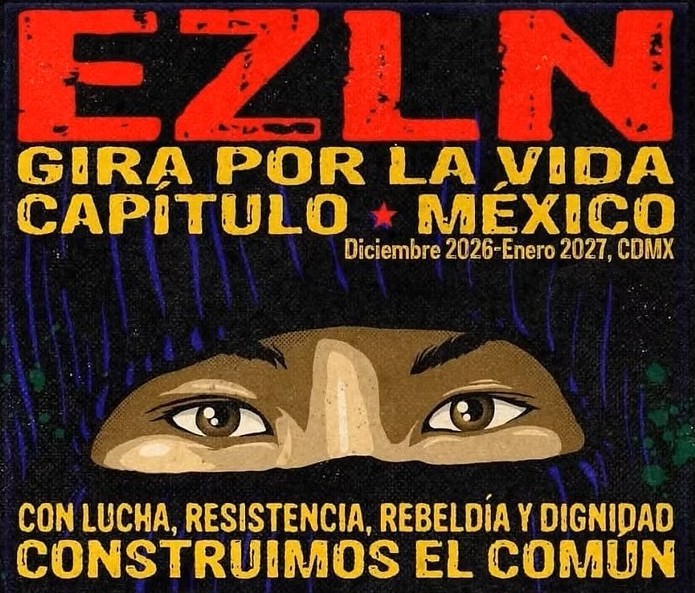
Poster for EZLN event titled 'Gira por la Vida, Capítulo México', scheduled for December 2026 to January 2027 in CDMX, featuring eyes peering from a ski mask with text emphasizing struggle, resistance, rebellion, and dignity.

tl;dr: the merch is at the bottom.

On July 21, during the gathering or “seedbed” entitled “War against Humanity (Populations and Nature Under Siege),” called for by the Zapatista Army of National Liberation (EZLN) in San Cristóbal de Las Casas, Chiapas, Mexico, EZLN spokesperson Insurgent Subcommander Moisés announced that a delegation of 1,111 Zapatistas would travel to Mexico City in December, staying for the entire month. They will hold a series of meetings, gatherings, protests, and marches; organize the next “Gathering of Resistances and Rebellions” and “Gathering of Art;” and, on January 1, 2027, celebrate the 33rd anniversary of the EZLN’s armed uprising from the heart of the Mexican state.

However, the main motivation for the “Tour for Life – Mexico Chapter” is to meet with collectives and organizations searching for their disappeared family members and loved ones. More often than not, these efforts are led by the mothers of the disappeared. In elaborating on the upcoming trip in an August 9 statement, Moisés and Insurgent Captain Marcos stated that “Where are they?” is the most important question today in Mexico and Central America: “One of the main goals of our trip and stay in Mexico City is to meet with the collectives of those searching. Not only to listen to them and echo their demand for truth and justice. But also to offer them the collective embrace of the Zapatista peoples and communities. And, through that embrace, to try to let them know, at least a little, just how much we admire, respect, and love them.”

Continue reading →
Meanwhile, in Mexico: Axolotls and attacks on autonomy

With the on-again, off-again war against Iran, Israel’s “ceasefire” slaughters in Gaza and Lebanon, the fact that everything is unaffordable and people can’t find jobs, and the nonconsensual foisting of an immensely inept Skynet on all of us, it’s hard to track – let alone process and still function – with all that is happening under the current worldwide regime of fascist terribleness. But in case the barrage of promotions hasn’t wormed its way into your brain yet, let us not forget that the World Cup is right around the corner, another Carnival of Capitalism to distract us.

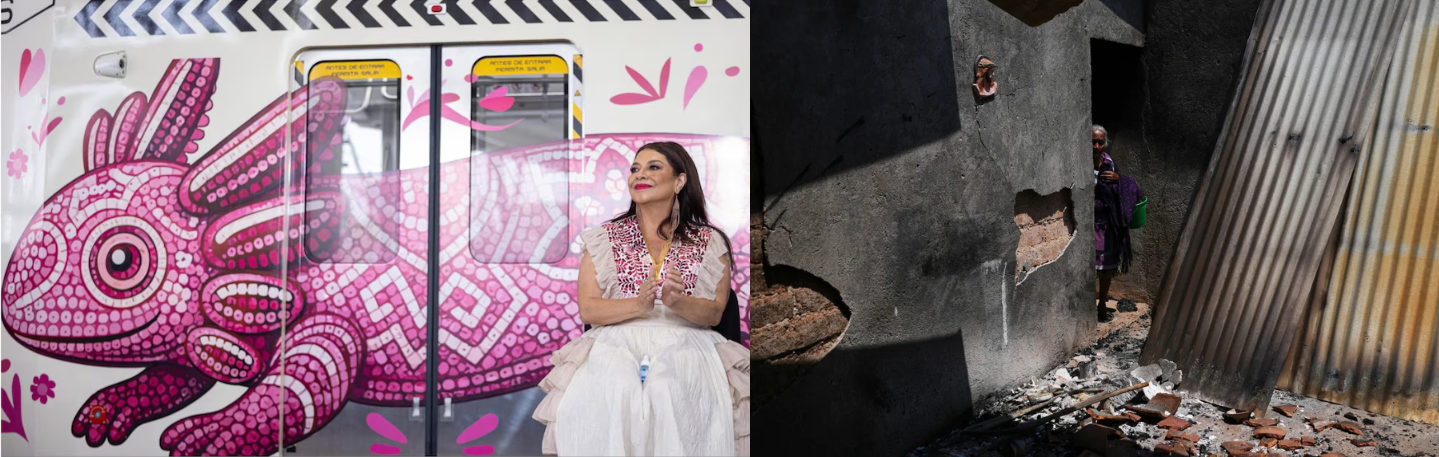
In Mexico City, the head of the government, Clara Brugada, is preparing for the event by overseeing the spending of between 500 million and 3.2 billion pesos (29 to 185 million USD) to basically paint purple axolotls all over the city. Why fix crumbling infrastructure when one can just “axolotlify” it? Why attend to the fact that rent has increased 155% in the city and every 48 hours three houses are taken off the market and turned into vacation rentals as gentrification spirals out of control? Where social cleansing is not limited to painted axolotls but increased raids against migrants in the city? As expected, some of the populace has responded with memes. Others have taken to the streets, pointing to the deeper crises in Mexico, with the cry that “Behind the Cup are hidden graves and troops.”

For her part, President Claudia Sheinbaum thinks the “axolotlization” of Mexico City “looks pretty.” But she’s also got her hands full with CIA officers driving off cliffs in Chihuahua and blowing up narcos in the State of Mexico, not to mention her ally, Rubén Rocha Moya, the currently-on-sabbatical governor of Sinaloa being indicted by the United States for protecting the Chapitos faction of the Sinaloa Cartel in return for its help getting elected. This not only implicates a prominent member of the ruling MORENA party in organized crime, but also shows he is an active partisan in the Sinaloa Cartel’s internal war that has left more than 4,000 dead and 3,500 disappeared since September 2024.

Continue reading →

Subversion and self-critique in the self-managed university

I am pleased to share that my first peer-reviewed article, “Re-visioning the university: José Revueltas and academic self-management,” has been published by the journal Radical Americas. Below is a short post contextualizing and summarizing the article that I wrote for the journal’s blog, reposted here with permission.

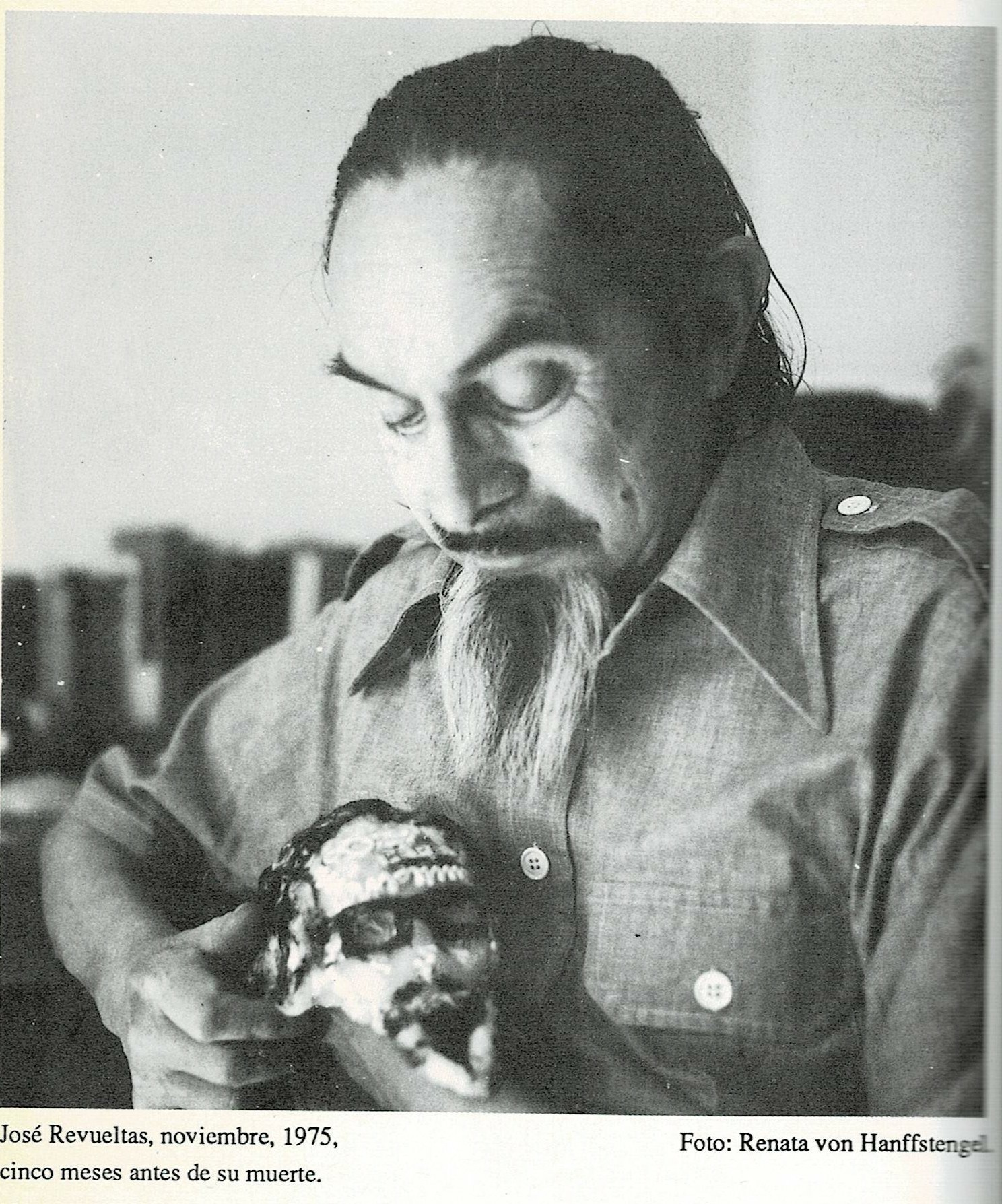
This past 14 April marked fifty years since the death of José Revueltas, a singular figure of the mid-twentieth-century Mexican left. A four-time political prisoner, a winner of the National Prize for Literature, a communist twice expelled from the Mexican Communist Party, and a self-taught university professor, Revueltas was a heterodox, flawed, contradictory but immensely committed individual in the struggle for a better world. As a student of social movements and state repression in Mexico, I was intrigued by both his fascinating biography and – with important and notable exceptions – the limited scholarly engagement his later work and theoretical contributions have received.

Initial drafts of this article came together as students around the United States and beyond claimed space on their campuses to demand an end to U.S. and academic complicity with Israel’s genocide in Gaza. That wave of mobilization has passed, but another will surely come. In the meantime, the university remains in crisis, caught between forces of neoliberalism and far-right reaction and the ever-present question of its role in society. Revisiting Revueltas’s theory of academic self-management as put forward during the student movement in Mexico City in 1968 thus seems apropos at this moment. I am excited to have it published as an open-access article by Radical Americas, a journal welcoming early career professionals (which I most definitely am) and dedicated to the practice of systemic critique.

As such, my article seeks to accomplish two main tasks. One is to trace Revueltas’s political trajectory over the decades, demonstrating how it evolved to criticize the means he once embraced as the framework for revolutionary change, and how this evolution coincided with the dynamics of the 1968 movement. The second is to examine the contents of his theory of academic self-management as a transformative vehicle for the restructuring of society as a whole. In his attempt to theorize and give shape and direction to a movement as it was unfolding, Revueltas argued for the subversive role of the university as space for the self-critique of the society in which it was embedded. He proposed a non-hierarchical institution collaboratively managed by faculty and students dedicated to reflexively engaging with the most pressing concerns of the country and world. His vision for academic self-management began in the university but did not end there. Instead, practices of self-management would extend to the masses, ultimately leading to a socialist Mexico predicated upon absolute freedom, democracy, and justice. While aspirational, arguably utopian, and not explicitly adopted by the student movement, Revueltas’s theory offers insights not only into his own political progression and the mobilizations of which he was a part but can serve as a point of inflection for those immersed in similar concerns today.


Re-visioning the university: José Revueltas and academic self-management by Scott Campbell (Claremont Graduate University, CA, USA) is published in Radical Americas, volume 11.

Update on Yorch: Saying Goodbye

Translated from the Spanish-language post on the Auditorio Che Facebook page.
Learn more about Mexican anarchist political prisoner Jorge “Yorch” Esquivel here.

UPDATE: At 11:30am on Tuesday, December 9, 2025, beloved compa Jorge “Yorch” Esquivel passed on. More information will be made available in time.

December 6, 2025, 3:40pm

Dear family, compas, friends, and community:

Thank you very much for all your letters, love, and solidarity with our beloved Yorch. We have read each and every one of your messages and we are very grateful because we know that he hears us and knows that he is not alone.

We want to share with you that our compañero’s health has become more delicate every day. Even with the dignified attention that he is finally receiving and the enormous and loving efforts made by doctors and hospital personnel charged with his treatment, due to the advanced state of deterioration he was in upon arriving at the hospital – where he is now – it has been very complex attending to his urgent condition. After the long period of medical neglect, the effects of the damned prison on all facets of prisoners’ health – and more in this case, where the violence of the State and UNAM orchestrated repression against him – and his prior medical issues which themselves paint a picture of potential complications due to his hospitalization, multiple surgeries, and irreversible damage suffered in 2019 when Yorch survived appendicitis that was not treated in time.

Sadly, our compañero now does not have the possibility of recovering a dignified quality of life and he has a very high probability of remaining in the state he is in now and due to the risks presented by the procedures and treatments indicated by his clinical state in the coming days. During recent weeks, Yorch was wandering from site to site without precise information. We did not receive clear news regarding his condition, treatment, or anything else. The prison authorities and those of the various hospitals where he has been this past month did not inform us of the severity of his condition until he arrived at the current hospital and we learned minutes before they had to intubate him – due to neurological failures that don’t allow for him to breathe unaided – that this was just a small part of the series of complications he has. The situation took us completely by surprise.

Continue reading →

Fighting against forgetting

At the invitation of Mirtha Pérez, the mother of Nadia Vera, I prepared this short piece on grief and collective memory ten years after the Narvarte murders. It was originally published in Spanish on Memorial Narvarte.

I did not know Alejandra, Mile, Nadia, Rubén or Yesenia. I only learned of their existence after their deaths. It is a double loss to realize the lives one might have encountered had they not been stolen so abruptly and so cruelly. Despite not knowing them in life, I have had the honor to participate in a very small way in trying to maintain their memories and presences over the past ten years.

It began when I read Mirtha’s letter-poem to her daughter, Nadia, marking one year after her murder. Working with independent media outlets in what is called the United States, I translated her letter, published it online, and shared it among friends, comrades, and on social media. As a result, a dear compa who was editing an anthology on collective grief and mourning asked to include the translation in the volume, along with a brief introduction written by me.

Continue reading →

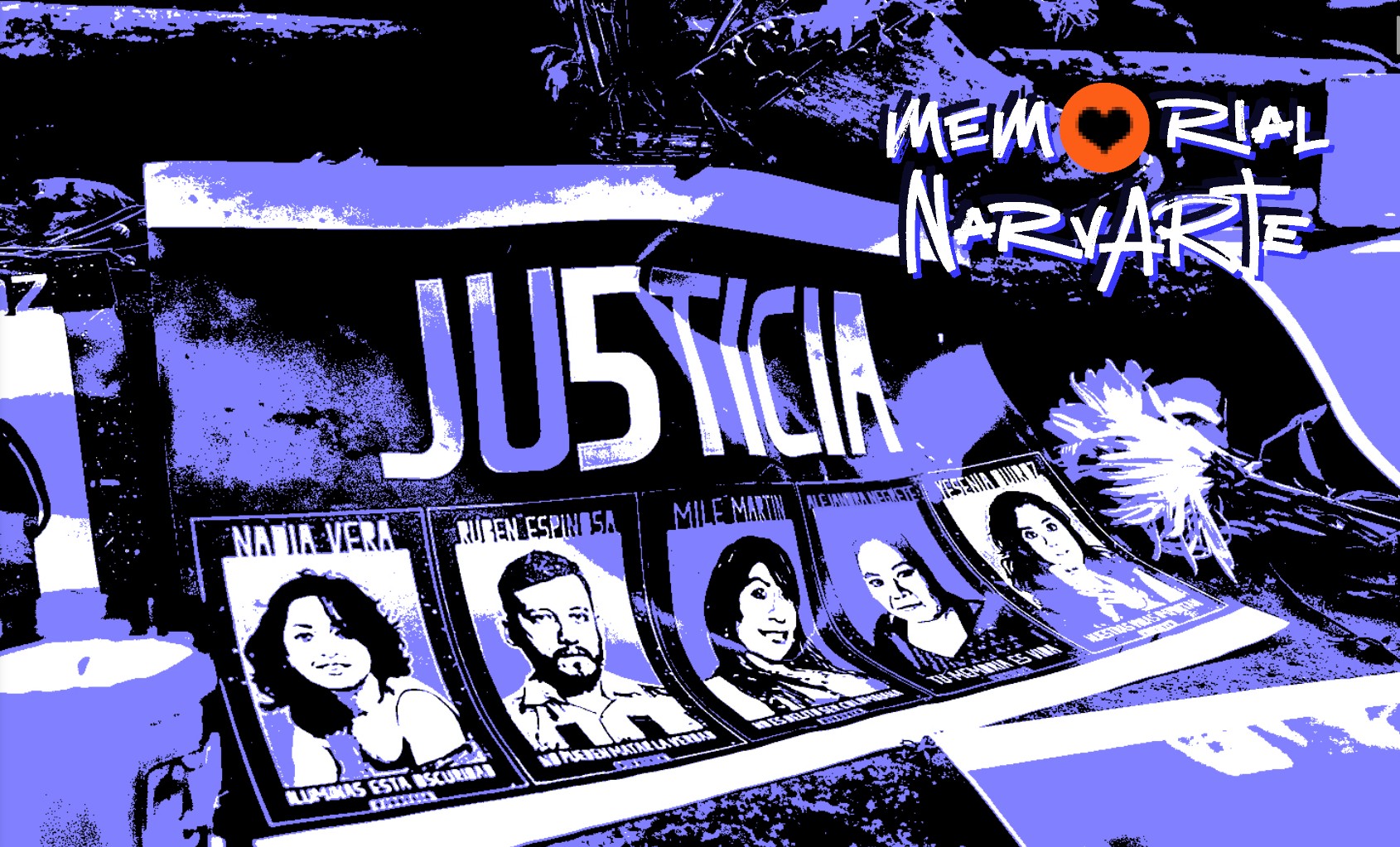
Marking 10 years since the Narvarte murders: Justice, struggle, and memory

Originally posted on It’s Going Down.

On July 31, 2015, Alejandra Negrete, Mile Martín, Nadia Vera, Rubén Espinosa and Yesenia Quiroz were murdered in an apartment in the Narvarte neighborhood of Mexico City. In the ten years since, their family members, friends, and comrades have been demanding justice and struggling to keep their memories alive. While three people have been detained for the killings, evidence ignored by the Mexico City prosecutor’s office implicates former officials of that office in the killings. It has also refused to investigate the role of the administration of Javier Duarte, former governor of Veracruz, from where Nadia, a radical activist, and Rubén, a journalist, fled fearing for their safety after receiving threats. To mark ten years, those accompanying the families in their search for truth and justice have created a digital common archive: Memorial Narvarte. Below is a text announcing the archive along with a piece by Mirtha Luz Pérez Robledo, the mother of Nadia Vera. Both were translated by Scott Campbell.


Memorial Narvarte: An Archive for the Future

Ten years after Alejandra Negrete, Mile Martín, Nadia Vera, Rubén Espinosa and Yesenia Quiroz were taken from us, we continue putting faith in collective memory.

After the multi-femicide and homicide that occurred on July 31, 2015, in an apartment at 1909 Luz Saviñón Street in the Narvarte neighborhood of Mexico City, authorities tried to create a “historical truth,” to shelve the case without considering that Nadia and Rubén fled from threats in Veracruz, and without following the different lines of investigation linked to Nadia’s activism and Rubén’s journalism. What followed would be a demand for justice in the face of criminalization, revictimization, xenophobia, and discrimination against the 5; as well as a collective demonstration of resistance and living memory.

Over the course of this decade, together with their families and allied organizations, we made space amid State neglect and abandonment. We want to continue building a dissident common sense to the hegemonic narratives regarding the recent history of our country and the acts that mark us. That is why we are building a common archive, a space of digital memory to remember them: memorialnarvarte.org.

Continue reading →

UNAM seeks to demobilize students, but protests continue

Originally published on It’s Going Down.

A short text by Camilo Ocampo, published on Pie de Página and translated by Scott Campbell, that looks at recent developments at the National Autonomous University of Mexico. Since the publishing of this article, the struggle has spread throughout UNAM, with reports of five departments on “total strike” as of Wednesday, April 9, 2025. Those are Social and Political Sciences, Arts and Design, Engineering, Chemistry, and Architecture; with a partial strike in the Economy Department.

In the midst of a politically tense atmosphere within UNAM, the University Council, the highest governing body, approved a change in Article 15 of the University Tribunal Regulations, which seeks to implement the suspension or expulsion of students and academics who engage in “acts of vandalism” on the institution’s campuses, as well as those who participate in drug dealing.

Students, workers, academics and even part of the University Council warn that this measure violates the freedom to protest, given the lack of clarity distinguishing between what is considered an act of vandalism and the right to protest.

Continue reading →

Raffle in Solidarity with Indigenous Anarchist Miguel Peralta

For more information about Miguel Peralta and the persecution he has been facing for the past decade, read this update from his support group.

Note: If you are located in what is called the United States and would like to participate in the raffle, Miguel’s support crew welcomes your participation! Please contact me for more information. The suggested price of the raffle ticket is $50 MXN ($2.50 USD), but you are welcome to contribute more if you would like. Prize winners will be responsible for covering shipping costs and will not be eligible for prizes that contain perishable items. A continually updated list of prizes can be found on the event’s Facebook page.

As you know, the case of Miguel Peralta Betanzos and the persecution and repression that his community, Eloxochitlán de Flores Magón, is experiencing, have been going on for more than ten years.

After years of imprisonment, hunger strikes, legal games, going back and forth in court at different judicial levels, etc., Miguel Peralta’s case reached the Supreme Court, which represented the possibility of putting an end to his persecution and obtaining his full and absolute freedom. However, things were not as favorable as one might think, and on November 6, the Supreme Court issued a resolution in which it limited itself to recommending that the Collegiate Court of the City of Oaxaca make review of Miguel’s case from an intercultural perspective. With this, the case returned to those instances, which are far from his community, family, legal team and support group.

Continue reading →

Building support for anarchist political prisoner Jorge “Yorch” Esquivel and Okupa Che

Originally published on It’s Going Down.

On this episode of the It’s Going Down podcast, IGD contributor Scott Campbell speaks with Flor, a compa in so-called Mexico actively involved in supporting anarchist political prisoner Jorge “Yorch” Esquivel. They speak about Okupa Che, an autonomous, self-managed space on the campus of the National Autonomous University of Mexico (UNAM), a project where Yorch has been a long-term participant. They then talk about the various charges and legal battles Yorch has faced since 2016, his ongoing imprisonment since December 8, 2022, and his recent sentence of seven years and six months. Flor also provides information on how folks can act in solidarity with Yorch and discusses the cases of other political prisoners in Mexico.

For more information about Yorch and Okupa Che, check out the following resources:

The Campus Movement and Academic Self-Management

Originally published on It’s Going Down.

As Israel’s brutal genocide against the Palestinian people and Palestine itself continues past the 200-day mark, students around the so-called United States have risen up and are carrying out occupations and erecting encampments on their campuses. These acts are extremely inspiring, militant, and hopeful – calling to mind the campus occupations from the early aughts, the student mobilizing against the war on Vietnam in the 1960s and protests against apartheid in South Africa in the 1980s. Breathless blather from politicians and the media have turned what are actions against genocide into a “controversy” that deftly manages to ignore the political content of what is currently unfolding across the country. As Samuel P. Catlin notes in his exceptional essay, “The Campus Does Not Exist”:

Campus panic is a sustained note in the American public conversation; from Vietnam to Gaza, it has never let up. Reliably, every few months something happens “on campus” that the media inflates to the status of a national emergency: a speaker is invited, a speaker is disinvited, a speaker is not disinvited, a professor teaches, a student complains, a protest takes place. The media offers these incidents as scandals so fascinating and disturbing that they eclipse even a genocide.

At the front of any conversation regarding what is happening on college campuses must be an acknowledgement of what the action is in response to: an ongoing, U.S.-facilitated genocide. It seems both absurd and necessary to note that what matters above all is the genocide. Students (and some faculty and staff) are taking tangible, direct action to pressure institutions complicit in the genocide into divesting and disassociating from that most atrocious of acts. That opposition to genocide has been successfully constructed as “controversial” in this country merely demonstrates the insipid nature of what passes for public discourse and the paucity of thought contained within it.

Continue reading →