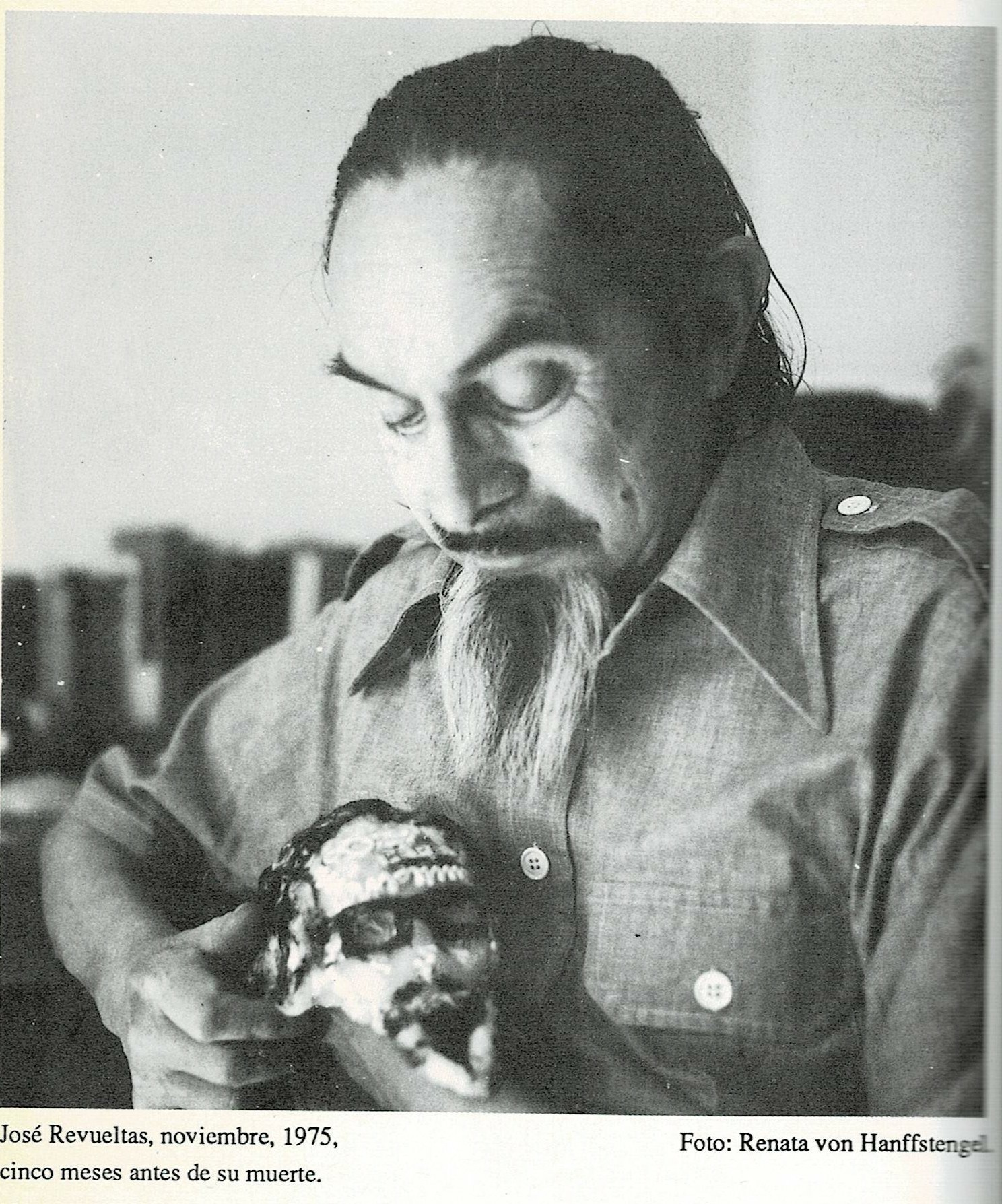
Subversion and self-critique in the self-managed university

I am pleased to share that my first peer-reviewed article, “Re-visioning the university: José Revueltas and academic self-management,” has been published by the journal Radical Americas. Below is a short post contextualizing and summarizing the article that I wrote for the journal’s blog, reposted here with permission.

This past 14 April marked fifty years since the death of José Revueltas, a singular figure of the mid-twentieth-century Mexican left. A four-time political prisoner, a winner of the National Prize for Literature, a communist twice expelled from the Mexican Communist Party, and a self-taught university professor, Revueltas was a heterodox, flawed, contradictory but immensely committed individual in the struggle for a better world. As a student of social movements and state repression in Mexico, I was intrigued by both his fascinating biography and – with important and notable exceptions – the limited scholarly engagement his later work and theoretical contributions have received.

Initial drafts of this article came together as students around the United States and beyond claimed space on their campuses to demand an end to U.S. and academic complicity with Israel’s genocide in Gaza. That wave of mobilization has passed, but another will surely come. In the meantime, the university remains in crisis, caught between forces of neoliberalism and far-right reaction and the ever-present question of its role in society. Revisiting Revueltas’s theory of academic self-management as put forward during the student movement in Mexico City in 1968 thus seems apropos at this moment. I am excited to have it published as an open-access article by Radical Americas, a journal welcoming early career professionals (which I most definitely am) and dedicated to the practice of systemic critique.

As such, my article seeks to accomplish two main tasks. One is to trace Revueltas’s political trajectory over the decades, demonstrating how it evolved to criticize the means he once embraced as the framework for revolutionary change, and how this evolution coincided with the dynamics of the 1968 movement. The second is to examine the contents of his theory of academic self-management as a transformative vehicle for the restructuring of society as a whole. In his attempt to theorize and give shape and direction to a movement as it was unfolding, Revueltas argued for the subversive role of the university as space for the self-critique of the society in which it was embedded. He proposed a non-hierarchical institution collaboratively managed by faculty and students dedicated to reflexively engaging with the most pressing concerns of the country and world. His vision for academic self-management began in the university but did not end there. Instead, practices of self-management would extend to the masses, ultimately leading to a socialist Mexico predicated upon absolute freedom, democracy, and justice. While aspirational, arguably utopian, and not explicitly adopted by the student movement, Revueltas’s theory offers insights not only into his own political progression and the mobilizations of which he was a part but can serve as a point of inflection for those immersed in similar concerns today.


Re-visioning the university: José Revueltas and academic self-management by Scott Campbell (Claremont Graduate University, CA, USA) is published in Radical Americas, volume 11.
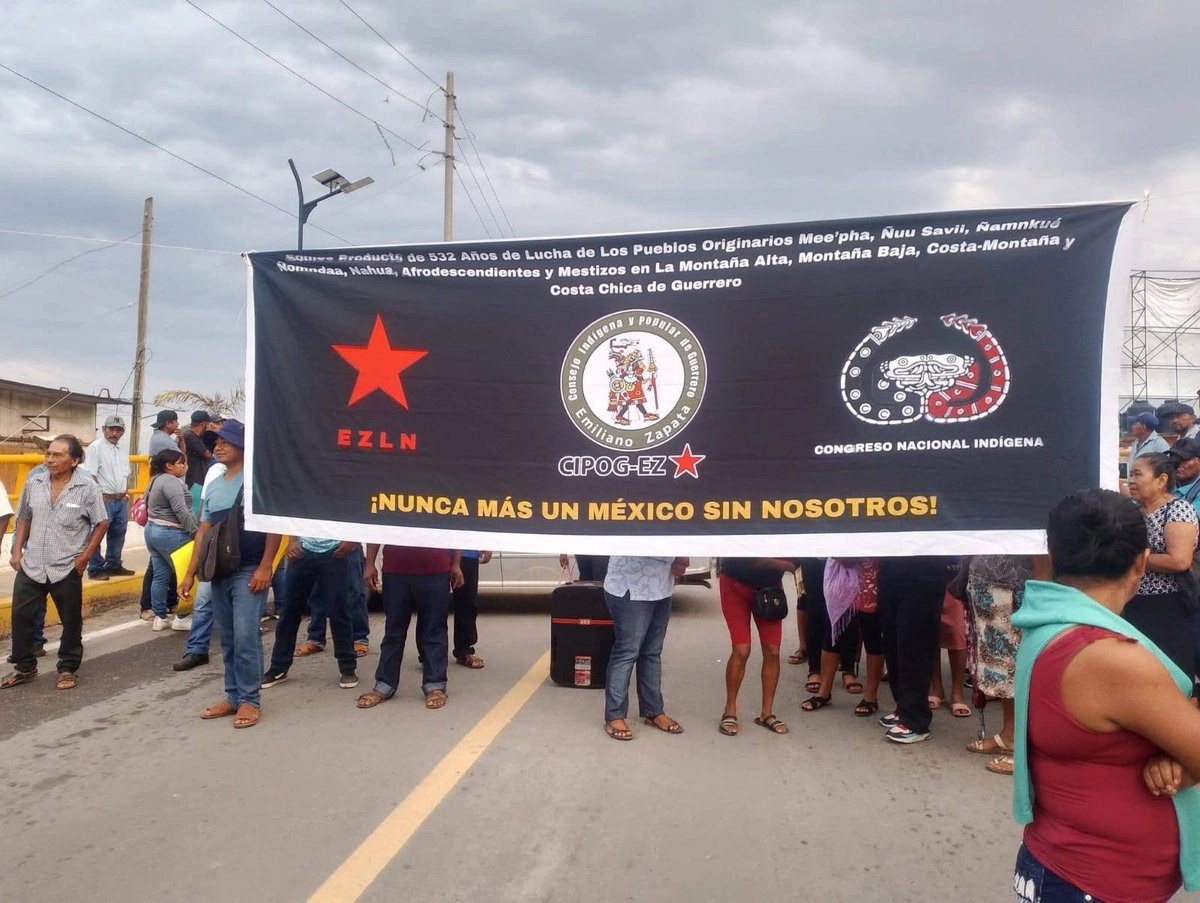
In the face of the war that traverses the world, our country, and our state: Let’s organize!

The following statement by the Indigenous and Popular Council of Guerrero – Emiliano Zapata (CIPOG-EZ) announces that the organization is joining with the Union of Peoples and Organizations of the State of Guerrero (UPOEG). Shortly after this statement, the two groups, alongside the affiliated Community Police of the Regional Coordinator of Communal Authorities of the Founding Communities (CRAC-PC-PF), issued a manifesto that mirrors much of what is addressed below. The below was translated from the Spanish by Scott Campbell.

On Friday, January 30, alongside human rights observers, these groups organized a caravan to El Terrero, Guerrero, from which 300 community members were displaced six years ago by the state-backed narco-paramilitary group Los Ardillos. On the way, Los Ardillos attacked the caravan twice, with heavy weapons fire and exploding drones. The army and National Guard, both of whom were nearby, did not intervene. The caravan was forced to turn back. Fortunately, no one was injured or killed.

TO THE ZAPATISTA ARMY OF NATIONAL LIBERATION

TO THE NATIONAL INDIGENOUS CONGRESS-INDIGENOUS GOVERNING COUNCIL

TO THE NATIONAL AND INTERNATIONAL SEXTA

TO THE NETWORKS OF RESISTANCE AND REBELLION

TO REBELLIOUS EUROPE

TO NATIONAL AND INTERNATIONAL HUMAN RIGHTS BODIES

TO THE CIVIL OBSERVATION MISSION OF THE SEXTA

TO THE FREE AND INDEPENDENT MEDIA

TO THE PEOPLE OF GUERRERO

TO THE PEOPLE OF MEXICO AND THE WORLD

January 27, 2026

Brothers and sisters, the war that unfolds all over the world is the same that is experienced in Mexico. Our dead are added to the dead which are counted by the thousands. In this new partitioning of the world and territorial reconfiguration, capitalism strikes with greater violence to appropriate everything, even though to do so it must trample on the pretenses that the very same capitalism claims exist: the sovereignty of the nation-state, national and international law, human rights, minority rights, Indigenous rights, women’s rights, and children’s rights. Not sovereignty, nor law, nor respect for life in any of its forms: everything is earnings at any cost. The masks have fallen and capitalism shows itself for what it is – war and death against humanity and life.

In the state of Guerrero, murders are part of daily life, the State does not exist as a representative of the popular will, and the laws are a dead letter. For many years our state has been governed by capitalists, be they mining companies that plunder natural resources or be they criminal groups that poison our young people and terrorize the entire population. The state pretends to exist to keep up appearances of being one more part of an orderly country with progress and development – damn lies! As such we can see the photograph of President Claudia Sheinbaum with Guerrero state governor Evelyn Salgado finishing breakfast, both smiling, they hug, they pose, while the country continues filling with clandestine graves, while searching mothers keep up hope of finding their children alive, digging in hills and mountains, while the borders fill with criminals that displace entire communities, be they criminals from the cartels or criminals of the world, Donald Trump and his goons, who with satisfaction and mockery see how they have the world’s political class on its knees, including Mexico.

Continue reading

Addiction and electoral politics

voting-addiction-insanity-einsteinOne of the most insidious aspects of addiction is that it’s a disease which convinces you that you don’t have it. It manifests in a powerful form of denial. Ask a person with addiction why they drink or use and the answer will rarely be, “Because I’m an addict.” Invariably the reply will pin the cause on a certain circumstance, person or event, or just “because I want to, I can stop anytime, leave me alone.” For the addict, the few times drinking or using didn’t lead to things getting out of control, or to a series of unintended consequences, are firmly grasped onto and elevated as proof that one doesn’t have a problem. The mountain of evidence to the contrary is swept out of mind. When things go awry they are presented as aberrations instead of what they are, which is the norm. Desperate to prove to ourselves and others that we’ve got things under control, we repeatedly pick up again, convinced that this time it will be different. It never is. And the cycle continues on its ruinous spiral.

Continue reading