Afropessimism and Palestinian Liberation: An Essay

In October 2023, at the beginning of an ever-escalating genocide against the Palestinian population of Gaza, I wrote some rambling, rather perfunctory, thoughts on Afropessimism and Palestinian Liberation. I have since attempted to elaborate my thinking into a more structured argument, the result of which is the below essay. Declined for publication by several academic journals, I have decided to post it here, unsure of its merits but hoping amidst the words there may be a useful contribution to the conceptualizations of our collective struggles for liberation and the centrality of the Palestinian cause. I welcome feedback, critical or otherwise. As it is a lengthy essay, I have also made it available as a PDF.

Abstract: This paper draws upon Black feminist theory and Afropessimism to interrogate Palestinian demands for liberation. In doing so, it figures Zionism as a project of modernity and evaluates its epistemology through Sylvia Wynter’s formulation of the “genre of Man.” Subsequently, it picks up Afropessimism’s extension of Wynter’s thought to critique the ontology of the Human. As Zionism, a modern endeavor, knows itself through the othering of Palestinians, an Afropessimistic reading of Palestinian demands is examined. It is argued that Palestinian liberation is an impossibility in the current ordering of knowledge and being, demanding the end of the Human and this world.

In the face of genocide, the question of Palestinian liberation has never been more salient. Yet what liberation looks like and how to obtain it is a matter of debate. Formations such as the Palestine Liberation Organization and the Palestinian National Authority have accepted a two-state solution framework that would see a State of Palestine established alongside the State of Israel. Others have called for one binational state, where Israelis and Palestinians would live side by side under a secular, democratic government.[1] For its part, Palestinian civil society has focused less on a specific solution and more on the implementation of rights guaranteed under international law. This approach can be seen in the 2005 call for Boycott, Divestment, and Sanctions against Israel, which demands an end to the Israeli occupation of Palestinian territory, equal rights for Palestinian citizens of Israel, and the right to return for Palestinian refugees.[2] In a similar manner, scholars such as Rashid Khalidi have called for a focus on the inequality present in the Zionist project, proposing that a just solution in Palestine should be premised on equal rights for all inhabitants of the region: “Absolute equality of human, personal, civil, political, and national rights must be enshrined in whatever future scheme is ultimately accepted by the two societies. This is a high-sounding recommendation, but nothing else will address the core of the problem, nor will it be sustainable and lasting.”[3]

On the surface, appeals to equality and international law hold a certain resonance. They are aspirational yet practical, fitting within the current discourse regarding the fair and just organization of societies. At the same time, such approaches are hindered by unquestioned assumptions regarding the origins and intentions of constructs such as equality and international law, as well as the possibility of obtaining true or absolute justice within the current world paradigm. This paper argues that the present ontological and epistemological foundations of human being in this world – on which claims to equality or international law are based – impede the realization of Palestinian liberation. It posits that Palestinian freedom necessitates the creation of new worlds and, rather than the legislating of equality, the jettisoning of constructs such as modernity and the Human.

To make its case, this paper will place questions of Palestinian liberation into conversation with Black feminist thought and Afropessimism. It will first demonstrate the Zionist project to be one firmly rooted in modernity and loyalty to whiteness. Subsequently, it will draw upon the critiques of modernity formulated by Black feminist theorists, primarily Sylvia Wynter, arriving at a problematization of Man, or the current supremacy of the white, Western bourgeois male. Afropessimism will extend Wynter’s judgment of Man to encompass that of the Human, showing that Humanity itself is contingent upon anti-Blackness. Having troubled the construct of the Human, this paper will apply an Afropessimistic reading to Palestinian liberation, asking if total freedom means destruction of the Human, and Palestinians have been rendered as not-Human by Zionism, how can Afropessimism inform Palestinian liberation? I argue that Afropessimism not only assists in descriptively generating a theoretical reading of the Palestinian plight as the anti-modern Other, but also can prescriptively aid in conceptualizing resistance. My culminating argument, as mentioned above and built off the frameworks offered by Afropessimism and the Black feminist theory from which it emerged, is that true Palestinian liberation necessitates the end of modernity, the Human, and therefore, this world.

Continue reading

Marco Antonio Suástegui: The Warrior Lineage of the Yopes

Originally published on It’s Going Down.

The following article by Vidulfo Rosales Sierra, translated by Scott Campbell, pays tribute to Marco Antonio Suástegui, a longtime and well-respected community organizer in Guerrero, Mexico, who played a key role in the defeat of the neoliberal La Parota dam project. He was targeted by a gunman and shot eight times on April 18, passing away on April 25.

Marco Antonio Suástegui Muñoz, son of Pedro Suástegui Valeriano and Noelia Muñoz Rodríguez, campesinos from La Parota. The Suásteguis are the founders of the communal nucleus of Cacahuatepec, they and other families fought for the creation of communally held property. Later, other leaders would be coopted by the PRI members of the National Campesino Confederation (CNC), one of the cacique figures was Eduardo Valente Navidad. These corrupt leaders handed out commission positions and sold lands to the highest bidder.

In 2000, the federal government began to talk about several large-scale infrastructure projects. Airports and large dams to generate energy and provide water to cities and towns would be built. One of these was to be in Guerrero. It was La Parota hydroelectric dam. It would cover an area of 17,000 hectares and would be 190 meters high. It would cover the municipalities of Acapulco, San Marcos, and Juan R. Escudero. The reservoir would be used as a lake for ecotourism. The bay of Acapulco would be joined with La Parota dam.

In 2003, with René Juárez as governor, engineers from the Federal Electricity Commission (CFE) began to build wells and sample houses, heliports, and other basic works, without consulting the community. The campesinos became concerned and obtained information about the damage caused by the work.

The communities of Garrapatas, Arroyo Verde, and San José would be buried under water. This worried them and, in their assemblies, they decided to set up an encampment in El Fraile to block the passage of machinery and CFE personnel. The campesinos went to see Marco Antonio and Felipe Flores for advice and to strengthen the movement. Marco Antonio did not hesitate for a moment. He went to the encampment. Together with Felipe Flores, they began to organize the struggle, traveling through various communities with communal lands, the ejidos of Dos Arroyos and Los Huajes.

Continue reading

Statement on the Occasion of the 15th Anniversary of the Murder of Bety Cariño and Jyri Jaakkola

Originally posted on It’s Going Down.

On April 27, 2010, a solidarity and mutual aid caravan to the besieged autonomous Triqui municipality of San Juan Copala left the city of Oaxaca. Along the way, it was ambushed by government-backed paramilitaries belonging to UBISORT (Union for the Social Well-Being of the Triqui Region). The paramilitaries killed Mixtec organizer Bety Cariño and Finnish solidarity activist Jyri Jaakkola and wounded several others. The following statement marks 15 years since the murders. It was translated by Scott Campbell.

To the media
To national and international public opinion
To social, solidarity, and human rights organizations
To the National Indigenous Congress and the Indigenous Governing Council
To the Zapatista Army of National Liberation
To the Indigenous peoples of Mexico and the world

On the occasion of the 15th anniversary of the murder of Bety Cariño and Jyri Jaakkola:

Today marks 15 years of impunity. Fifteen years since the murder of Bety and Jyri. And, faithful to custom – and the necessary stubbornness of keeping memory alive – we return to this date with the same wounded but unshakeable dignity.

In this digital era, our compañeros have been converted into a QR code, a WhatsApp message, an app, a song, a video that travels the world, a worn photo, a graphic exhibition. But they are not only that: they are a voice that resists in time, in the memory of those of us who refuse to forget.

In these 15 years, we have traveled the entire alphabet – from A to Z – going to every corner where it was possible for us to be, asking for justice. Sometimes we found a warm space, a friendly face that knew how to listen to what should be Justice; but most of the time we only found the eternal bureaucracy, the lie, the indifference. The sidewalks were our place of dialogue, our classrooms, our public plazas: in hunger strikes, in marches, in blockades, in endless waits before public officials and “authorities” of any level. We never expected anything from them. And time has only confirmed that institutional justice in Mexico is a failure.

Continue reading

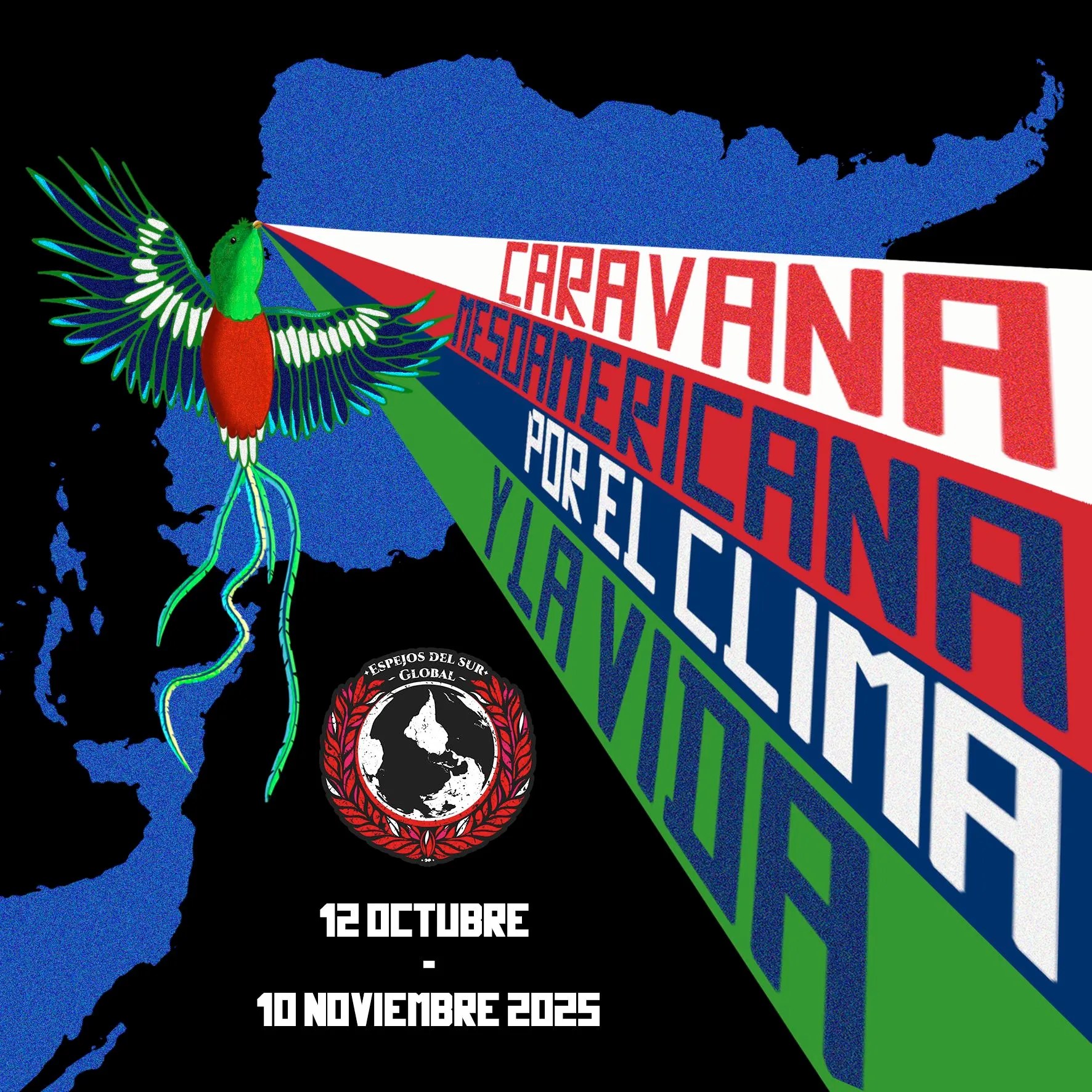
First Call for the Mesoamerican Caravan for the Climate and Life

Originally published on It’s Going Down.

A call to participate in a caravan traveling from Mexico to Brazil organized by Indigenous and campesino social movements to take place later this year. Published in Spanish on the Centro de Medios Libres and translated by Scott Campbell.

To all the struggles, peoples, and movements of Mesoamerica, Abya Yala, and the Global South:

The climate crisis advances unstoppably, and with it, the devastation of our territories, our cultures, and our very lives. Dispossession, extractive megaprojects, and structural violence stalk us with greater intensity every day. In the face of this planetary emergency, we respond with unity, resistance, and hope.

This caravan will be a space of encounter and mobilization for the peoples and communities that fight in defense of Mother Earth and of territories. We will unite our voices and forces to resist violence, make visible the biodiversity and cultural plurality of our peoples, and denounce the financial system that perpetuates destruction and dispossession.

The caravan will leave from the Mexican southeast, passing through Guatemala, El Salvador, Honduras, Costa Rica, Panama, Colombia, Ecuador and will arrive in Belém, Brazil, where we will raise our voice in the framework of the UN Conference on Climate Change (COP30) and in the midst of this Civilizational Crisis that threatens our future with global collapse.

Continue reading

UNAM seeks to demobilize students, but protests continue

Originally published on It’s Going Down.

A short text by Camilo Ocampo, published on Pie de Página and translated by Scott Campbell, that looks at recent developments at the National Autonomous University of Mexico. Since the publishing of this article, the struggle has spread throughout UNAM, with reports of five departments on “total strike” as of Wednesday, April 9, 2025. Those are Social and Political Sciences, Arts and Design, Engineering, Chemistry, and Architecture; with a partial strike in the Economy Department.

In the midst of a politically tense atmosphere within UNAM, the University Council, the highest governing body, approved a change in Article 15 of the University Tribunal Regulations, which seeks to implement the suspension or expulsion of students and academics who engage in “acts of vandalism” on the institution’s campuses, as well as those who participate in drug dealing.

Students, workers, academics and even part of the University Council warn that this measure violates the freedom to protest, given the lack of clarity distinguishing between what is considered an act of vandalism and the right to protest.

Continue reading

When the horror comes to light again. March 15 in Mexico: National Mourning

Originally posted on It’s Going Down.

On March 5, the Warrior Searchers of Jalisco, a collective of family members of the disappeared, found a gruesome scene on a ranch in Teuchitlán, near Guadalajara, Jalisco. There, at a location supposedly searched by the state government in September 2024, they found three cremation ovens, clandestine graves, hundreds of human remains, and countless personal items and clothing, along with lists of names. The discovery of the forced recruitment and extermination camp run by the Jalisco New Generation Cartel (CJNG) has sent shockwaves throughout Mexico. It is a moment that makes plain the profound severity of the crisis gripping the country and the collective trauma endured after nearly twenty years of the so-called “drug war.” Civil society organizations have called for Saturday, March 15, to be a day of national mourning, with no place for politicians. The below text by Silvia L. Gil, published in Revista Común and translated by Scott Campbell, wrestles with the significance of what was found in Teuchitlán and what might be needed to counter the horror.

Several years ago, I heard a colleague say that in order to stop evil from reproducing itself, we had to stop denying it. She argued that our societies had put on a blindfold. Although this may be true in some parts of the world, it seemed to me that in Mexico what we needed was more of a truce, to stop staring horror in the face. That the problem was not exactly that we should look more or better, but that to survive in the face of what we already saw we should stop looking. At least for a while. This apparent paradox – pain surrounds us, but we cannot become so sensitized as we run the risk of being paralyzed – is very important in this time when violence and extreme precarity have intensified. There comes a point at which we are unable to assimilate all that we see in a world of injustice. If in other latitudes with this situation – which we can call a global war against life – an answer is sought to the initial question of how to not deny the pain that is spreading throughout the world, in Mexico, the question did a double somersault: once we have seen it all, once we have moved beyond any fictional scenario, what kind of deep transformation of the human do we need so that the horror never repeats itself again?

Continue reading

Raffle in Solidarity with Indigenous Anarchist Miguel Peralta

For more information about Miguel Peralta and the persecution he has been facing for the past decade, read this update from his support group.

Note: If you are located in what is called the United States and would like to participate in the raffle, Miguel’s support crew welcomes your participation! Please contact me for more information. The suggested price of the raffle ticket is $50 MXN ($2.50 USD), but you are welcome to contribute more if you would like. Prize winners will be responsible for covering shipping costs and will not be eligible for prizes that contain perishable items. A continually updated list of prizes can be found on the event’s Facebook page.

As you know, the case of Miguel Peralta Betanzos and the persecution and repression that his community, Eloxochitlán de Flores Magón, is experiencing, have been going on for more than ten years.

After years of imprisonment, hunger strikes, legal games, going back and forth in court at different judicial levels, etc., Miguel Peralta’s case reached the Supreme Court, which represented the possibility of putting an end to his persecution and obtaining his full and absolute freedom. However, things were not as favorable as one might think, and on November 6, the Supreme Court issued a resolution in which it limited itself to recommending that the Collegiate Court of the City of Oaxaca make review of Miguel’s case from an intercultural perspective. With this, the case returned to those instances, which are far from his community, family, legal team and support group.

Continue reading

The Watermelon Scare: Attacks on Palestine Solidarity Are Aimed At Silencing the Anti-War Movement

Originally published on It’s Going Down.

By Scott Campbell

On October 15th, the Samidoun Palestinian Prisoner Solidarity Network was labeled a “terrorist entity” by Canada and subjected to sanctions by the United States. These designations follow a previous ban in Germany and the labeling of Samidoun as a “terrorist organization” by Israel. The U.S. claims Samidoun is a “sham fundraiser whose efforts have supported terrorism” by the Popular Front for the Liberation of Palestine (PFLP), a Marxist-Leninist Palestinian political party also labeled as a “Foreign Terrorist Organization” by the U.S. For its part, Samidoun states it “does not have any material or organizational ties to entities listed on the terrorist lists of the United States, Canada or the European Union.”

Two days later, Republican Senator Marco Rubio sent a letter to the U.S. Attorney General requesting he “immediately open a domestic terrorism investigation” into the popular pro-Palestine website and social media account, Unity of Fields, known for posting anonymous reports of direct actions. In a statement, the group said it is “an anti-imperialist propaganda front…we don’t do actions, we only report on them and receive anonymous submissions.”

As the Civil Liberties Defense Center (CLDC) recently noted, Rubio also pushed the Attorney General to charge four activists in Florida who were arrested for writing pro-choice graffiti following the fall of Roe v Wade for “terrorism.” One activist was sentenced to a year in prison by the Middle District of Florida, the same court that recently awarded only 8 months to a man convicted of literally firebombing a Planned Parenthood clinic.

Likewise, while Rubio is trying to claim that an Instagram account is terrorism, he has of course stayed quiet while his own party works overtime to spread rampant misinformation in the wake of two devastating hurricanes hitting his state and about the upcoming election – to say nothing of members of his own party regularly attending neo-Nazi gatherings and increasing aligning with white nationalists.

One may disagree with Samidoun and Unity of Fields on their specific political positions, but the entire movement against the ongoing war and genocide in Gaza should be concerned with the state’s move to target them. In no way can Samidoun be understood as a “sham charity” or “terrorist entity,” nor a media project like Unity of Fields as responsible for “domestic terrorism.” Even if one were to accept the legitimacy of power to deploy a subjective term such as “terrorism,” in reality, the extent of Samidoun’s work is posting statements, organizing public educational and political events, and pushing online action campaigns, while Unity of Fields maintains a counter-info website and social media accounts.

Continue reading

Amid the Electoral Farce, Capitalist War Against the Peoples

Originally posted on It’s Going Down.

The following statement provides an overview of some of the current struggles in so-called Mexico in the lead up to the June 2 presidential elections and was translated by Scott Campbell.

To the CCRI-CG EZLN
To the Zapatista Army of National Liberation, EZLN
To the Sixth Commission of the EZLN
To the National Indigenous Congress, CNI
To the Indigenous Governing Council, CIG
To Ma. de Jesús Patricio Martínez, Spokeswoman of the CNI-CIG
To the People, Tribes, Nations, Communities, and First Neighborhoods that were never conquered
To the National and International Sexta
To the Networks of Resistance and Rebellion
To the Insubordinate, Dignified and Rebel Europe
To those that signed the Declaration for Life
To the free, independent, alternative, or whatever they’re called media…

Siblings All

With the arrival of the “Fourth Transformation,” [1] its governing policies increased the militarization of Indigenous peoples and communities, especially in Zapatista territory. Paramilitary groups and organized crime operate with total impunity as guarantors of the imposition of not just megaprojects of death such as the Maya Train, the Interoceanic Corridor, and the Morelos Integral Project; they are at the service of the state and big capital to carry out the displacement of territory, Mother Earth, and life.

Amid its “ELECTORAL FARCE,” we see that, in recent weeks, nothing matters but votes, polls, debates, numbers, and electoral preferences; but, above all, its strategy to attack and discredit its enemies as a campaign strategy.

This June 2, a “democracy” is not in dispute, much less a leftist one. What is really in dispute is an economic and political power that seeks to sustain itself with militarization, with impunity, and with the accumulation of wealth in the hands of a few in the service of large transnationals. Their plan is to sustain this “Fourth Transformation” with a CAPITALIST WAR against Indigenous peoples and communities.

Continue reading

The Campus Movement and Academic Self-Management

Originally published on It’s Going Down.

As Israel’s brutal genocide against the Palestinian people and Palestine itself continues past the 200-day mark, students around the so-called United States have risen up and are carrying out occupations and erecting encampments on their campuses. These acts are extremely inspiring, militant, and hopeful – calling to mind the campus occupations from the early aughts, the student mobilizing against the war on Vietnam in the 1960s and protests against apartheid in South Africa in the 1980s. Breathless blather from politicians and the media have turned what are actions against genocide into a “controversy” that deftly manages to ignore the political content of what is currently unfolding across the country. As Samuel P. Catlin notes in his exceptional essay, “The Campus Does Not Exist”:

Campus panic is a sustained note in the American public conversation; from Vietnam to Gaza, it has never let up. Reliably, every few months something happens “on campus” that the media inflates to the status of a national emergency: a speaker is invited, a speaker is disinvited, a speaker is not disinvited, a professor teaches, a student complains, a protest takes place. The media offers these incidents as scandals so fascinating and disturbing that they eclipse even a genocide.

At the front of any conversation regarding what is happening on college campuses must be an acknowledgement of what the action is in response to: an ongoing, U.S.-facilitated genocide. It seems both absurd and necessary to note that what matters above all is the genocide. Students (and some faculty and staff) are taking tangible, direct action to pressure institutions complicit in the genocide into divesting and disassociating from that most atrocious of acts. That opposition to genocide has been successfully constructed as “controversial” in this country merely demonstrates the insipid nature of what passes for public discourse and the paucity of thought contained within it.

Continue reading