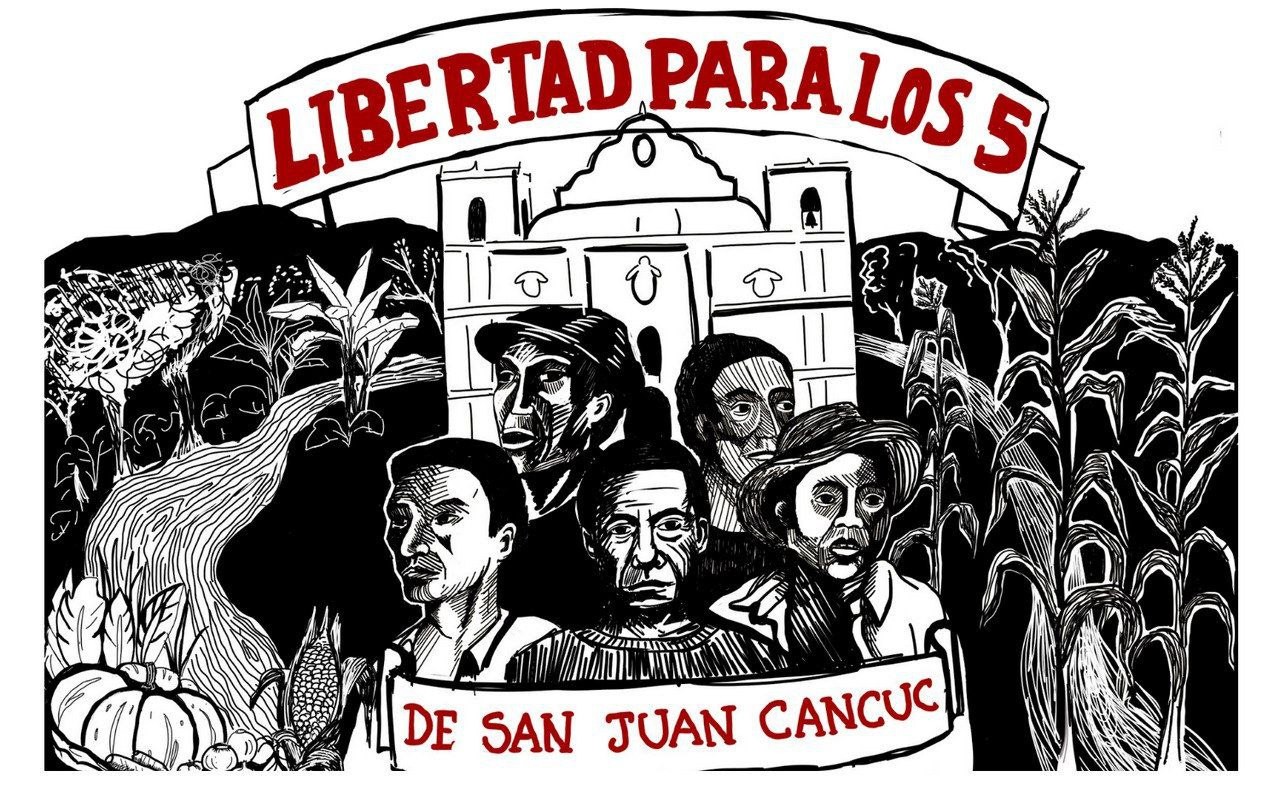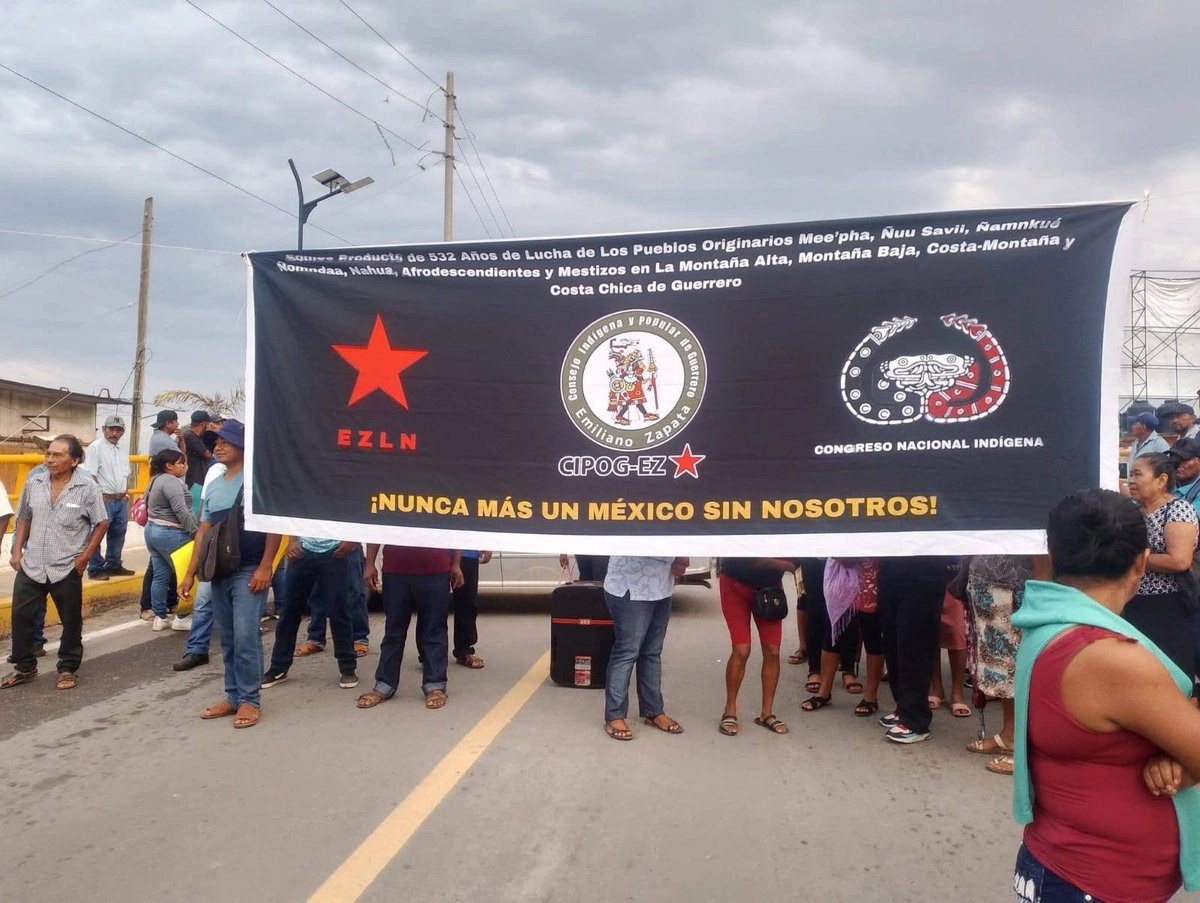
The San Juan Cancuc Five are free!

A statement from the Grupo de Trabajo No Estamos Todxs, originally published in Spanish and translated by Scott Campbell, on the release of the five Tzeltal political prisoners from San Juan Cancuc, Chiapas. Read more about their case here.

Valle de Jovel, November 21, 2025, from the territory called Mexico.

To all the compas that have accompanied the fight for the freedom of our imprisoned compañeros from San Juan Cancuc.

To their relatives and our five formerly imprisoned compañeros from San Juan Cancuc, to them above all.

For more than three years, we have had the enormous opportunity to accompany our imprisoned compañeros. Years of talks, of hugs, of seeing them and knowing them, of their dreams and their hopes. Above all, of their dignified demand for justice and freedom.

Today, in this land where injustice has become the norm, but resistance and dignified rage have also become a permanent condition. Today, dawn brought with it a rumor that turned into a cry and then a song: our five compañeros from San Juan Cancuc are free.

Free, but not due to the goodwill of the bad government, but due to the dignified stubbornness of their families, of their community, and of all the hands and hearts that, from so many corners of the world, did not stop fighting against the machinery that manufactures guilt.

Continue reading

Freedom for the prisoners from San Juan Cancuc, Chiapas

Originally posted on It’s Going Down.

UPDATE: On November 21, 2025, a court ordered the immediate release of the five imprisoned compañeros from San Juan Cancuc. Read a statement regarding their release here.

The text below provides an overview of the case of five imprisoned Tzeltal land defenders from San Juan Cancuc, Chiapas, and how they can be supported during a crucial moment in the fight for their freedom.

The Context

San Juan Cancuc is an Indigenous Tzeltal municipality in the highlands of Chiapas located about halfway between the popular tourist destinations of San Cristóbal de Las Casas and the Cascadas de Agua Azul. For more than 20 years, the federal and state governments have been attempting to “develop” the region via the construction of a superhighway, called the Highway of Cultures. This highway would connect the coast of Chiapas in the west – where the Interoceanic Corridor will pass – with the highlands and jungle regions of the east – where they Maya Train will pass. With neoliberal development comes militarization, and attempts have been underway to construct a National Guard base near San Juan Cancuc. Since coming to power in 2018, the MORENA party has accelerated these projects.

The proposed Highway of Cultures is to pass through San Juan Cancuc and the State has put pressure on the municipality to agree to the construction – including withholding social programs. In repeated community assemblies, the residents of the municipality and neighboring communities have rejected both construction of the superhighway and the National Guard base.

Continue reading

Statement on the Occasion of the 15th Anniversary of the Murder of Bety Cariño and Jyri Jaakkola

Originally posted on It’s Going Down.

On April 27, 2010, a solidarity and mutual aid caravan to the besieged autonomous Triqui municipality of San Juan Copala left the city of Oaxaca. Along the way, it was ambushed by government-backed paramilitaries belonging to UBISORT (Union for the Social Well-Being of the Triqui Region). The paramilitaries killed Mixtec organizer Bety Cariño and Finnish solidarity activist Jyri Jaakkola and wounded several others. The following statement marks 15 years since the murders. It was translated by Scott Campbell.

To the media
To national and international public opinion
To social, solidarity, and human rights organizations
To the National Indigenous Congress and the Indigenous Governing Council
To the Zapatista Army of National Liberation
To the Indigenous peoples of Mexico and the world

On the occasion of the 15th anniversary of the murder of Bety Cariño and Jyri Jaakkola:

Today marks 15 years of impunity. Fifteen years since the murder of Bety and Jyri. And, faithful to custom – and the necessary stubbornness of keeping memory alive – we return to this date with the same wounded but unshakeable dignity.

In this digital era, our compañeros have been converted into a QR code, a WhatsApp message, an app, a song, a video that travels the world, a worn photo, a graphic exhibition. But they are not only that: they are a voice that resists in time, in the memory of those of us who refuse to forget.

In these 15 years, we have traveled the entire alphabet – from A to Z – going to every corner where it was possible for us to be, asking for justice. Sometimes we found a warm space, a friendly face that knew how to listen to what should be Justice; but most of the time we only found the eternal bureaucracy, the lie, the indifference. The sidewalks were our place of dialogue, our classrooms, our public plazas: in hunger strikes, in marches, in blockades, in endless waits before public officials and “authorities” of any level. We never expected anything from them. And time has only confirmed that institutional justice in Mexico is a failure.

Continue reading

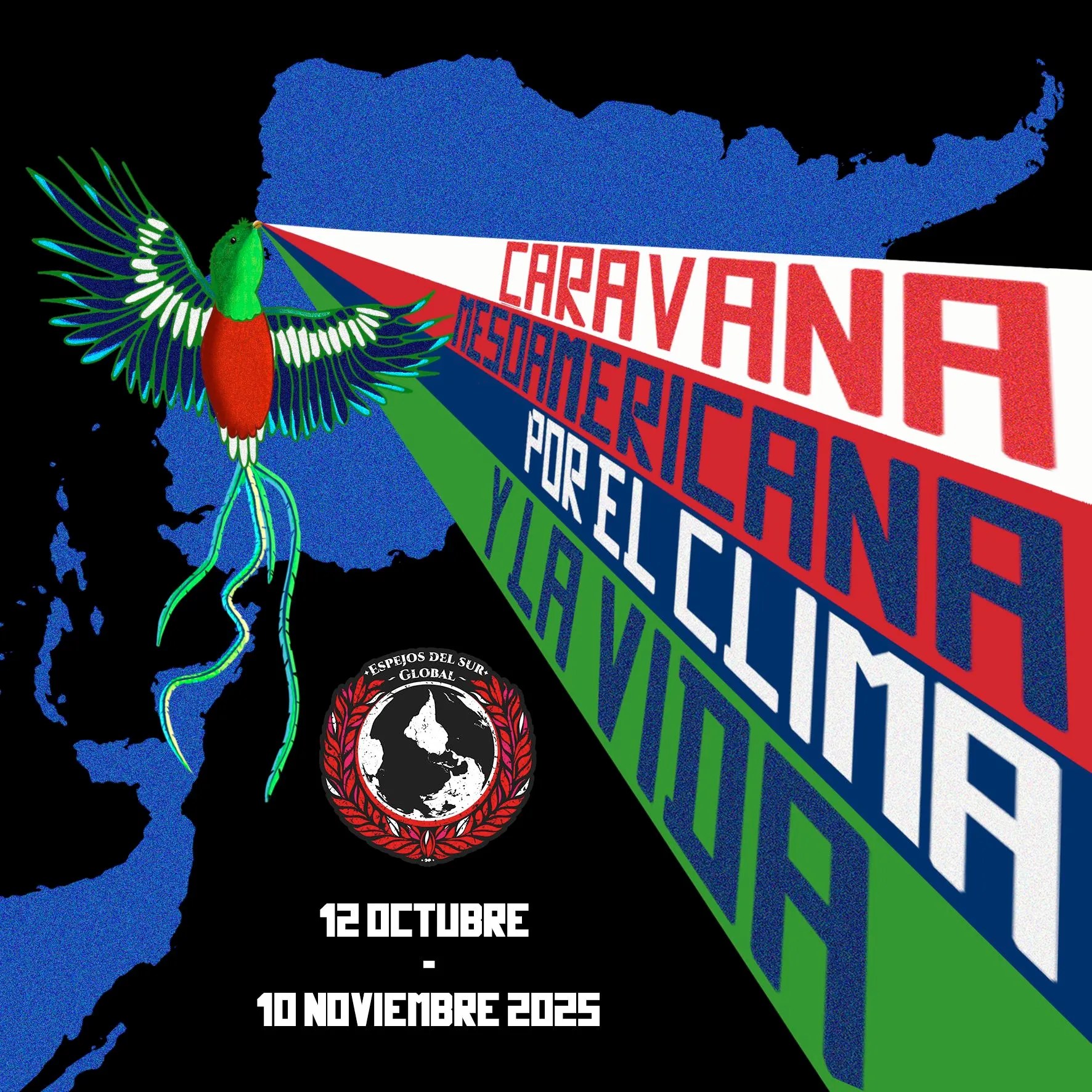
First Call for the Mesoamerican Caravan for the Climate and Life

Originally published on It’s Going Down.

A call to participate in a caravan traveling from Mexico to Brazil organized by Indigenous and campesino social movements to take place later this year. Published in Spanish on the Centro de Medios Libres and translated by Scott Campbell.

To all the struggles, peoples, and movements of Mesoamerica, Abya Yala, and the Global South:

The climate crisis advances unstoppably, and with it, the devastation of our territories, our cultures, and our very lives. Dispossession, extractive megaprojects, and structural violence stalk us with greater intensity every day. In the face of this planetary emergency, we respond with unity, resistance, and hope.

This caravan will be a space of encounter and mobilization for the peoples and communities that fight in defense of Mother Earth and of territories. We will unite our voices and forces to resist violence, make visible the biodiversity and cultural plurality of our peoples, and denounce the financial system that perpetuates destruction and dispossession.

The caravan will leave from the Mexican southeast, passing through Guatemala, El Salvador, Honduras, Costa Rica, Panama, Colombia, Ecuador and will arrive in Belém, Brazil, where we will raise our voice in the framework of the UN Conference on Climate Change (COP30) and in the midst of this Civilizational Crisis that threatens our future with global collapse.

Continue reading

Raffle in Solidarity with Indigenous Anarchist Miguel Peralta

For more information about Miguel Peralta and the persecution he has been facing for the past decade, read this update from his support group.

Note: If you are located in what is called the United States and would like to participate in the raffle, Miguel’s support crew welcomes your participation! Please contact me for more information. The suggested price of the raffle ticket is $50 MXN ($2.50 USD), but you are welcome to contribute more if you would like. Prize winners will be responsible for covering shipping costs and will not be eligible for prizes that contain perishable items. A continually updated list of prizes can be found on the event’s Facebook page.

As you know, the case of Miguel Peralta Betanzos and the persecution and repression that his community, Eloxochitlán de Flores Magón, is experiencing, have been going on for more than ten years.

After years of imprisonment, hunger strikes, legal games, going back and forth in court at different judicial levels, etc., Miguel Peralta’s case reached the Supreme Court, which represented the possibility of putting an end to his persecution and obtaining his full and absolute freedom. However, things were not as favorable as one might think, and on November 6, the Supreme Court issued a resolution in which it limited itself to recommending that the Collegiate Court of the City of Oaxaca make review of Miguel’s case from an intercultural perspective. With this, the case returned to those instances, which are far from his community, family, legal team and support group.

Continue reading

Gaza Solidarity Encampments on Occupied Land

The above map and following essay are from a project produced for a course I took last semester. As it may be of some relevance or utility, I have chosen to post it here. As always, thoughts, critiques, and feedback is welcomed.

The map accompanying this essay attempts to situate via multiple data points the location of Gaza Solidarity Encampments installed on the campuses of colleges and universities during April and May 2024 in what is demarcated as Los Angeles County. In particular, it seeks to raise the question of the implications of the taking of space in solidarity with an Indigenous struggle for liberation in Palestine on land that itself was ethnically cleansed and genocided of most of its Indigenous inhabitants. To do so, it first notes the identities and territories of the original populations of what is now Los Angeles County: the Tongva, Kizh, and Chumash peoples. Upon that is layered the colonial infrastructure and place designations to orient the gaze from a settler lens with the intention of inspiring reflection on the imposition of settler colonialism and belonging in space. If the colonial place names were absent, would the viewer’s familiarity with the area change? Finally, using tent icons, the map indicates the approximate location of the five Gaza Solidarity Encampments in the area that were erected in April and May 2024, along with the identification of the college or university, the name given to the encampment by those involved, and the Indigenous lands upon which the encampment was placed. The intention of the map is not to condemn nor to celebrate, but to problematize the conception of space in the context of resistance and to encourage the incorporation of a decolonial perspective in the work of protest.

Continue reading

Communal Government of Chilón, Chiapas: For the Defense of Life and Mother Earth

Originally posted on It’s Going Down.

A statement shared by the Communal Government of Chilón, Chiapas, following a march in the municipality, outlining their activities, concerns, and demands. It was published on Radio Zapatista and translated by Scott Campbell.

Chilón, Chiapas, on March 9, 2024

To the national and international organizations
To the original peoples of Mexico and the world
To the defenders of Indigenous and human rights
To the independent media
To the people in general 

We are the Communal Government of the municipality of Chilón, belonging to the original Tzeltal people. Our struggle began more than six years ago with the objective of creating an alternative path to that of the system of political parties. Today we conclude the visits to our 11 Attention Centers distributed throughout the municipality: Bachajpon, Palma Xanahil, Patwits, San Antonio Bulujib, Ch’ich’, Ahlan Sac Hun, Lázaro Cárdenas, Pamanabil, Sacun Palma, San Jerónimo T’ulih’a and Chilón, where we held 11 assemblies in which we had the opportunity to listen to our people and to inform them about our proposal for struggle and for life.

With pain and indignation, we listened to the various problems that the communities continue living through, and how our brothers and sisters are facing them. We note that the clandestine sale of alcohol and drugs has increased in the communities, which has caused the deaths of innocents and the destruction of families. We warn with concern about the increase in organized crimes cells and their collusion with the political party system. Election year has begun and the political campaigns have already shown their corrupt ways, going so far as to hand out alcohol at their events, intoxicating and manipulating the public. We said it from the start and we repeat it: political parties split, divide, and subjugate the people.

Continue reading

Colonialism and Yaqui Resistance

Family members of ten community members of Loma de Bácum who were disappeared on July 14, 2021, hold up images of their missing loved ones.

The following is an English-language translation of a brief essay I wrote for a course I am taking called Epistemologías del Sur. As I dislike the academic practice of creating work that doesn’t go beyond the classroom, I’m publishing it here in case it might be of any use or interest. For the latest information on Fidencio Aldama and his case, see this recently published statement.

For the past several years, part of my work has been as a member of the Fidencio Aldama Support Group. A small, binational collective of individuals in what they call the United States and Mexico, we work through a variety of means to advocate for the immediate release of Yaqui political prisoner Fidencio Aldama and to support him and his family during his imprisonment. Currently serving a 14-year sentence for a homicide he did not commit, Fidencio’s incarceration is rooted in his and his community of Loma de Bácum’s steadfast resistance to the imposition of a natural gas pipeline through their territory. Echoes of the arguments put forward by the epistemologies from the South in this course can be easily identified through the lenses of Fidencio’s case and the centuries-long tradition of Yaqui resistance and self-defense.

Continue reading

Podcast on Fidencio Aldama and Miguel Peralta

On the most recent It’s Going Down podcast, a compa and I discuss the cases of Indigenous political prisoner Fidencio Aldama and politically persecuted Indigenous anarchist Miguel Peralta in so-called Mexico. We also touch on topics such as migration and neoliberal megaprojects. Have a listen here!

Interview with Freed Indigenous Political Prisoner José Antonio Arreola of Nahuatzen

Originally posted on It’s Going Down.

La versión original de esta entrevista en español puede encontrarse aquí.

The following is an interview with José Antonio Arreola, a former political prisoner released after serving more than three years of a seven-year sentence based on trumped-up charges. He is a member of the autonomous Indigenous Citizens’ Council of Nahuatzen, a P’urhépecha community in Michoacán. A previous interview with José Antonio can be read here.

After more than three years in prison, you won your freedom on February 9, when the Supreme Court ordered your immediate release. Congratulations on this victory. How are you doing? How does it feel to be back home?

I feel very happy, I feel very glad to now be with my children, with my wife, with all my family there in my community of Nahuatzen.

For those who are unfamiliar with your case, can you share some background on the struggle in Nahuatzen and the events that led to your political imprisonment?

The reason why I ended up in prison, being a political prisoner, is because of the following. In 2015, Nahuatzen rose up against the insecurity that the municipal government had been causing since its inception. An insecurity throughout the entire community. The residents, when they saw that organized crime came for some compañeros and took one of them, got together. We all gathered in the main square in our community and decided at that moment that the plan to follow was to meet with the entire municipal government in the municipal president’s office and to be able to ask for information about our compañero. The situation ended, thank God, with us recovering our compañero.

We called for a plebiscite through a statement read through the public address system in our community, where each person was asked to voluntarily come and sign sheets of paper with their name and a copy of their ID. I can tell you that nearly 5,000 signatures were collected out of the 5,000 photocopies. That is why, in 2017, we won a ruling from the Supreme Court, order 035, which resolved that we are an Indigenous community, that gave us our autonomy, our self-government, our self-determination. Subsequently, we filed another lawsuit to obtain the resources directed to our community, which was also granted to us by the Supreme Court through the Toluca regional court.

Continue reading