“The struggle occurs in a given territory, with very specific characteristics, with very specific enemies and their particularities, to know all these elements is our responsibility.”
It is time to deepen the struggle against the state, against capital, and against the forms they use to continue to perfect their means of dominion over us. Different materials for spreading information and reflection have been developed in recent times. Blogs, magazines, newspapers and countless other materials have been produced by compañeros with different contours but with the same intention: to contribute to the social war from an anti-authoritarian and offensive perspective.
I’m excited to share news about the launch of a new microsite on the San Quintín rebellion in Mexico published by Regeneración Radio to which I contributed the translation from the Spanish original. Below are excerpts from the site. I strongly encourage you to visit the full site. It’s worth it.
The strawberry harvest was approaching and thousands of farmworkers were preparing to shut down the Transpeninsular Highway on March 17, 2015. There was no turning back. Two years earlier, a slogan had spread like a dust cloud throughout all of San Quintín Valley: fair wages. And between the rows, there where celery, squash, greens, chile, beet, cucumber, tomato, strawberry, blackberry and raspberry are planted to be sent to the other side of the border, there was already talk of a “crazy idea”: they had to rise up.
For Gloria, the movement has changed her life. Before March 17, she wasn’t aware that a strike was being planned for the entire valley. But that day she arrived at the school where she works as a teacher and the classes had been suspended. “I went back to bed. Later they told me: ‘there’s a movement and the highways, the banks are closed.’ I left and there was no one in town. I walked until I reached a group of people and approached a lady who was at the front. She told me that they were denouncing, as farmworkers, the injustices and the violations of their rights. She said to me: ‘Don’t stay silent, child, you have to speak, wherever you are, you have to speak.’” A mountain of memories came over her and she joined in the fury.
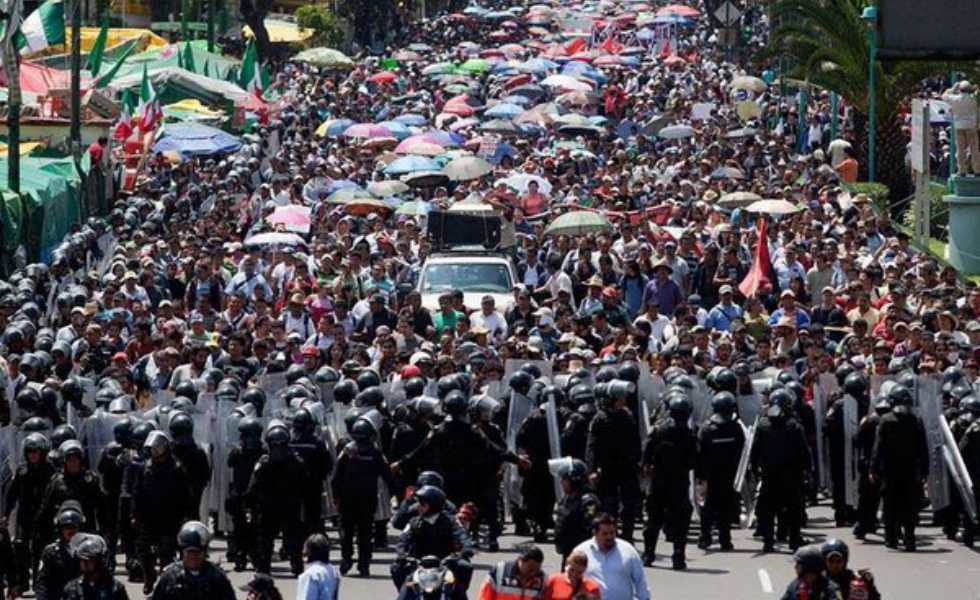
The last edition of Insumisión started with news of the national teachers strike in Mexico and that’s where we’ll kick things off here. It’s been an intense fifteen days since the National Coordinating Body of Education Workers (CNTE) began an indefinite strike on May 15, primarily against plans by Mexican President Enrique Peña Nieto to implement neoliberal reforms to the country’s education system.
Since being selected as president in 2012, Peña Nieto has attempted to privatize and standardize the Mexican education system, along with instituting policies to disempower Latin America’s largest union, the National Union of Education Workers (SNTE), and its dissident and more radical faction, the CNTE. In 2013, the CNTE mobilized its base to fight back against similar reform efforts. An article I wrote then gives some context to the developments occurring now, as well as clarifying the distinctions between the SNTE, the CNTE, and their relationships to the state.
As the violence and repression instigated, permitted and perpetrated by the Mexican State continues to grow, it can become overwhelming to summarize it in these pages in a way that does justice to the victims and survivors of state terror and impunity. Yet as the grim tallies multiply and impact more and more lives, so does the clarity that what the state offers even in its best moments is no solution at all, and from that point resistance flourishes. The sparks of refusal and defiance despite the odds ignite around the country, making meaning out of that which seems so senseless, breathing reclaimed life into a panorama of death. As América del Valle of Atenco said earlier this month, “Even with everything they did to us, we don’t come here today as martyrs. We don’t come to cry…We’ve come here to say NO!” Lxs insumxs. Let’s see what they’ve been up to over the past two weeks.
As I came home from work on Thursday, I could see one of my roommates on the phone at the other end of the house, waving me towards him, a look of concern and distress in his eyes. We went outside, where he shared what had happened a few minutes prior. He, who I’ll call L, had just had a bizarre interaction with our other roommate, who I’ll call M. (I’ve changed the identities, left out specifics and received M’s permission before posting this.)
M had all of the sudden begun speaking incoherent non-sequiturs to L and locked herself in her room. He didn’t know what was going on and didn’t know what to do. What followed was a four-hour series of events where I tried to assist someone experiencing a severe mental health crisis while encountering my own unfitness to do so and the frustration at a lack of safe options available.
Happy May Day! Around Mexico today numerous marches will be held, primarily organized by the National Education Workers Union (SNTE) and its more radical tendency, the National Education Workers Coordinating Body (CNTE). A few of the demonstrations are listed on It’s Going Down’sroundup of May Day actions. These marches are usually large, as the teachers union requires their members to show up. That extra incentive probably isn’t needed this year, as the teachers are fed up with the state’s repression and attacks on public education. The CNTE has already announced an indefinite national strike for May 15, and as a warm- up held the largest march in its 37-year history in Tuxtla Gutiérrez, Chiapas on April 22. Stretching more than three miles with 100,000 participants, the march was in response to the repression faced by teachers there the week before. While the CNTE base has consistently demonstrated its militancy, the leadership remains stuck in the politics of respectability, as demonstrated during the April 22 march when they ordered that “no one should commit acts of vandalism and that anyone caught would be detained; that no one would be masked or cover their face.” The gap between the two seems likely only to widen as the union’s actions intensify.
When it comes to teachers and protests, fresh on everyone’s mind is Ayotzinapa. When it comes to a relentless dedication to preserving impunity at all costs, the Mexican state is quite impressive. This was on full display last week as the Interdisciplinary Group of Independent Experts (GIEI) sent by the Inter-American Court of Human Rights (CIDH) released its final 600-page report in a four-hour press conference on April 24. The GIEI’s mandate was cut short by the CIDH following the Mexican government’s consistent harassment, subterfuge and non-cooperation. “The experts assured that the authorities have not followed key lines of investigation, evidence has been manipulated, obstructed and investigative work rejected, officials that would have participated in the disappearance protected, and alleged suspects tortured to obtain confessions that support the government’s version.” The details are too expansive to explore here, but the short version is that the GIEI found the students were under surveillance, the attack on them was recorded and coordinated among local and state police and the army, and that the head of the Criminal Investigations Agency (akin to the FBI in the US) had a personal role in manipulating evidence and illegally detaining and torturing someone who later “confessed” to involvement in the disappearance.
One of the most insidious aspects of addiction is that it’s a disease which convinces you that you don’t have it. It manifests in a powerful form of denial. Ask a person with addiction why they drink or use and the answer will rarely be, “Because I’m an addict.” Invariably the reply will pin the cause on a certain circumstance, person or event, or just “because I want to, I can stop anytime, leave me alone.” For the addict, the few times drinking or using didn’t lead to things getting out of control, or to a series of unintended consequences, are firmly grasped onto and elevated as proof that one doesn’t have a problem. The mountain of evidence to the contrary is swept out of mind. When things go awry they are presented as aberrations instead of what they are, which is the norm. Desperate to prove to ourselves and others that we’ve got things under control, we repeatedly pick up again, convinced that this time it will be different. It never is. And the cycle continues on its ruinous spiral.
Several victories for social movements in Mexico were recounted in the Insumisión posted on March 17. This edition focuses on the state’s response, which in the first part of April has been expressed through two of the state’s inherent qualities: force and coercion.
One of the victories mentioned was that of the Otomí community of San Francisco Xochicuautla in the State of Mexico. After years of organizing, in February a court suspended the expropriation decree issued by the federal government for a highway to be built through their forest and town. The community celebrated, but in a case of foreshadowing, said they would not rest until the entire highway project was canceled. The state emphatically made clear that the project was still on, when on April 11th it besieged and invaded the town with 800 to 1,000 riot police. In complete disregard for the court ruling, the police escorted in heavy machinery belonging to Grupo Higa (the owner of which is a close friend of Mexican President Enrique Peña Nieto), that began clearing land for the highway and also demolished the home of one of the movement’s leaders. The solidarity extended to Xochicuautla was powerful and immediate, which included the Zapatistas and the National Indigenous Congress issuing a “Maximum Alert” both for Xochicuautla and Ostula in Michoacán, due to an ambush against the Community Police of that autonomous Nahua community, which killed one. This seemed to catch the state off-guard, as on April 13 they ordered the construction be stopped and promised to pay for the damages. But they also said they would be leaving a number of state police nearby to guard the machinery in the meantime. In response, the community has organized 24-hour patrols in case of renewed construction, and the situation remains tense.
The Civic Council of Popular and Indigenous Organizations of Honduras (COPINH) reports, communicates and denounces the following:
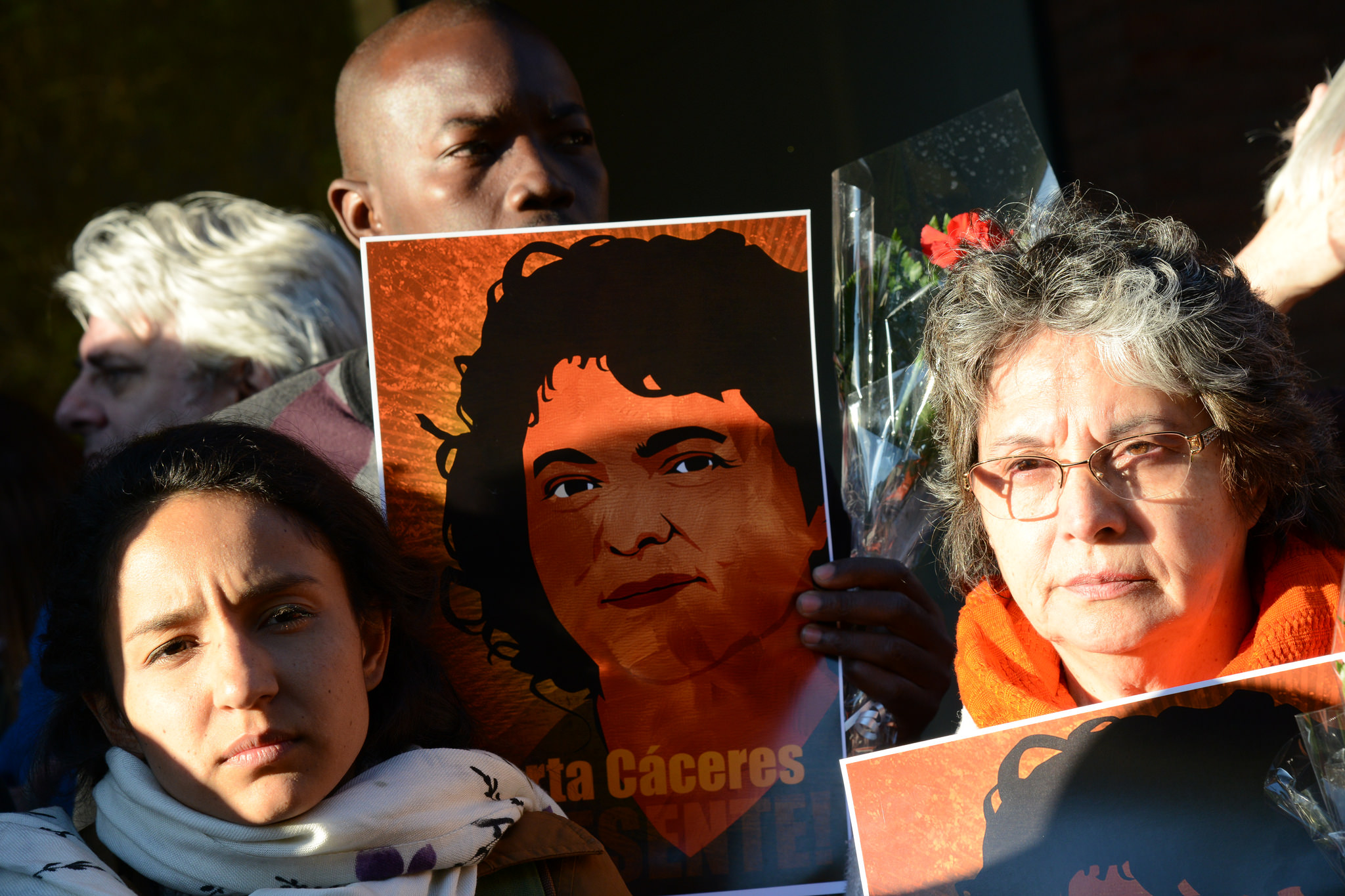
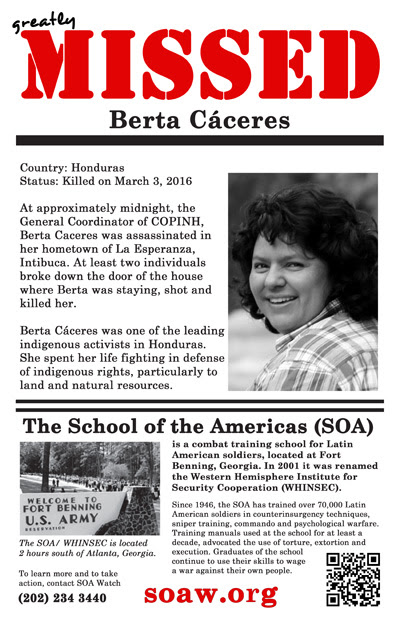
We appreciate the national and international solidarity for an objective, impartial and non-racist investigation that clarifies the facts around the political assassination of our compañera and General Coordinator, Berta Cáceres, and leads to the truth and to justice, with the true material and intellectual authors of the murder being subjected to the law, as well as learning the facts and motives by which her murder was planned and carried out, however, we reiterate that the State of Honduras continues to fail to fulfill its obligations in this respect. Not accepting our requests, such as for an independent international investigative commission that has the trust of our organization, are the reasons for which we haven’t trusted, don’t trust and never will trust in the national laws and for which we denounce our country’s legal authorities’ manipulation of the investigation into the vile and horrendous murder of our compañera Berta Cáceres. And that Mr. Juan Orlando Hernandez has not shown the political will to speed up the investigative process and one month after the murder, neither the compañera’s relatives nor COPINH have received an official report on behalf of the government about how the investigation is proceeding into identifying the material and intellectual perpetrators.
Translator’s note: On April 1, Gustavo Castro was permitted by the Honduran government to leave the country and is now back in Mexico.
COPINH
March 29, 2016
Translated by Scott Campbell
Relatives of Berta Cáceres report that the Attorney General is protecting the murderers. There are economic ties between the coordinator of the prosecution and DESA’s lawyers [the company behind the Agua Zarca dam]. They claim that the Honduran State knew of the plan to murder indigenous leader Berta Cáceres.
Public Letter
President of the Republic, Juan Orlando Hernández,
Attorney General of the Republic, Oscar Chinchilla,
The relatives of Berta Cáceres, the COPINH [Civic Council of Popular and Indigenous Organizations of Honduras], the Platform of Social and Popular Movements of Honduras (PMSPH) and the Popular Coordination Berta Cáceres, for the ears of Honduran society and the international community, we are writing you to express and demand the following:

 Originally published on It’s Going Down.