The following piece by Erika Lozano, published by Desinformémonos and translated by Scott Campbell, discusses the hunger strike started by women from Eloxochitlán de Flores Magón, Oaxaca, demanding the release of seven political prisoners from the community.
Mazatec women encamped in front of the Federal Judiciary Council in Mexico City to demand the release of their relatives after seven years in prison. Argelia Betanzos, Bertha Reynosa and Carmela Bonfil, from Eloxochitlán, Oaxaca, demanded a meeting with the president of the council, Arturo Zaldívar Lelo de Larrea.
“What brings us here is desperation, since the innocence of our family members has been proven by legal evidence, as has the fabrication of the crimes of which they are accused,” explained Betanzos during an interview. She is the daughter of prisoner Jaime Betanzos Fuentes, and she started a hunger strike on Tuesday, May 25, stating she will not leave until she has an answer. She also denounced that “using the pandemic as a pretext,” there has been no progress in the case on the part of Oaxacan authorities.
On Tuesday, May 18, around 120 students from the Mactumactzá Rural Normal School blockaded the Chiapa de Corzo-San Cristóbal highway in Chiapas, Mexico. The students were protesting changes to the admissions process to the school that would disadvantage working class, rural and Indigenous students. Seen as an attempt to change the makeup of the student body or as a step towards closing the school (which has already been closed four times by the Mexican state), students took to the streets, along with others who joined in solidarity.
#Chiapas, Mexico. More than 200 students from the Rural Normal School #Mactumatzá were detained by state police this morning. Most of their whereabouts are still unknown. Students were protesting for better access to publc education! We’re calling for international solidarity! ❤️ pic.twitter.com/xoHPaQhqll
In response, Chiapas State Police brutally attacked the blockade, firing tear gas and beating students with batons. In total, 95 people were arrested, 74 women and 19 men, all but two of them students. All 95 were moved to the high-security prison of El Amate. During the course of the arrests and transfer, the women students were forced to strip naked and were sexually assaulted by police. All those arrested are facing charges of rioting with a gang enhancement, violent robbery, damages, and attacks on the public peace and the bodily and cultural integrity of the state.
Above is an interview/conversation I had with Daniel for his D Report podcast. We discussed the case of Yaqui political prisoner Fidencio Aldama, the history of Yaqui resistance in defense of their territory, settler colonialism, and racialized neoliberal extractivist capitalism. For more details on the podcast, please see Daniel’s post here.
A message from Yaqui political prisoner and land defender Fidencio Aldama from prison in Ciudad Obregón, Sonora, Mexico. Fidencio has been locked up since October 27, 2016 and is serving 15+ years for a crime he did not commit.
The following article, translated partially by me from the Spanish version on Pie de Página, looks at the women-led struggle against the passing of a U.S. company’s gas pipeline through Yaqui territory in so-called Mexico. It also touches on the case of Yaqui political prisoner Fidencio Aldama, serving a 15+ year sentence related to resistance to the pipeline. For more information on Fidencio, visit fidencioaldama.org.
Text: Daliri Oropeza and Reyna Haydee Ramirez Photos: Daliri Oropeza
The gas pipeline was already a foregone conclusion, at least that’s what the company, the subsidiary, and the government of Sonora thought. They were wrong. Yaqui women narrate how they have stopped this project.
Loma de Bácum, Sonora: A gigantic metal pipe can be seen at the bottom of a hole in the earth. The family of Carmen García look into the hole which was dug by the people of Loma de Bácum to remove the gas pipeline.
The people used an excavator they seized from the company IEnova, affiliate of the United States transnational, Sempra Energy. The company was building the gas pipeline without the approval of those who live there. A consultation was never carried out. So, after an assembly, the entire community went to where the pipeline was being laid. There, they excavated and cut out with a blowtorch nearly ten kilometers of pipeline, which they then took to Ciudad Obregón to sell as scrap metal.
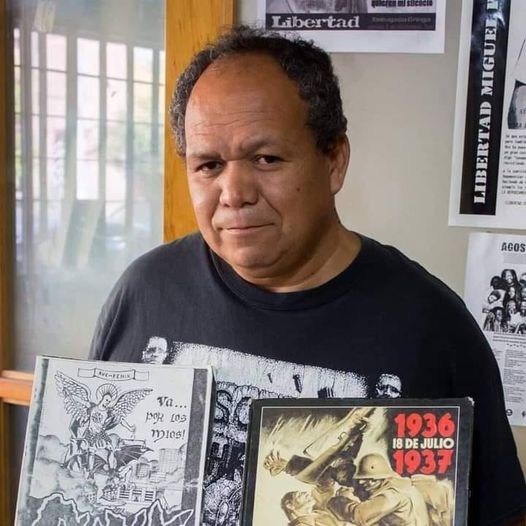
A translated statement from Noticias de Abajo and the Biblioteca Social Reconstruir (Social Reconstruction Library – an anarchist library and social space in Mexico City), on the passing of longtime anarchist organizer Tobi.
“…when I die, my friends may write on my grave: Here lies a dreamer, and my enemies: Here lies a madman. But there will be no one who dares engrave these words: Here lies a coward and traitor to his ideas.” – Ricardo Flores Magón
On January 10, 2021, we learned of the passing of anarchist compañero Tobi, one of those responsible for continuing the Biblioteca Social Reconstruir after the loss of Ricardo Mestre. Tobi was a social activist from the punk and anarchist movements who participated actively in the spreading and promotion of anarchist ideals.
We are sharing a message circulated by the Library regarding this moment of mourning for the worldwide anarchist movement, as well as video clips from “Workshopping Anarchy,” a project held at the Alicia Cultural Multiforum with the participation of the Library and other allies, in order to remember the feeling-thinking (sentipensar) of our dear friend Tobi.
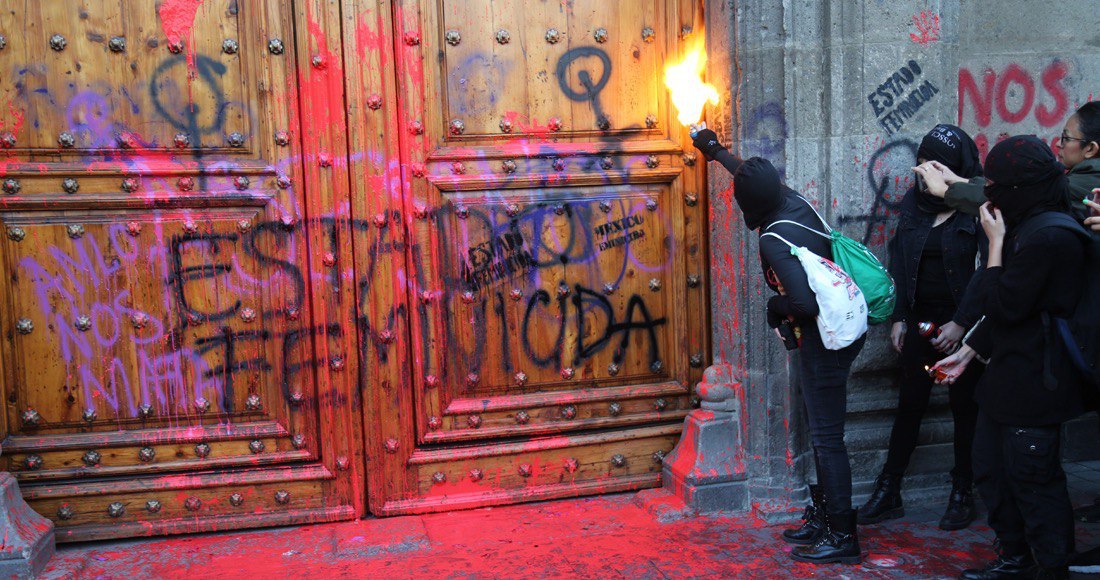
The following article, written by Afinidades Conspirativas and translated by Scott Campbell, examines the recent wave of feminist protests and actions throughout Mexico and the role of anarchism amidst these mobilizations. All footnotes and photo captions are from the original Spanish version, which can be found as a PDF here.
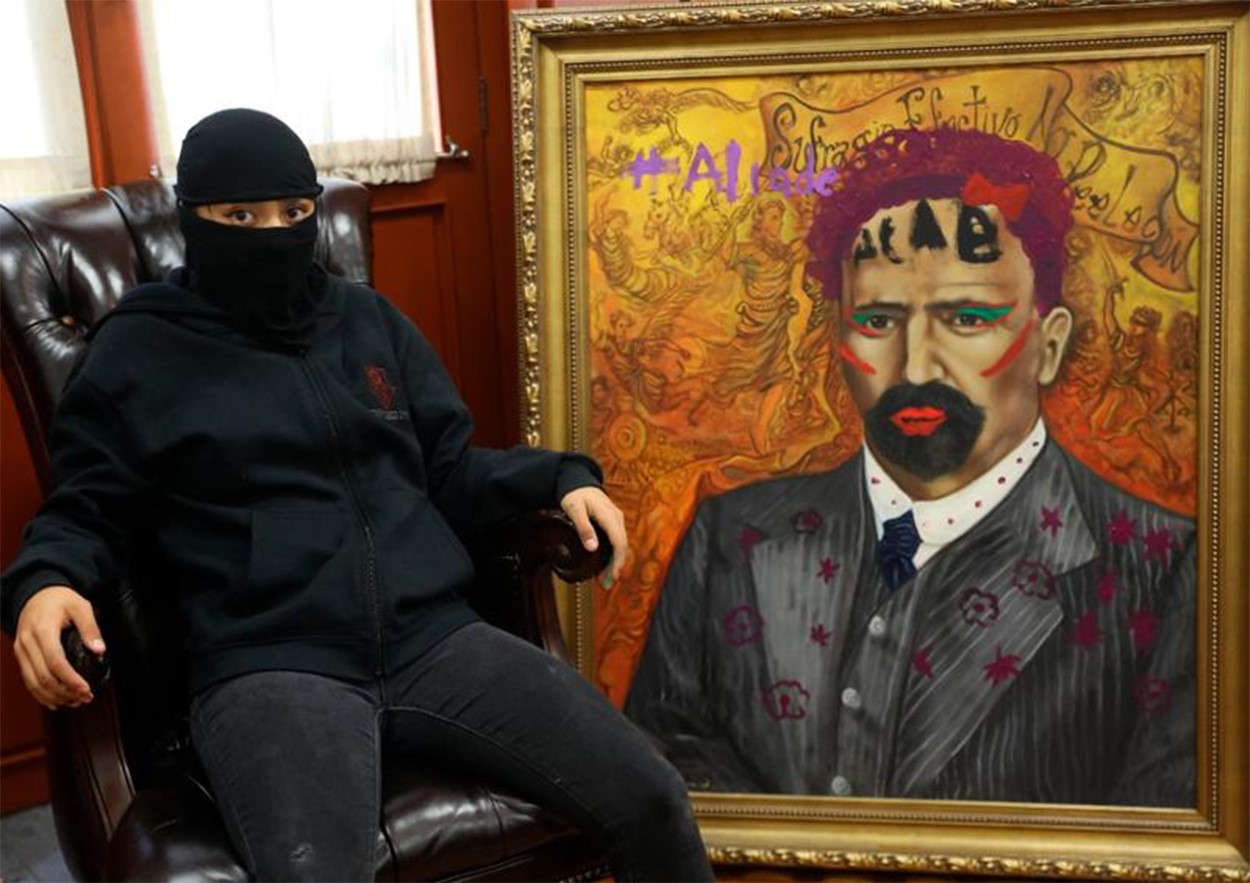
After this article was written, it cameto light that those involved in the occupation of the National Human Rights Commission (CNDH), in particular the Okupa Black Bloc, are trans-exclusionary radical feminists (TERF). IGD condemns the transphobic politics of those involved in the Not One Less Okupa. Given the scope and analysis of the article, we have decided to leave it up and encourage readers to keep this information in mind when reading the piece.
“You’re a big shot, drawing on my painting…I hope your action fixes everything” José Manuel Núñez A., painter of the Madero portrait[1]
“If I can’t dance, I don’t want to be part of your revolution” Emma Goldman
“If we can’t be violent, it’s not our revolution” Manada de lobxs [Pack of wolves]
The multiplicity of forms that anarchisms have taken in recent decades leads us to reexamine the tendencies and strategies that are reconfiguring themselves or emerging from these forms, as well as their influences on other struggles. Here it is necessary to distinguish a principle held among anarchisms that sets them apart from the liberal or leftist groups that are assumed to be anarchist. We could define this principle as an ethic that, created from an individuality in common, becomes an affront to any form of hierarchical power. As such, to understand anarchism today as an ideology would be a myopia that allows for the development of aberrations such as “anarchocapitalism” or an understanding of Zapatismo and of many forms of feminism as anarchist. Thinking about the latter, it would be worth remembering Emma Goldman, who ranted against the suffragettes of her time (the first wave of feminism), based on the understanding that freedom could not be achieved at the ballot box. Today’s feminisms are very diverse: there are the reformists with sympathy for the State, with authoritarian and essentialist views about the body; as well as others that are completely liberal, united under the banner of lacking a convincing critique against power; but also among them are some that come together under an anarchist ethic.
On this episode of the It’s Going Down podcast, IGD contributor Scott Campbell interviews Yunuen Torres, a community member from the autonomous P’urhépecha municipality of Cherán, Michoacán. More than nine years ago, on April 15, 2011, the residents of Cherán rose up and removed from their community illegal loggers linked to cartels, the municipal authorities, and the police. In the time since, they created an autonomous communal government where political power rests in the hands of the community and that has been designed to meet the needs of the more than 20,000 inhabitants of Cherán.
The conversation discusses the uprising and its context, how the communal government was formed and how it functions, the changes and challenges experienced in the community as a result of nine years of autonomy, as well as how Cherán is facing the COVID-19 pandemic, and what lessons and inspiration the community’s struggle may offer to other struggles and social movements in other locations.
The interview was conducted in Spanish and rerecorded in English. Many thanks to the comrade who offered their voice for this recording. The two music tracks included in this podcast are both from Cherán. The first is by Colectivo Aho and the second composed by music teacher Mario López and performed by the young musicians of the Banda Sinfónica Infantil y Juvenil Cherán K’eri. A transcript of the interview can be found below.
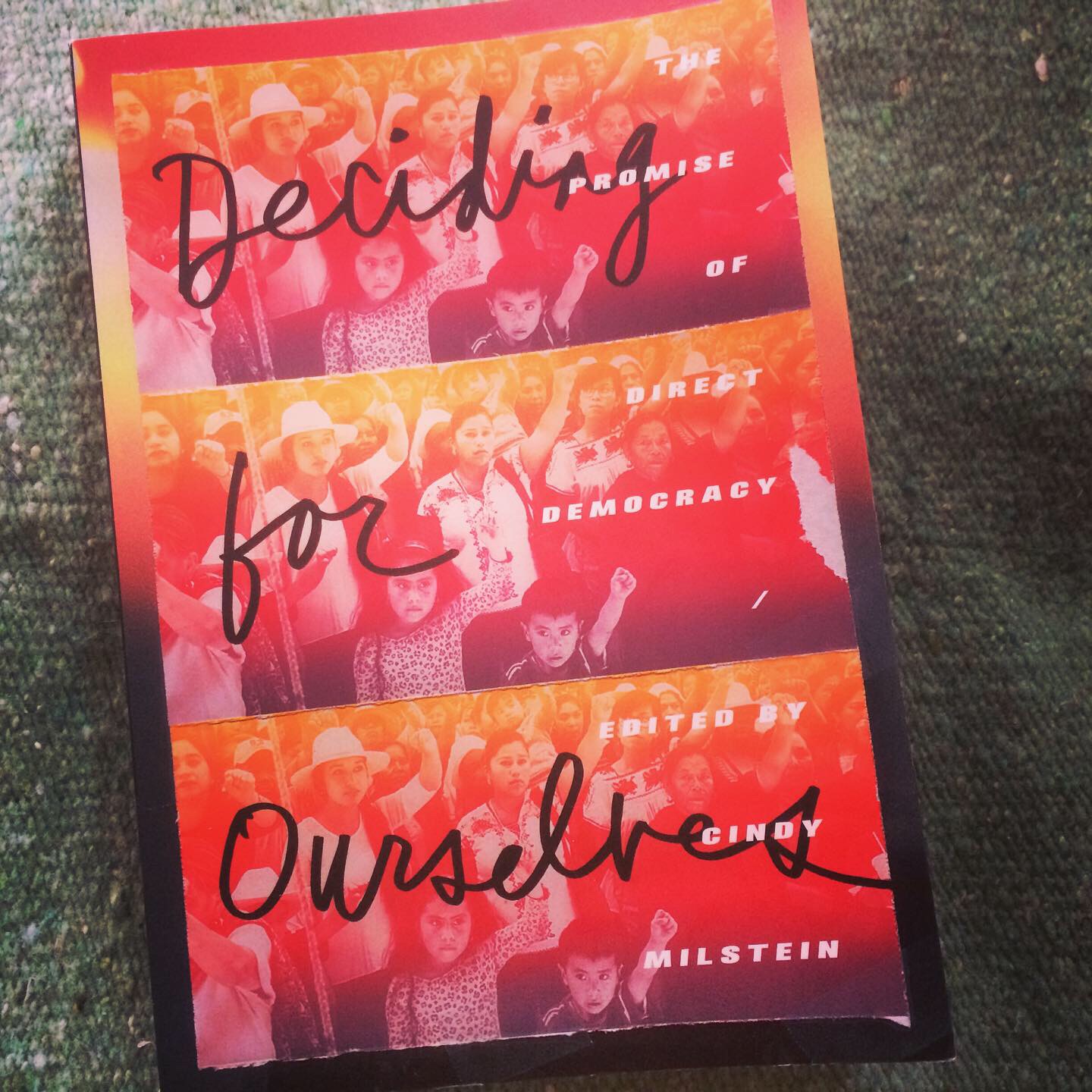
While it emerges in the midst of tragic and difficult circumstances, I am excited for the release of the anthology Deciding for Ourselves: The Promise of Direct Democracy, edited by Cindy Milstein and to which I contributed the chapter “The Bonfires of Autonomy in Cherán.” As we make our way through this time of loss and uncertainty and begin to think about what comes next, I hope it may offer some insight and inspiration.
It’s now available for a short time on a “Pay What You Can” basis from AK Press.
As the book description reads, “A better world through self-determination and self-governance is not only achievable. It is already happening in urban and rural communities around the world.” This is what Deciding for Ourselves dives into, a theme that couldn’t feel more pressing and necessary.
My contribution looks at the indigenous P’urhépecha municipality of Cherán, located in Michoacán, Mexico. For the past nine years, Cherán has operated under a form of autonomous communal government after a popular uprising removed cartels, local police, politicians and political parties from the area. While the story of the rebellion and its immediate aftermath have been well documented, the chapter takes an in-depth look at how the communal government functions and meets the daily needs of Cherán’s residents, why the government took the form that it did, and how life has changed and is experienced in a place where community and government are woven into a shared communal fabric.
If mutual aid, solidarity, autonomy, self-determination and collective liberation are ideas that interest or resonate with you, this book is worth picking up. And at up to 75% off, it’s a great deal that also helps support an independent radical publisher.
I want to pause and think about the correct words and also recognize the linguistic paralysis produced by the maelstrom of femicidal violence. Because this is not the first time the tsunami of immediacy has removed the possibility of stopping to reflect on the importance of choosing the words with which we form our discourse. And, I assume, I am not the only one who in the urgency to speak cannot even name what or how much it hurts while I try to reflect more deeply on what we are living through.
Among the feminist reflections sparked by the atrocious femicide of Ingrid Escamilla, there is one that barely resonates and is worth lifting up: we face the abandonment of being citizens of a femicidal state to which we continue to confer our security despite it repeatedly proving itself to be the very perpetrator of violence against women and the propagator of hatred against women.






 Falling Into Incandescence