Gaza Solidarity Encampments on Occupied Land

The above map and following essay are from a project produced for a course I took last semester. As it may be of some relevance or utility, I have chosen to post it here. As always, thoughts, critiques, and feedback is welcomed.

The map accompanying this essay attempts to situate via multiple data points the location of Gaza Solidarity Encampments installed on the campuses of colleges and universities during April and May 2024 in what is demarcated as Los Angeles County. In particular, it seeks to raise the question of the implications of the taking of space in solidarity with an Indigenous struggle for liberation in Palestine on land that itself was ethnically cleansed and genocided of most of its Indigenous inhabitants. To do so, it first notes the identities and territories of the original populations of what is now Los Angeles County: the Tongva, Kizh, and Chumash peoples. Upon that is layered the colonial infrastructure and place designations to orient the gaze from a settler lens with the intention of inspiring reflection on the imposition of settler colonialism and belonging in space. If the colonial place names were absent, would the viewer’s familiarity with the area change? Finally, using tent icons, the map indicates the approximate location of the five Gaza Solidarity Encampments in the area that were erected in April and May 2024, along with the identification of the college or university, the name given to the encampment by those involved, and the Indigenous lands upon which the encampment was placed. The intention of the map is not to condemn nor to celebrate, but to problematize the conception of space in the context of resistance and to encourage the incorporation of a decolonial perspective in the work of protest.

Continue reading
The Campus Movement and Academic Self-Management

Originally published on It’s Going Down.

As Israel’s brutal genocide against the Palestinian people and Palestine itself continues past the 200-day mark, students around the so-called United States have risen up and are carrying out occupations and erecting encampments on their campuses. These acts are extremely inspiring, militant, and hopeful – calling to mind the campus occupations from the early aughts, the student mobilizing against the war on Vietnam in the 1960s and protests against apartheid in South Africa in the 1980s. Breathless blather from politicians and the media have turned what are actions against genocide into a “controversy” that deftly manages to ignore the political content of what is currently unfolding across the country. As Samuel P. Catlin notes in his exceptional essay, “The Campus Does Not Exist”:

Campus panic is a sustained note in the American public conversation; from Vietnam to Gaza, it has never let up. Reliably, every few months something happens “on campus” that the media inflates to the status of a national emergency: a speaker is invited, a speaker is disinvited, a speaker is not disinvited, a professor teaches, a student complains, a protest takes place. The media offers these incidents as scandals so fascinating and disturbing that they eclipse even a genocide.

At the front of any conversation regarding what is happening on college campuses must be an acknowledgement of what the action is in response to: an ongoing, U.S.-facilitated genocide. It seems both absurd and necessary to note that what matters above all is the genocide. Students (and some faculty and staff) are taking tangible, direct action to pressure institutions complicit in the genocide into divesting and disassociating from that most atrocious of acts. That opposition to genocide has been successfully constructed as “controversial” in this country merely demonstrates the insipid nature of what passes for public discourse and the paucity of thought contained within it.

Continue reading

The Unexpected Consequences of Anarchy in relation to Feminism in Mexico

Originally published on It’s Going Down.

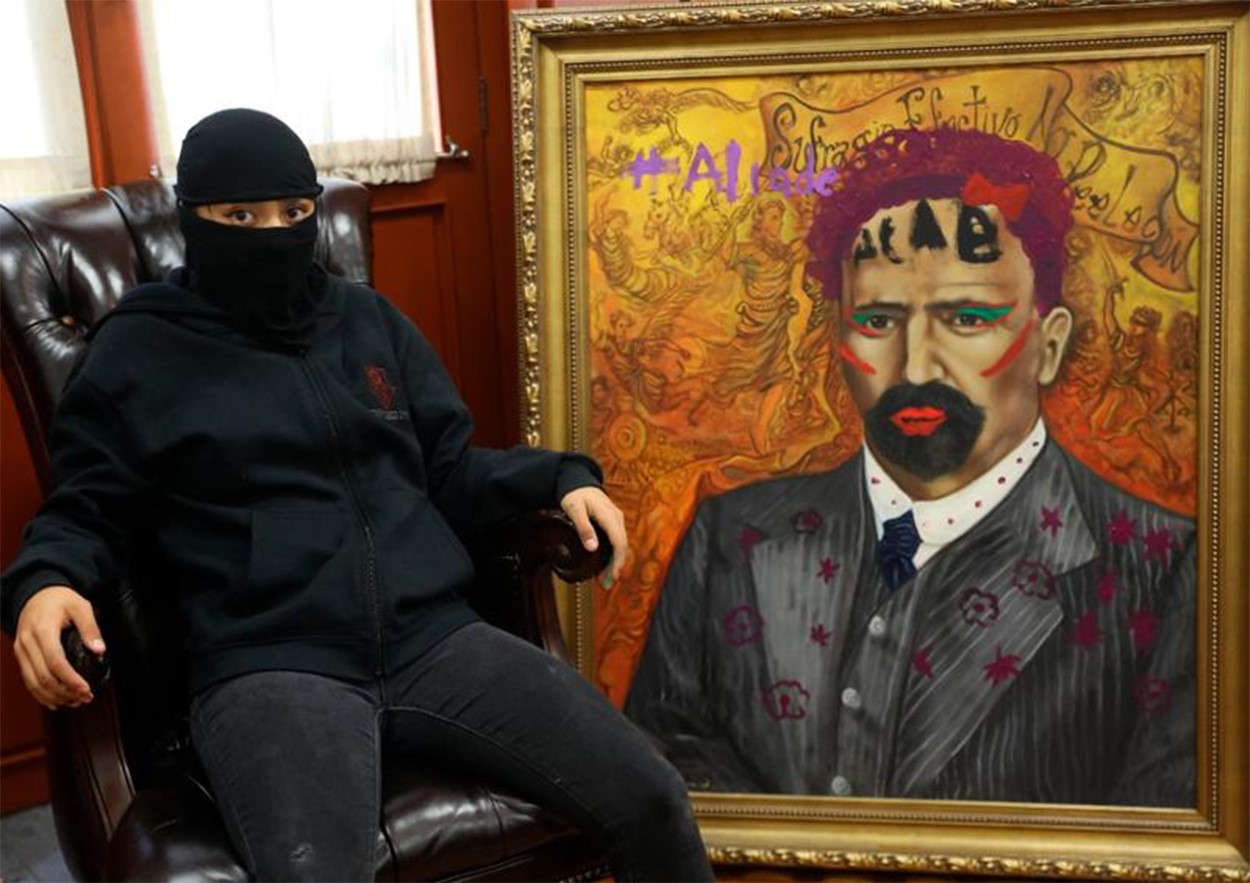
The following article, written by Afinidades Conspirativas and translated by Scott Campbell, examines the recent wave of feminist protests and actions throughout Mexico and the role of anarchism amidst these mobilizations. All footnotes and photo captions are from the original Spanish version, which can be found as a PDF here.

After this article was written, it came to light that those involved in the occupation of the National Human Rights Commission (CNDH), in particular the Okupa Black Bloc, are trans-exclusionary radical feminists (TERF). IGD condemns the transphobic politics of those involved in the Not One Less Okupa. Given the scope and analysis of the article, we have decided to leave it up and encourage readers to keep this information in mind when reading the piece.

“You’re a big shot, drawing on my painting…I hope your action fixes everything”
José Manuel Núñez A., painter of the Madero portrait[1]

“If I can’t dance, I don’t want to be part of your revolution”
Emma Goldman

“If we can’t be violent, it’s not our revolution”
Manada de lobxs [Pack of wolves]

The multiplicity of forms that anarchisms have taken in recent decades leads us to reexamine the tendencies and strategies that are reconfiguring themselves or emerging from these forms, as well as their influences on other struggles. Here it is necessary to distinguish a principle held among anarchisms that sets them apart from the liberal or leftist groups that are assumed to be anarchist. We could define this principle as an ethic that, created from an individuality in common, becomes an affront to any form of hierarchical power. As such, to understand anarchism today as an ideology would be a myopia that allows for the development of aberrations such as “anarchocapitalism” or an understanding of Zapatismo and of many forms of feminism as anarchist. Thinking about the latter, it would be worth remembering Emma Goldman, who ranted against the suffragettes of her time (the first wave of feminism), based on the understanding that freedom could not be achieved at the ballot box. Today’s feminisms are very diverse: there are the reformists with sympathy for the State, with authoritarian and essentialist views about the body; as well as others that are completely liberal, united under the banner of lacking a convincing critique against power; but also among them are some that come together under an anarchist ethic.

Continue reading

Growing Surge Joining May 31 Global Action Against the Militarization of Zapatista Territory

Originally posted on Avispa Midia

By Ñaní Pinto, Avispa Midia
Translated by Scott Campbell

With a sense of urgency, several collectives, organizations and adherents to the Sixth Declaration of the Lacandón Jungle, as well as support networks for the Indigenous Governing Council (CIG), met on May 9 to agree upon actions against the increased military and paramilitary presence in Zapatista territories.

The collectives also spoke out against the recent increase in attacks, including the killings of members of the National Indigenous Congress (CNI), particularly in the states of Guerrero and Oaxaca.

For these reasons, the organizations agreed to hold a Global Action on May 31 against the militarization of Zapatista territory and in defense of the land, territory and autonomy of the indigenous peoples and communities of the CIG-CNI.

Continue reading

Combative October 2: On the Institutionalization and Autonomy of Social Protest

combative-tlatelolco-march-feature

Originally posted to It’s Going Down
From Radio Zapote
Translated by Scott Campbell

Forty-eight years after the Tlatelolco massacre we continue demanding justice for the murdered, disappeared, persecuted, tortured, defamed, and imprisoned, as even though the killers and masterminds have not been tried and punished, those compañeros who fell in the militant struggle remain present in the popular and social struggles today as part of our memory, solidarity, guidance, dignity, strength, inspiration, rage and courage. Today, no one doubts that IT WAS THE MEXICAN STATE who planned and carried out that mass murder, just as it did with the disappearance of 43 teaching college students on September 26, 2014, as from Tlatelolco to Ayotzinapa one can trace a historical continuity that affirms the totalitarian character of the state that today we can characterize as “narco and terrorist.”

Continue reading

Insumisión: Schools Remain Closed as the State Amasses Forces of Repression

Originally posted on It’s Going Down
By Scott Campbell

As the strike against educational reform by teachers belonging to the National Coordinator of Education Workers (CNTE) in Mexico enters its fourth month, the conflict between the people and the neoliberal narcostate seems poised to take another turn, a potentially violent one. The government is running out of tricks, leaving the likelihood it will return to its old standby, state violence, all the more likely.

When the strike first began on May 15, the government’s tactic was to ignore the teachers, refusing to talk to them. As that failed and support for the teachers grew, it tried brute force, leading to the Nochixtlán massacre on June 19, a day when twelve were killed. That repression caused national outrage and succeeded in turning a teachers’ movement into a popular one. The government then offered up negotiations as a fig leaf, yet meeting after meeting made clear that the state had no actual interest in negotiating anything. The school year started in Mexico on Monday, August 22, but teachers remain on strike and schools have not opened in Oaxaca, Chiapas, Guerrero, Michoacán and parts of Mexico City.

Continue reading

In Oaxaca, Police Threatening the Relatives of those Killed by the State

police-student-blockade-oaxacaBy Renata Bessi and Santiago Navarro F.
June 29, 2016
Avispa Midia
Translated by Scott Campbell

It has been more than a week since the massacre of June 19, perpetrated by the Mexican state, who gave the order to the Federal Police to retake control of this state. There is still no justice. The toll continues to climb, 12 deaths recorded so far, dozens disappeared and at least 100 wounded by firearms. On top of dealing with the aftermath of the deaths, now the relatives of the dead and wounded are being threatened so they don’t take any legal action. This was reported by lawyers advising the families.

“There is fear because there have already been threats directed towards the families and the prisoners who were arrested. They even arrested twenty people who were in the municipal cemetery digging a grave to bury a family member who passed away on June 18 due to causes unrelated to this situation. They tortured them during transport and they were held in the state police barracks for more than two days and in the end they released them and told them to go, that nothing had happened. Things are not so simple,” said Mariana Arrellanes, a lawyer with Section 22 (of the teachers union) in Oaxaca.

Continue reading