Ayotzinapa and Palestine bleed on the same map

Originally published on It’s Going Down.

September 26, 2025, marks 11 years since the State attack on students from the Ayotzinapa Rural Normal School in Iguala, Guerrero, during which six people were killed, 25 wounded, and 43 students disappeared. The following is the transcript of a Spanish-language audio segment produced by Radio Cósmica Libre in collaboration with the efforts of Communicators for Palestine. It is based on information provided by Eduardo Ibañez from the Mexico City Encampment for the 43. It has been translated into English by Scott Campbell.

Mexico, September 26, 2014. Palestine, July 2014. Two dates that seem unrelated but that resonate with a shared echo.

That night in Iguala, 43 campesino students were uprooted from their dormitories, from their classrooms, from their dreams. That summer in Gaza, more than 2,000 Palestinian lives were taken in a matter of weeks by the military machinery of Israel. What connects a young normalista from Guerrero with a Palestinian girl who will never become a teenager? The answer is in the language of State violence, in the economy of death that connects the Mexican narco-state with Israeli necropolitics.

It is a long story. In Mexico, the rural normal schools emerged in the 1930s to educate the children of poor campesinos and to train teachers committed to their communities. In Palestine, the Nakba of 1948 inaugurated a life under occupation, dispossession, and forced displacement.

Two processes that appear distinct but that share the experience of peoples who were denied the right to exist in conditions of dignity. In 2014, the stories intersected. While Gaza suffered bombardments during July and August, students from the Ayotzinapa rural normal school went out into the streets of Mexico to protest in solidarity.

Just one month later, they themselves were victims of forced disappearance and murder in Iguala. The disappearance did not just erase bodies, it also condemned mothers, sisters, and wives to a life of interminable searching. State violence produces widows, orphans, mutilated families, communities condemned to permanent mourning.

State crime has no passport. Governments that kill in the name of security learn from one another. Necropolitics speaks many languages, but death always says the same thing: “You don’t matter.”

Continue reading

Marco Antonio Suástegui: The Warrior Lineage of the Yopes

Originally published on It’s Going Down.

The following article by Vidulfo Rosales Sierra, translated by Scott Campbell, pays tribute to Marco Antonio Suástegui, a longtime and well-respected community organizer in Guerrero, Mexico, who played a key role in the defeat of the neoliberal La Parota dam project. He was targeted by a gunman and shot eight times on April 18, passing away on April 25.

Marco Antonio Suástegui Muñoz, son of Pedro Suástegui Valeriano and Noelia Muñoz Rodríguez, campesinos from La Parota. The Suásteguis are the founders of the communal nucleus of Cacahuatepec, they and other families fought for the creation of communally held property. Later, other leaders would be coopted by the PRI members of the National Campesino Confederation (CNC), one of the cacique figures was Eduardo Valente Navidad. These corrupt leaders handed out commission positions and sold lands to the highest bidder.

In 2000, the federal government began to talk about several large-scale infrastructure projects. Airports and large dams to generate energy and provide water to cities and towns would be built. One of these was to be in Guerrero. It was La Parota hydroelectric dam. It would cover an area of 17,000 hectares and would be 190 meters high. It would cover the municipalities of Acapulco, San Marcos, and Juan R. Escudero. The reservoir would be used as a lake for ecotourism. The bay of Acapulco would be joined with La Parota dam.

In 2003, with René Juárez as governor, engineers from the Federal Electricity Commission (CFE) began to build wells and sample houses, heliports, and other basic works, without consulting the community. The campesinos became concerned and obtained information about the damage caused by the work.

The communities of Garrapatas, Arroyo Verde, and San José would be buried under water. This worried them and, in their assemblies, they decided to set up an encampment in El Fraile to block the passage of machinery and CFE personnel. The campesinos went to see Marco Antonio and Felipe Flores for advice and to strengthen the movement. Marco Antonio did not hesitate for a moment. He went to the encampment. Together with Felipe Flores, they began to organize the struggle, traveling through various communities with communal lands, the ejidos of Dos Arroyos and Los Huajes.

Continue reading

Mexico: “They are Literally Killing Us” – Call for a National Caravan for a Dignified Life for Indigenous Peoples

Originally posted on It’s Going Down.

Via the National Indigenous Congress (CNI)
Translated by Scott Campbell

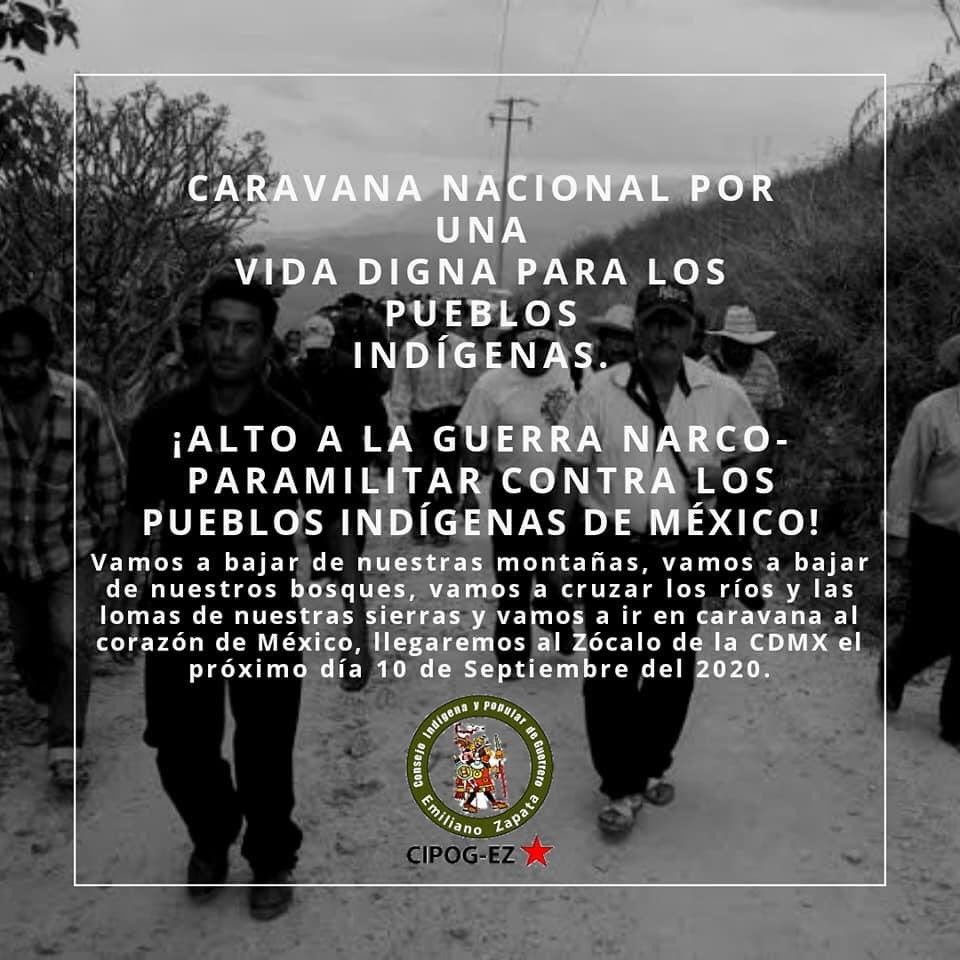
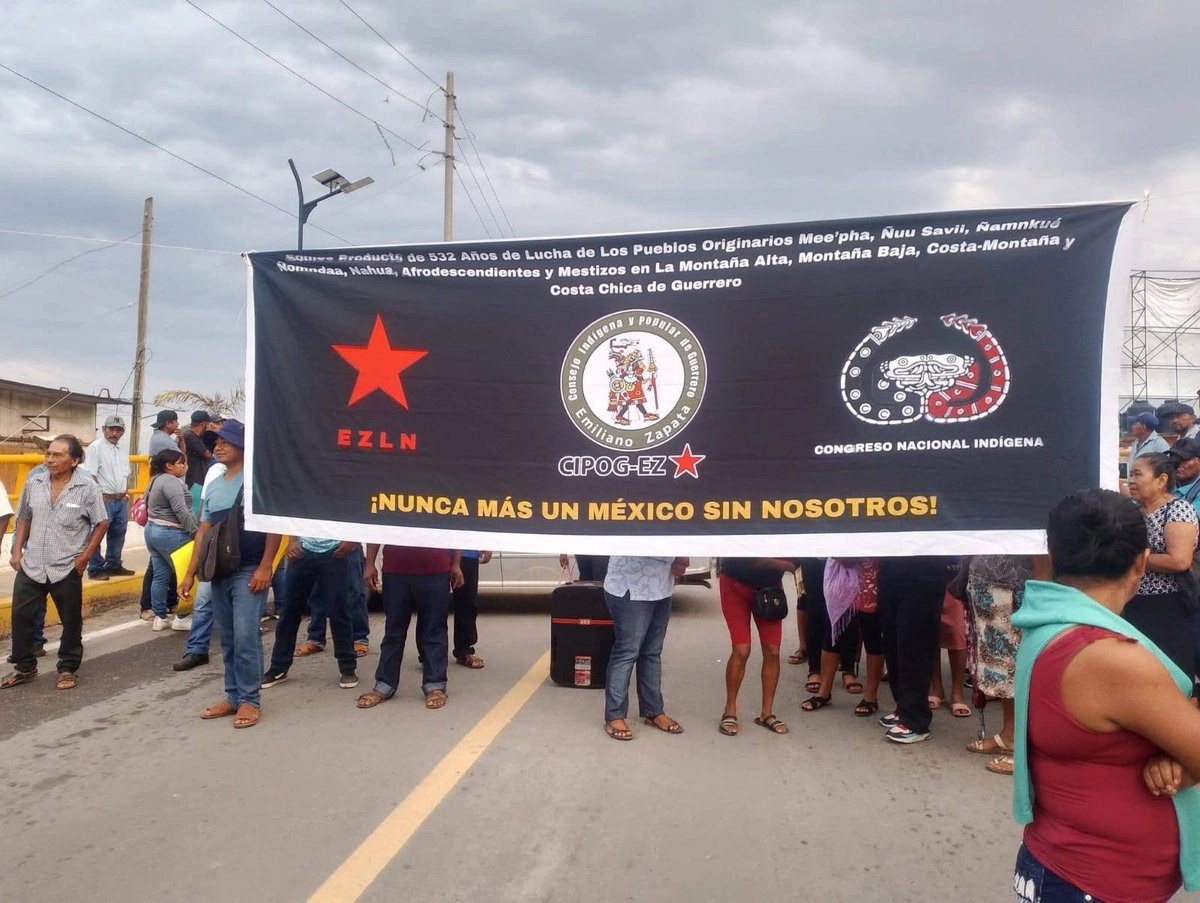
As men, women, boys, girls, grandfathers and grandmothers of the Indigenous communities that we are: Na Savi, Me´pháá, Nahua, Ñamnkué, mestizos and Afro-Mexicans from the state of Guerrero, and who are organized in the Indigenous and Popular Council of Guerrero – Emiliano Zapata (CIPOG-EZ), together with our comradely communities in the National Front for the Liberation of the Peoples (FNLP) and the Campesino Organization of the Southern Sierra (O.C.S.S.), we have not forgotten that we are suffering a war against our peoples. A war that began 527 years ago and one that continues. Governments come, governments go, be their logos of one color, two colors or three colors, it doesn’t matter: their boss is the same.

We continue dying from hunger, from the lack of hospitals and doctors, and from poverty, but not just that: they are literally killing us. As if we were animals, as if we were something worthless, something that isn’t human. The narco-paramilitaries hunt us on the roads, in our homes, and our families have to flee. They are the ones they call the displaced, and they go, walking, uprooted from their land, entire communities without a home, with the pain of their murdered relatives, and without knowing if they will eat tomorrow or if they will sleep under a roof, worse off than animals.

Continue reading

The Neoliberalism of Mexico’s New Government Continues to Dispossess and Kill

Originally posted on Avispa Midia

By Ñaní Pinto, Avispa Midia
Translated by Scott Campbell

For the indigenous peoples of Mexico, the winds of war today seem to be the same as those of previous governments. Andrés Manuel López Obrador’s (AMLO) government has been in power just four months and the imposition of development projects, dispossession, persecution, harassment, forced disappearances, and murders continue as before.

On May 4, in the southern Mexican state of Guerrero, indigenous Nahuas belonging to the Popular Indigenous Council of Guerrero – Emiliano Zapata (CIPOG-EZ), held a meeting to coordinate actions at state and federal agencies to pressure them into meeting their social and political demands that had been rejected by the three levels of government. At the end of the meeting, at approximately 6pm, an armed group in Chilapa, Guerrero, kidnapped and later murdered José Lucio Bartolo Faustino and Modesto Verales Sebastián, both members of the National Indigenous Congress (CNI).

Continue reading

The Earthquake of Our Struggle for Our 43 Children

Originally posted on It’s Going Down

Via Radio Zapatista
Translated by Scott Campbell

Ayotzinapa, Guerrero, September 26, 2017. – Three years after the forced disappearance of our children, the Fathers and Mothers of the normalistas [teaching college students] remain standing, present in the heart of the homeland to affirm our struggle alongside the families impacted by the earthquake, who in the midst of disaster are also seeking their loved ones. Pain and indignation have united us and in this embrace of solidarity we face a government that does not pay attention to our demands. Since that terrible night of September 26, we have not relented against a government that keeps untouched a pact of impunity with the state perpetrators who colluded with organized crime. Our nights of insomnia and days of uncertainty have marked a new path in our lives; we are now a movement dedicated to fighting the battle to dismantle the historical truth devised by the PGR [Federal Attorney General’s Office] in order to find the whereabouts of our children.

Continue reading

Insumisión: Community Self-Defense Against Narcos and the State

community-police-tixtla-guerrero

Originally published to It’s Going Down
By Scott Campbell

As those of us in the U.S. come together to plan for the incoming Trump regime, hopefully we can find some inspiration and affinity with the ongoing resistance happening in Mexico. After this summer’s teachers’ strike and popular mobilizations collapsed, communities and organizations in Mexico have returned to the essential but none-too-glorious work of building community self-defense and organization to maintain their gains and prepare for the next uprising that will inevitably occur.

This edition looks at communities around Mexico creating and defending autonomy, taking matters into their own hands to provide for their security from the state, organized crime and corporations. There are also updates on prisoners, community media and Ayotzinapa. This will probably be the final Insumisión of 2016. Since starting in March, we’ve put out 14 of them and appreciate that people find them useful. In 2017, we are hoping to expand our Mexico coverage and part of that will be a trip I am planning to take in a couple of months to connect face-to-face with many of the organizations you read about in these columns and to produce exciting original content. To help make that happen, please contribute to and spread the word about our fundraiser for the trip.

Continue reading

Mexico: Teacher and Community Police Leader Disappeared and Murdered

irineo-salmeron-crac-pc

Originally posted on It’s Going Down
From Desinformémonos
Translated by Scott Campbell

Chilpancingo, Guerrero | According to local press reports, the body of teacher Irineo Salmerón Dircio was found the morning of November 25. The teacher and coordinator of the Regional Coordinator of Community Authorities (CRAC-PC) was kidnapped by an armed group on November 23.

According to state press reports, one of the two bodies found in bags near the community of Amate Amarillo in the municipality of Chilapa de Álvarez belonged to the coordinator of the CRAC-PC, who had been kidnapped by an armed group the previous Wednesday.

Continue reading

Insumisión: It Was the State

Originally posted to It’s Going Down
September 29, 2016
By Scott Campbell

Several significant events have unfolded during the past couple weeks in Mexico, from an end the teachers’ strike to the commemoration of major key dates for the resistance. As ever, the repression and impunity with which the Mexican state operates has continued unabated. There’s a lot to cover, so let’s jump right in.

Ayotzinapa

Protests in Chilpancingo, Guerrero on September 25.

Protests in Chilpancingo, Guerrero on September 25.

On September 26, 2014, students from the Raúl Isidro Burgos Rural Teachers’ College in Ayotzinapa, Guerrero were traveling to Mexico City to participate in the annual mobilization marking the October 2, 1968 Tlatelolco massacre. They were intercepted by state forces in Iguala, Guerrero, where police opened fire, killing six – three students and three passersby. Forty-three other students were disappeared and to this day their location and fate remain unknown.

Continue reading

Insumisión: Schools Remain Closed as the State Amasses Forces of Repression

Originally posted on It’s Going Down
By Scott Campbell

As the strike against educational reform by teachers belonging to the National Coordinator of Education Workers (CNTE) in Mexico enters its fourth month, the conflict between the people and the neoliberal narcostate seems poised to take another turn, a potentially violent one. The government is running out of tricks, leaving the likelihood it will return to its old standby, state violence, all the more likely.

When the strike first began on May 15, the government’s tactic was to ignore the teachers, refusing to talk to them. As that failed and support for the teachers grew, it tried brute force, leading to the Nochixtlán massacre on June 19, a day when twelve were killed. That repression caused national outrage and succeeded in turning a teachers’ movement into a popular one. The government then offered up negotiations as a fig leaf, yet meeting after meeting made clear that the state had no actual interest in negotiating anything. The school year started in Mexico on Monday, August 22, but teachers remain on strike and schools have not opened in Oaxaca, Chiapas, Guerrero, Michoacán and parts of Mexico City.

Continue reading

Insumisión: Amidst the Barricades, Building a Movement for the Long Run

guelaguetza-popular

Fists raised at the Teachers-Peoples Guelaguetza as the names of the fallen from Nochixtlán are read.

Originally posted to It’s Going Down
By Scott Campbell

Next week, teachers in Mexico belonging to the National Coordinator of Education Workers (CNTE) will mark three months on strike. Three months without pay, of sleeping in encampments far from home, of funerals, arrests, disappearances, beatings, fear, uncertainty, and endless hours of marching. Yet the union has remained steadfast in its demand for the repeal of the educational reform and by doing so has created space for a much larger movement to emerge alongside it. What appeared at first as solidarity is increasingly moving toward coherent unity, as the people see their demands reflected in those of the teachers and vice versa. This mutual identification is rooted in an understanding that the forces responsible for creating the innumerable injustices occurring in Mexico can be traced back to neoliberal capitalism as deployed by a corrupt narcostate operating with impunity.

While events in Mexico haven’t been making headlines in the past couple of weeks, the struggle is still on. Along with mobilizing effective displays of its vitality, the movement has been using the decline in repression after the Nochixtlán massacre and the ongoing negotiations with the government to build sturdier foundations for the inevitable confrontations that lie ahead – be they during this phase of resistance or ones that will follow.

Continue reading