Statement 0.2: Ungovernable Oaxaca. Black June, Oaxaca de Magón

oaxaca-ungovernable-molotov

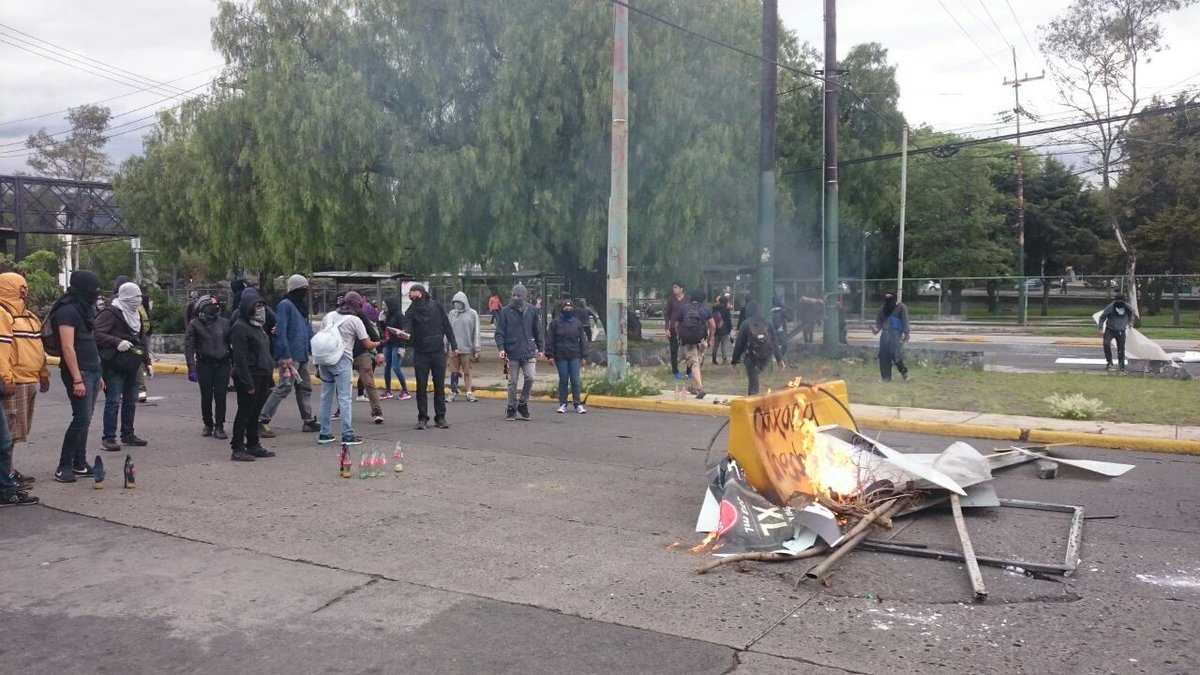
In solidarity with the uprising in Oaxaca, Avenida Insurgentes Sur – a major thoroughfare in Mexico City – is blocked on Monday near the campus of the National Autonomous University of Mexico.

Published by Proyecto Ambulante
June 21, 2016
Translated by Scott Campbell

Our rage cannot be contained by police bullets, by the State’s jails, by the media’s lies. Our dead will not be forgotten, their combative spirit has spread so that we may take justice into our hands.

Nochixtlán and Oaxaca resisted as the Isthmus region has resisted, demonstrating to the powerful that we don’t fear them, that we will confront them, we will defeat them; in the cold Mixteca the frontline has not been neglected. In spite of the pain that invades the people, they know the worst way to remember those who died in battle is to abandon the war.

Continue reading

Call Out: Month for the Earth and Against Capital, June 5 – July 5

mes-tierra-contra-capitalOriginally published on It’s Going Down.
Via Contra-Info
May 29, 2016
Translated by Scott Campbell

“The struggle occurs in a given territory, with very specific characteristics, with very specific enemies and their particularities, to know all these elements is our responsibility.”

Documents for an insurrectionary topology.

It is time to deepen the struggle against the state, against capital, and against the forms they use to continue to perfect their means of dominion over us. Different materials for spreading information and reflection have been developed in recent times. Blogs, magazines, newspapers and countless other materials have been produced by compañeros with different contours but with the same intention: to contribute to the social war from an anti-authoritarian and offensive perspective.

Continue reading

The San Quintín Rebellion

san-quintin-rebellionI’m excited to share news about the launch of a new microsite on the San Quintín rebellion in Mexico published by Regeneración Radio to which I contributed the translation from the Spanish original. Below are excerpts from the site. I strongly encourage you to visit the full site. It’s worth it.

The strawberry harvest was approaching and thousands of farmworkers were preparing to shut down the Transpeninsular Highway on March 17, 2015. There was no turning back. Two years earlier, a slogan had spread like a dust cloud throughout all of San Quintín Valley: fair wages. And between the rows, there where celery, squash, greens, chile, beet, cucumber, tomato, strawberry, blackberry and raspberry are planted to be sent to the other side of the border, there was already talk of a “crazy idea”: they had to rise up.

For Gloria, the movement has changed her life. Before March 17, she wasn’t aware that a strike was being planned for the entire valley. But that day she arrived at the school where she works as a teacher and the classes had been suspended. “I went back to bed. Later they told me: ‘there’s a movement and the highways, the banks are closed.’ I left and there was no one in town. I walked until I reached a group of people and approached a lady who was at the front. She told me that they were denouncing, as farmworkers, the injustices and the violations of their rights. She said to me: ‘Don’t stay silent, child, you have to speak, wherever you are, you have to speak.’” A mountain of memories came over her and she joined in the fury.

Visit The San Quintín Rebellion microsite.

COPINH Statement on the Investigation, Leadership and Solidarity

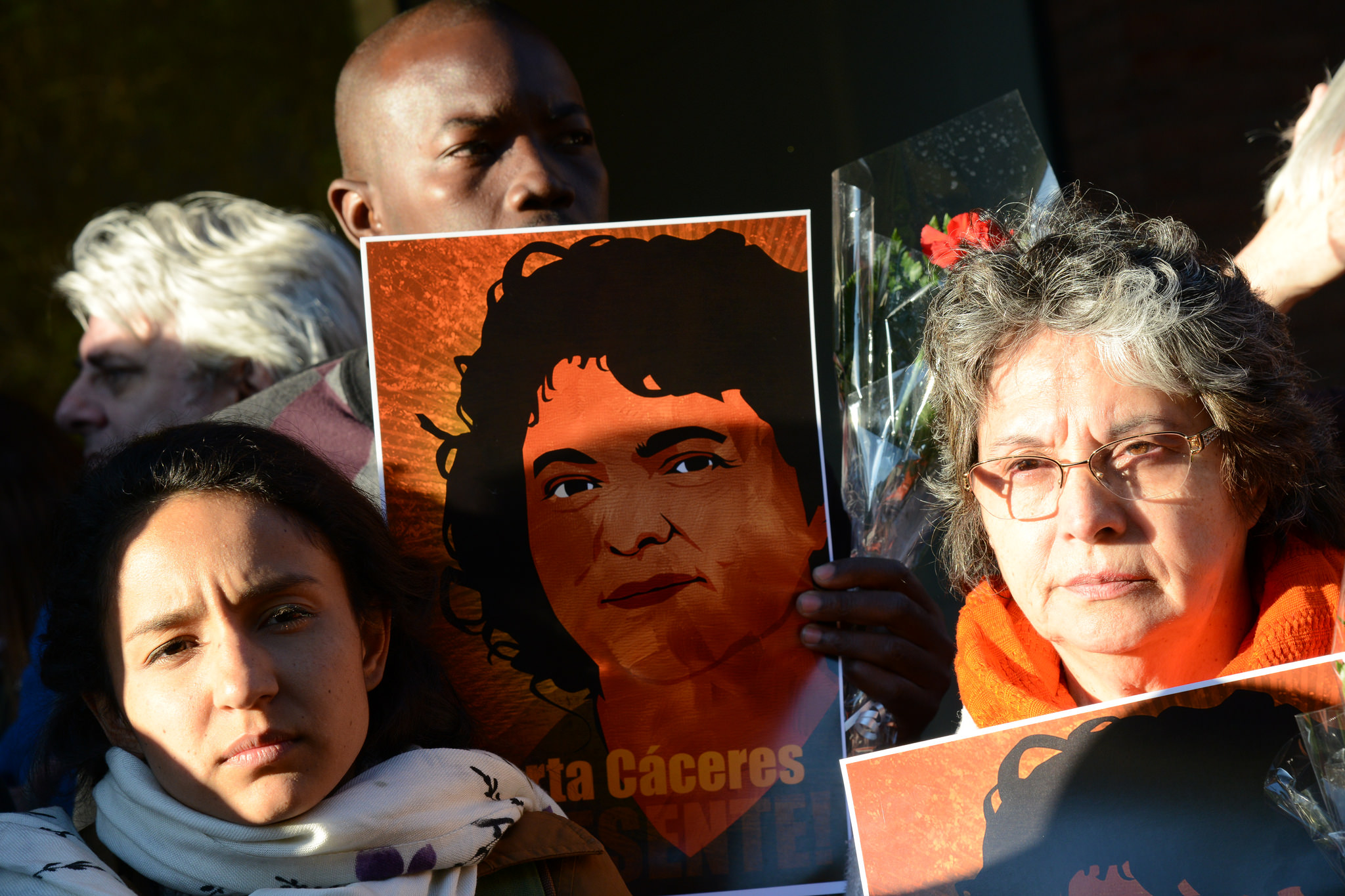
berta-caceres-cidh-oea-hijaCOPINH
April 8, 2016
Translated by Scott Campbell

The Civic Council of Popular and Indigenous Organizations of Honduras (COPINH) reports, communicates and denounces the following:

  1. We appreciate the national and international solidarity for an objective, impartial and non-racist investigation that clarifies the facts around the political assassination of our compañera and General Coordinator, Berta Cáceres, and leads to the truth and to justice, with the true material and intellectual authors of the murder being subjected to the law, as well as learning the facts and motives by which her murder was planned and carried out, however, we reiterate that the State of Honduras continues to fail to fulfill its obligations in this respect. Not accepting our requests, such as for an independent international investigative commission that has the trust of our organization, are the reasons for which we haven’t trusted, don’t trust and never will trust in the national laws and for which we denounce our country’s legal authorities’ manipulation of the investigation into the vile and horrendous murder of our compañera Berta Cáceres. And that Mr. Juan Orlando Hernandez has not shown the political will to speed up the investigative process and one month after the murder, neither the compañera’s relatives nor COPINH have received an official report on behalf of the government about how the investigation is proceeding into identifying the material and intellectual perpetrators.

Continue reading

Public Letter: We Have the Right to Think that You are Part of the Crime

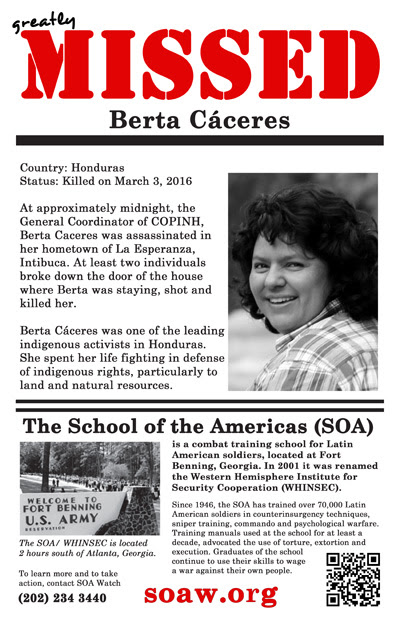
berta-caceres-missedTranslator’s note: On April 1, Gustavo Castro was permitted by the Honduran government to leave the country and is now back in Mexico.

COPINH
March 29, 2016
Translated by Scott Campbell

Relatives of Berta Cáceres report that the Attorney General is protecting the murderers. There are economic ties between the coordinator of the prosecution and DESA’s lawyers [the company behind the Agua Zarca dam]. They claim that the Honduran State knew of the plan to murder indigenous leader Berta Cáceres.

Public Letter

President of the Republic, Juan Orlando Hernández,
Attorney General of the Republic, Oscar Chinchilla,

The relatives of Berta Cáceres, the COPINH [Civic Council of Popular and Indigenous Organizations of Honduras], the Platform of Social and Popular Movements of Honduras (PMSPH) and the Popular Coordination Berta Cáceres, for the ears of Honduran society and the international community, we are writing you to express and demand the following:

Continue reading

“I was born to be free” – Nestora Salgado

Originally posted on El Enemigo Común.

nestora-salgado-rifle-prison-releaseTranslator’s note: After seventeen months in prison and following a national and international campaign for her release, political prisoner Nestora Salgado was released from Tepepan prison in Mexico City on March 18, just days after the below essay was published. The commander of the Community Police in Olinalá, Guerrero, Salgado was charged with three counts of kidnapping. When those charges were dismissed, the state filed three more charges for kidnapping, theft and murder. Again, those charges were dismissed for lack of evidence.

Upon exiting the prison, she was received by dozens of community police officers from Olinalá and other towns in Guerrero. Handed a rifle and addressed as commander, she said, “We are going to keep struggling so they don’t keep repressing us. If this is needed [raising the rifle], then this is where we will go, but we won’t allow them to keep trampling on us.” At a press conference later in the day, she committed herself to fighting for the freedom of Mexico’s 500 political prisoners, in particular those jailed for carrying out their duties as community police. Joined by members from the Peoples Front in Defense of the Land from Atenco, those resisting the construction of the La Parota dam in Guerrero, and family members of the 43 disappeared students from Ayotzinapa, she led the count from 1 to 43. “I don’t represent any political party,” she said. “I only fight for my people. Sometimes they ask me if I’m afraid. And yes, I’m afraid, but I’ll die fighting for our people’s dignity. It doesn’t matter what I have to do, I am going to win freedom for our prisoners. I will be present in all of the struggles, as long as they need me.”

Continue reading

Enough! Second COPINH member assassinated in Honduras

copinh-honduras-marchaMarch 15, 2016
COPINH
Translated by Scott Campbell

The Civic Council of Popular and Indigenous Organizations of Honduras (COPINH) calls public attention to today’s murder of our compañero Nelson García, from the Río Chiquito community in the Cortés Department, at the hands of two unknown persons.

We regrettably inform you that compañero Nelson García was murdered when he arrived at his mother-in-law’s house to have lunch, after spending all morning helping move the belongings of displaced families from the Río Chiquito community.

The murder occurred in the midst of an eviction carried out against the community of Río Chiquito in the Río Lindo area, in the Cortés Department, during which approximately 100 police officers, 20 military police officers, 10 soldiers and several people from the DGIC (General Criminal Investigations Administration) invaded the territory reclaimed by 150 families, on which more than 75 had built their houses with the materials and efforts at hand.

Continue reading

Unyielding before power and its repression

Originally posted on It’s Going Down

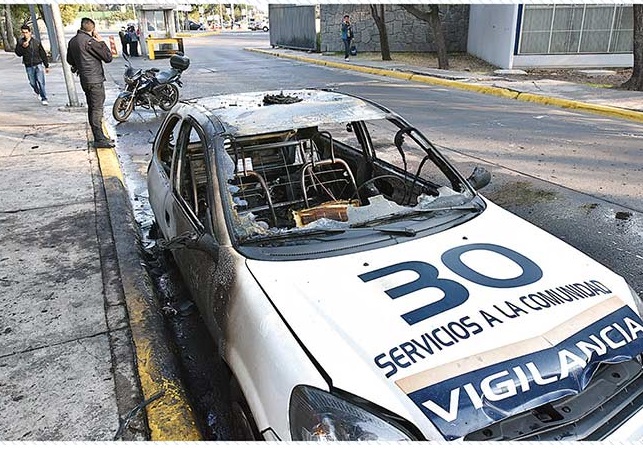
Iconocunam-vigilancia-quemadolasia
February 26, 2016
Translated by Scott Campbell

On the repressive circus mounted by the Mexican State

…what is condemned about anarchists is not the violence, but their having transcended denunciations and conferences, bringing disobedience, insubordination and the capacity for revolt to this point. What is condemned is precisely the fact of their standing up and walking from the point of a radical critique of power and an intransigent ethic of freedom; and, moreover, to do so until the very end.

Daniel Barret (Rafael Spósito)

When the unyielding have declared war on power with their daily, consistent action, there is not much need for “pretexts” in order to attack the subversives. For power, the fact that anarchists are unyielding to power’s norms, that they can’t be corrupted and don’t make alliances, is enough of a reason to attack them. It’s true, many times those who rule the world have to carry out “criminalization” campaigns in order to attack various struggles, anarchists included. However, other times these campaigns are much more than a campaign to “discredit”; besides, who wants credit? Do we need it? The vast majority of the time, these campaigns are part of a strike of greater magnitude, form part of an overwhelming strike that the State plans to inflict. It is within this context one can place recent events, part of power’s repression of the local anarchist or libertarian landscape, that is to say, in the Federal District [Mexico City].

Continue reading

We once again repeat we will not ask their approval to be free

Originally posted on It’s Going Down.

okupa-che-auditorio-unamTranslator’s note: The Okupa Che is an auditorium taken over during the 1999-2000 student strike at the National Autonomous University of Mexico, the largest university in Latin America. An autonomous, anti-authoritarian space, it has faced constant repression from state and university authorities. Yorch, a member of Okupa Che, was detained on Wednesday, when police planted a backpack on him containing large quantities of crack, clonazepam and marijuana. He is now being held in a federal prison in Hermosillo, Sonora. Regeneración Radio reports that there is a strong rumor the Federal Police are preparing to evict the Okupa. Several collectives have condemned Yorch’s arrest and the UNAM Academic University Assembly has issued a sign-on letter calling for Yorch’s freedom and an end to attacks on Okupa Che.

Okupa Che
February 25, 2016
Translated by Scott Campbell

To the independent media
To allied collectives and spaces
To the general public

For several years and in various ways we have been denouncing and exposing the campaign of vilification and harassment unleashed globally against the anarchist movement and Okupa Che in particular. No more than three months ago fake text messages directed at specific people in the name of the Office of the President threatened the violent eviction of the space and the possible location and detention of some of its “squatters.” Added to that, various hit pieces in the media have appeared in recent weeks making several claims that are supposedly related to the existence of the space. Periodicals complicit with UNAM’s Office of the President and with the State – La Razón and El Universal, for example – have thrown around conjectures and assumptions about business, drug trafficking and robbery, using the risky and premeditated theory that all of this is overseen by people connected to the squat.

Continue reading

Oaxaca, the fight for the air

Originally posted on El Enemigo Común

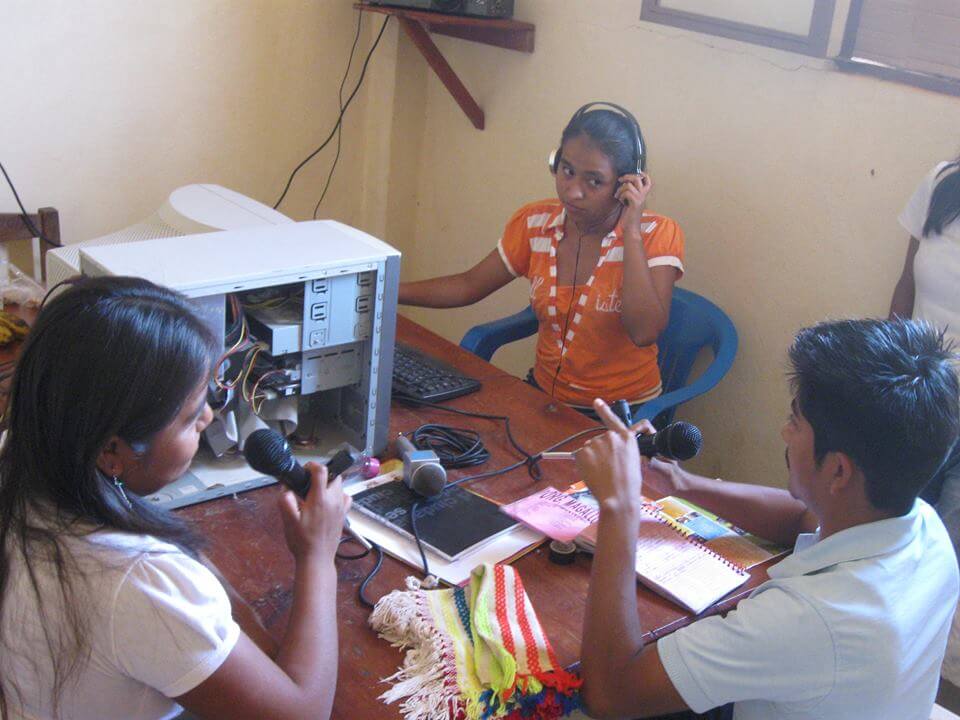
radio-oaxacaBy Jaime Quintana Guerrero
January 20, 2016
Desinformémonos
Translated by Scott Campbell

Bi, in the Binnizaá or Zapotec language, means “air”, means “spirit.” “For us, air not only represents life, it also carries loved ones who have died. When one dies, their spirit becomes air and returns to the people.”

The struggles against the wind farms that abound throughout the state also, then, contain this element: “They want to change the path of the wind, of the air, of our spirits, of our loved ones.”

Carlos Martínez Fuentes, a member of Radio Totopo in Juchitán, Oaxaca, is the one who explained the above. Radio Totopo, with its nine years transmitting together with the spirits in the air, also belongs to the Popular Assembly of the Juchitecan People.

The emergence of the radio was a result of sheer necessity. On the one hand, as a tool in the resistance struggle to Plan Puebla Panama, which includes the wind farm system being put into place between those two locations.

As well, because the tradition of the indigenous peoples of Oaxaca (as with most) is oral. The radio fits perfectly, then. “In Oaxaca, 16 different languages are spoken. The indigenous oral tradition is the key reason behind the existence of community radio stations and community assemblies, their main supporters,” explains José Juan Cárdenas, member of the Integral Community Communication organization.

Continue reading