Zines for these times

Photos courtesy of Cindy Barukh Milstein

9/13/25 Update: Another zine from Cindy has been published that also includes a contribution by me. Check out The Heart is a Muscle: 19 Embodiments of Antifascist Grief here.

How to make sense of this moment, survive and resist in this moment, and hold ourselves and one another up during this moment are all important and pressing concerns to many of us. Over the past several months, dear comrade Cindy Barukh Milstein (Mastodon; Instagram) has been editing and crafting zine-based interventions that speak directly to those matters.

At their kind invitation, I have had the honor of submitting short pieces to two of them. Rather than excising my own words from their context and placing them alone here, I wanted to encourage those who are interested to explore the two zines – and others! – in their entirety.

The first is Anarchist Compass: 29 Offerings for Navigating Christofascism. As Cindy writes, this zine is “an act of love and solidarity. It is intended for everyone who sees themselves on the side of antifascism, including those who’ve newly had their eyes opened. It’s especially dedicated to those who, in myriad ways, rebelliously, collectively, and bravely care for each other.”

The second is Everyday Antifascism: 14 Ways that Solidarity Keeps Us Safer. Again, Cindy states, “This zine does not offer sugarcoated ‘hope’ to somehow smooth over these utterly distasteful times. Yet I believe strongly in cracks in the edifice of hierarchical power and the promise they hold, and that there are always cracks even under the worst conditions. This zine, then, is a small sampler of acts of solidarity that just might keep us safer under fascism in order to get more of us to the other side, toward a world without fascism.”

While you’re clicking on links, here are two more with zines that Cindy has curated recently: Don’t Just Do Nothing: 20 Things You Can Do to Counter Fascism and Ritual as Resistance: 18 Stories of Defending the Sacred.

Enjoy! And remember to share!

Raffle in Solidarity with Indigenous Anarchist Miguel Peralta

For more information about Miguel Peralta and the persecution he has been facing for the past decade, read this update from his support group.

Note: If you are located in what is called the United States and would like to participate in the raffle, Miguel’s support crew welcomes your participation! Please contact me for more information. The suggested price of the raffle ticket is $50 MXN ($2.50 USD), but you are welcome to contribute more if you would like. Prize winners will be responsible for covering shipping costs and will not be eligible for prizes that contain perishable items. A continually updated list of prizes can be found on the event’s Facebook page.

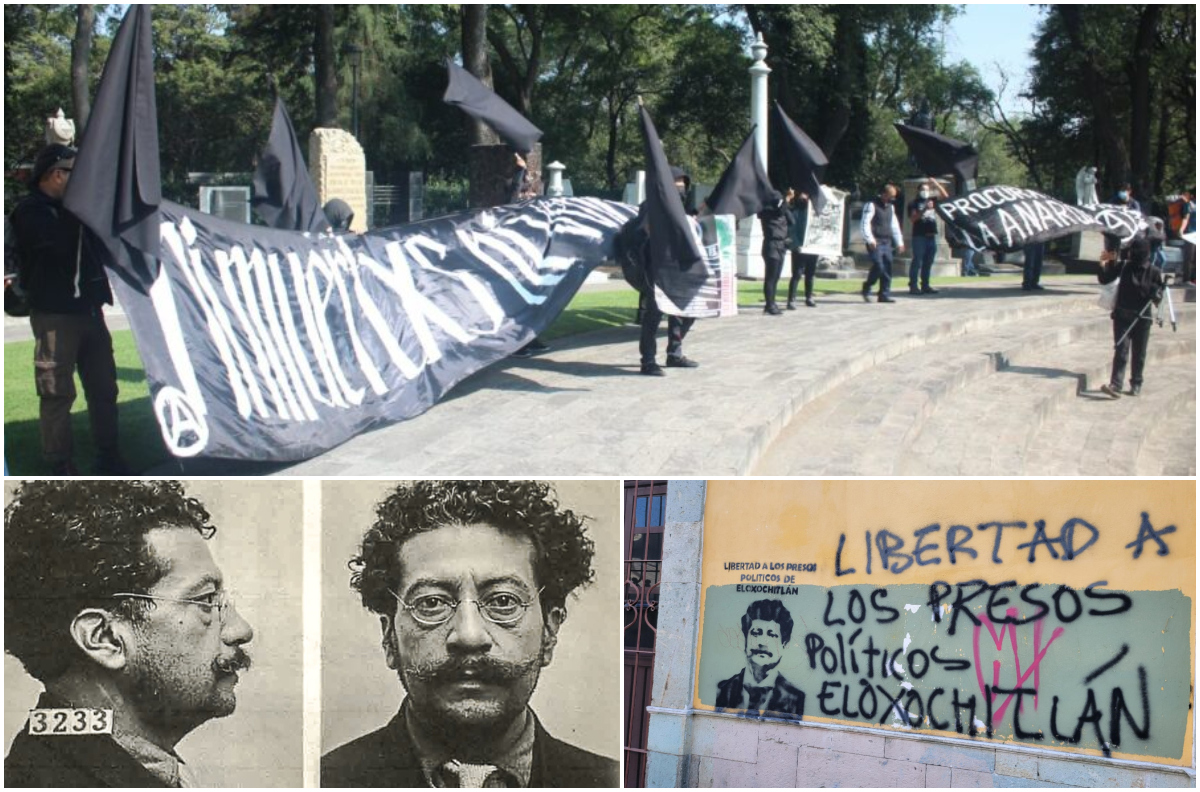
As you know, the case of Miguel Peralta Betanzos and the persecution and repression that his community, Eloxochitlán de Flores Magón, is experiencing, have been going on for more than ten years.

After years of imprisonment, hunger strikes, legal games, going back and forth in court at different judicial levels, etc., Miguel Peralta’s case reached the Supreme Court, which represented the possibility of putting an end to his persecution and obtaining his full and absolute freedom. However, things were not as favorable as one might think, and on November 6, the Supreme Court issued a resolution in which it limited itself to recommending that the Collegiate Court of the City of Oaxaca make review of Miguel’s case from an intercultural perspective. With this, the case returned to those instances, which are far from his community, family, legal team and support group.

Continue reading

Neither Dead nor Defeated: Anarchism and the Memory of Ricardo Flores Magón

Originally published on It’s Going Down.


Lee esta entrevista en español aquí.

On November 21, 2022, one hundred years after his death, anarchists gathered at the tomb of Ricardo Flores Magón in Mexico City, where clashes ensued with members of the Regional Confederation of Mexican Workers (CROM), leaving several compañerxs injured. In December, IGD contributor Scott Campbell interviewed Jaime, one of the anarchists present that day. The interview covers not only the events of November 21, but the life and legacy of Ricardo Flores Magón, the state’s attempts to recuperate his memory, and more.

How would you like to introduce yourself?

My name is Jaime. I’ll be speaking on behalf of those who took part in the action [on November 21], but which is not a collective. 

Can you speak to the importance of Ricardo Flores Magón? Who was he, what is the significance of his work and legacy?

Ricardo Flores Magón was an anarchist, born in Eloxochitlán de Flores Magón, Oaxaca, in 1873, and who, at a very early age, became aware of the political and economic situation in Mexico at that time. He had contact with anarchist and libertarian ideas; he read Bakunin, Kropotkin, and Malatesta. As well, his Indigenous Mazatec origin and the practices of Indigenous communities, such as solidarity and mutual aid, had a large influence on the formation of his thought and ideology. From a very young age, he began to fight, to combat, to organize against the dictatorship of Porfirio Díaz, which brought him persecution and repression. He, along with his brothers Jesús and Enrique, and people such as Juan Sarabia and others, founded a newspaper in 1900, called Regeneración, through the distribution of which a network of liberal groups was created that over the years evolved into an insurrectional network.

In 1905, the Regeneración group left Mexico for exile in the United States. By then, Ricardo Flores Magón and others had been imprisoned, had been persecuted, the Regeneración printing press had been confiscated, so they considered it unsustainable to continue the struggle in Mexico and went to the United States and settled in California. In 1905, they created the Organizing Junta of the Mexican Liberal Party (PLM), which is the political organization that guided or gave form to this organizational network. By 1906, it became an insurrectional network that encouraged and fomented armed uprisings in different parts of the country, primarily in Veracruz, in Chihuahua, in Acayucan, in Las Vacas, and so on. That is to say, Ricardo Flores Magón and others, such as Librado Rivera, Margarita Ortega, Jacinto Palomares, in short, a series of individuals, began to fight the dictatorship of Porfirio Díaz, but not to put an end to it and just install someone else as president.

Continue reading

Polyvalent Power: A Review of the “Power” Issue of “Perspectives on Anarchist Theory”

Originally published on It’s Going Down.

“A Love Supreme,” by Erin Bree of Gallery of the Streets, from issue 32 of Perspectives on Anarchist Theory.

During the height of the movement against neoliberal globalization in the U.S., numerous chants and sayings emerged or were resuscitated, such as, “This is what democracy looks like” or “The whole world is watching.” Fortunately, along with the phenomenon of summit-hopping itself, these utterances have largely fallen into disuse. A particularly nonsensical saying from that moment was “Speaking truth to power.” First coined by Bayard Rustin for a pamphlet he co-wrote in 1955, called Speaking Truth to Power: A Quaker Search for an Alternative to Violence, the notion has been rightfully critiqued by the likes of Noam Chomsky, who stated, “power knows the truth already, and is busy concealing it.”[1] Yet even this does not go far enough, as it maintains the presumption latent in the slogan that there exists a binary between those with power and those without it, or that power as such is a thing one can speak to.

Theorists from Spinoza to Gramsci to Foucault have attempted to wrestle with the question of what power is, arriving at no agreement aside from the fact that power is no one thing. In this sense, power can be understood as being “overdetermined,” a Freudian concept appropriated by Marxist theorists which, as explained by Stuart Hall, allows that “an idea, a symptom, or a dream symbol can itself be the condensation of a set of different chains of meaning, which are not manifest in the way in which the symbol is given.…One has to conceive of it as overdetermined; that is, the same symbol can be determined at different levels, by different kinds of discourses.”[2] The exploration of this discursive malleability of power, as well as the capacity of power to reify certain discourses, is at the heart of the most recent edition of Perspectives on Anarchist Theory, volume number 32, published in May of this year by the Institute for Anarchist Studies and oriented around the theme of “Power.”

Continue reading

Tobi, Anarchist Compañero from the Biblioteca Social Reconstruir, Passes Away

Originally posted on It’s Going Down.

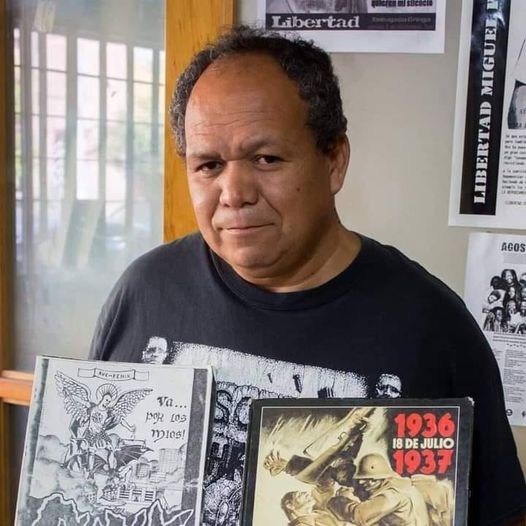
A translated statement from Noticias de Abajo and the Biblioteca Social Reconstruir (Social Reconstruction Library – an anarchist library and social space in Mexico City), on the passing of longtime anarchist organizer Tobi.

“…when I die, my friends may write on my grave: Here lies a dreamer, and my enemies: Here lies a madman. But there will be no one who dares engrave these words: Here lies a coward and traitor to his ideas.” – Ricardo Flores Magón

On January 10, 2021, we learned of the passing of anarchist compañero Tobi, one of those responsible for continuing the Biblioteca Social Reconstruir after the loss of Ricardo Mestre. Tobi was a social activist from the punk and anarchist movements who participated actively in the spreading and promotion of anarchist ideals.

We are sharing a message circulated by the Library regarding this moment of mourning for the worldwide anarchist movement, as well as video clips from “Workshopping Anarchy,” a project held at the Alicia Cultural Multiforum with the participation of the Library and other allies, in order to remember the feeling-thinking (sentipensar) of our dear friend Tobi.

Continue reading

The Unexpected Consequences of Anarchy in relation to Feminism in Mexico

Originally published on It’s Going Down.

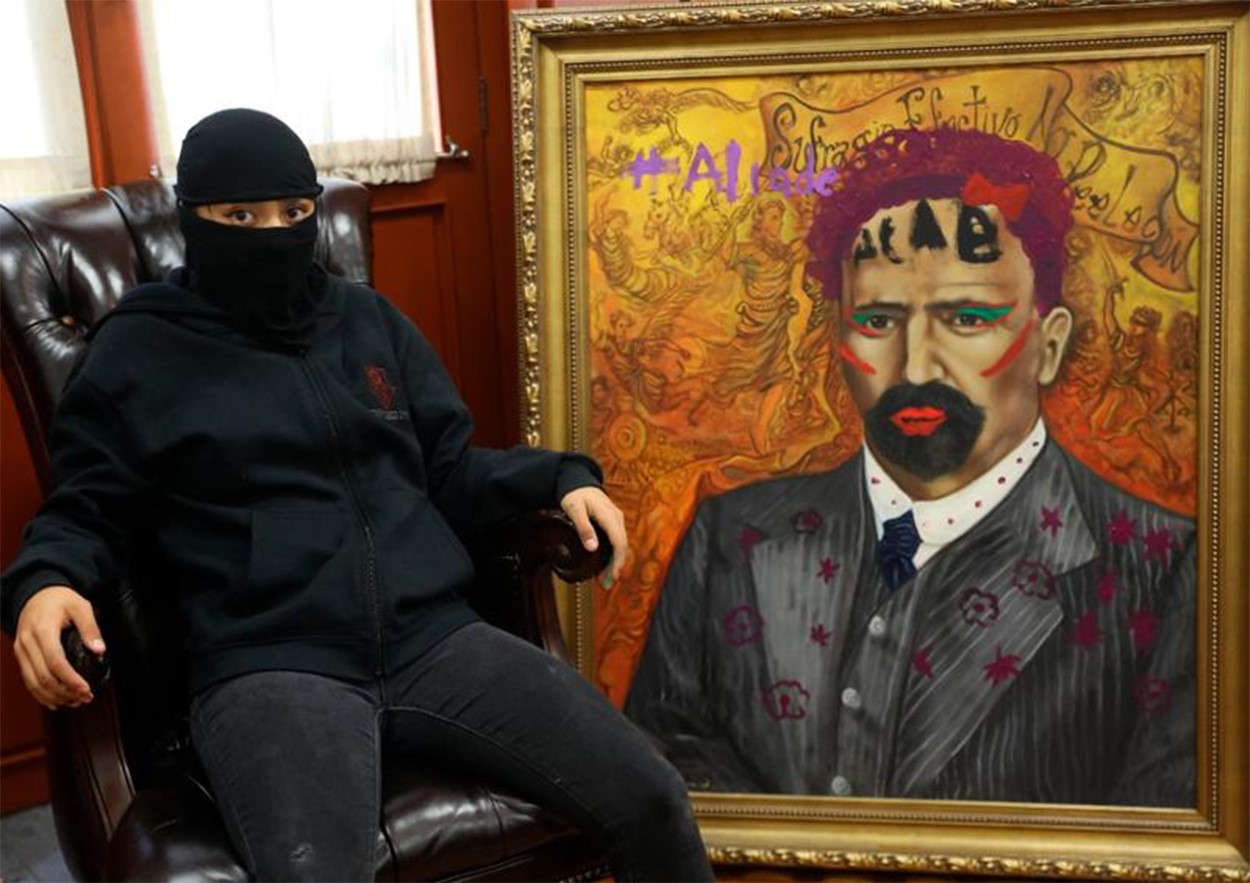
The following article, written by Afinidades Conspirativas and translated by Scott Campbell, examines the recent wave of feminist protests and actions throughout Mexico and the role of anarchism amidst these mobilizations. All footnotes and photo captions are from the original Spanish version, which can be found as a PDF here.

After this article was written, it came to light that those involved in the occupation of the National Human Rights Commission (CNDH), in particular the Okupa Black Bloc, are trans-exclusionary radical feminists (TERF). IGD condemns the transphobic politics of those involved in the Not One Less Okupa. Given the scope and analysis of the article, we have decided to leave it up and encourage readers to keep this information in mind when reading the piece.

“You’re a big shot, drawing on my painting…I hope your action fixes everything”
José Manuel Núñez A., painter of the Madero portrait[1]

“If I can’t dance, I don’t want to be part of your revolution”
Emma Goldman

“If we can’t be violent, it’s not our revolution”
Manada de lobxs [Pack of wolves]

The multiplicity of forms that anarchisms have taken in recent decades leads us to reexamine the tendencies and strategies that are reconfiguring themselves or emerging from these forms, as well as their influences on other struggles. Here it is necessary to distinguish a principle held among anarchisms that sets them apart from the liberal or leftist groups that are assumed to be anarchist. We could define this principle as an ethic that, created from an individuality in common, becomes an affront to any form of hierarchical power. As such, to understand anarchism today as an ideology would be a myopia that allows for the development of aberrations such as “anarchocapitalism” or an understanding of Zapatismo and of many forms of feminism as anarchist. Thinking about the latter, it would be worth remembering Emma Goldman, who ranted against the suffragettes of her time (the first wave of feminism), based on the understanding that freedom could not be achieved at the ballot box. Today’s feminisms are very diverse: there are the reformists with sympathy for the State, with authoritarian and essentialist views about the body; as well as others that are completely liberal, united under the banner of lacking a convincing critique against power; but also among them are some that come together under an anarchist ethic.

Continue reading

Update and Letters from Anarchist Prisoners on Hunger Strike in Mexico

solidarity-mexico-us-prison-strike

Mexico: Anarchist Prisoners End Hunger Strike but Remain Fasting
From Anarchist Black Cross – Mexico
Translated by Scott Campbell

Day 15 of the anarchist prisoners’ hunger strike.

After two weeks on hunger strike, due to the health of some and in order to avoid serious complications, anarchist prisoners Fernando Bárcenas, Luis Fernando Sotelo and Abraham Cortés, as well as activist Jesse Montaño, have decided to continue their collective struggle inside the prison with indefinite fasts and have ended the hunger strike.

We are reposting the text signed by Fernando Bárcenas.

Continue reading

Combative October 2: On the Institutionalization and Autonomy of Social Protest

combative-tlatelolco-march-feature

Originally posted to It’s Going Down
From Radio Zapote
Translated by Scott Campbell

Forty-eight years after the Tlatelolco massacre we continue demanding justice for the murdered, disappeared, persecuted, tortured, defamed, and imprisoned, as even though the killers and masterminds have not been tried and punished, those compañeros who fell in the militant struggle remain present in the popular and social struggles today as part of our memory, solidarity, guidance, dignity, strength, inspiration, rage and courage. Today, no one doubts that IT WAS THE MEXICAN STATE who planned and carried out that mass murder, just as it did with the disappearance of 43 teaching college students on September 26, 2014, as from Tlatelolco to Ayotzinapa one can trace a historical continuity that affirms the totalitarian character of the state that today we can characterize as “narco and terrorist.”

Continue reading

Mexico: Some Disruptive Reflections on the Murder of Compa Salvador Olmos

protest-huajuapan-chava-salvador-olmos-anarchistOriginally posted on It’s Going Down
From Contra Info
Translated by Scott Campbell

We write this after reading the “Statement from the Huajuapan Libertarian Bloc on the police murder of compañero Salvador Olmos ‘Chava’[more on Chava in English] as we believe given the escalation of the war and advancing repression on anarchist/libertarian settings it is necessary to clarify our positions in the interest of identifying the enemy’s multiple forms, as they are often reduced to criticisms of “government injustices” or simply “to believe that evil is embodied in a person or politician” and not the reality that it is the entire system of rulers and ruled who together actively participate in the maintenance of the capitalist social order.

Let it be clear! The following words are in no way aimed at tarnishing the memory of compañero Chava or to start polemical bickering, nor to cause fighting amongst ourselves, this is above all a reflection from compañeros for compañeros and we hope it is taken as such.

Continue reading

Insumisión: From Teachers’ Strike to People’s Rebellion

Originally published by It’s Going Down
By Scott Campbell

With the ongoing teachers’ strike that has morphed into a widespread rebellion, primarily in Oaxaca and Chiapas, we haven’t put together a more general roundup of resistance and repression in Mexico in some time. While that struggle is very much alive and well, the intensity with which it is unfolding has diminished some. This column will first take a look at the past three weeks of that conflict (if you need to get up to speed, check out this piece) and then cover some of the other recent events around the country.

The teachers belonging to the National Coordinator of Education Workers (CNTE) have now been on strike for more than two months. Since the massacre by federal and state forces in Nochixtlán, Oaxaca on June 19, in which eleven people were killed, the conflict has taken on an increasingly popular dimension. This has looked like direct actions, marches, material support and expressions of solidarity from across Mexico and beyond, in numbers far too large to recount individually.

Continue reading